

ESTUARINE FISH FARMIPJQ
14i
chlorophyll-containing organisms, and by colourless saprozoites, such
as the large populations of colourless euglenoids in the sediment-water
interface. Many kinds of bacteria also use these materials, which are
thus brought back into circulation.
11. The microjlora as food material
The great quantity of organic matter in all stages of degradation
which accumulates in estuaries supports a correspondingly great flora
of bacteria, which may become the direct food for a wide range of
animals (Lackey, 1967-8). Enormous numbers of bacteria flourish on
mud-flats, and their presence gives an important nutritional quality to
fine sediment and suspended particles. They cover exposed surfaces
of all kinds. It is certain that most groups of invertebrates and some
fishes, especially small fishes, are able to flourish and grow on an
exclusive diet of bacteria.
12. Some quantities of organic matter present in estuarine soils
A simple way of estimating the organic matter in estuarine soils is
to heat a sample to 580°C for several hours. The organic matter is
burnt away, and the loss in weight represents the organic matter,
subject to some errors which are not important for the present comparison.
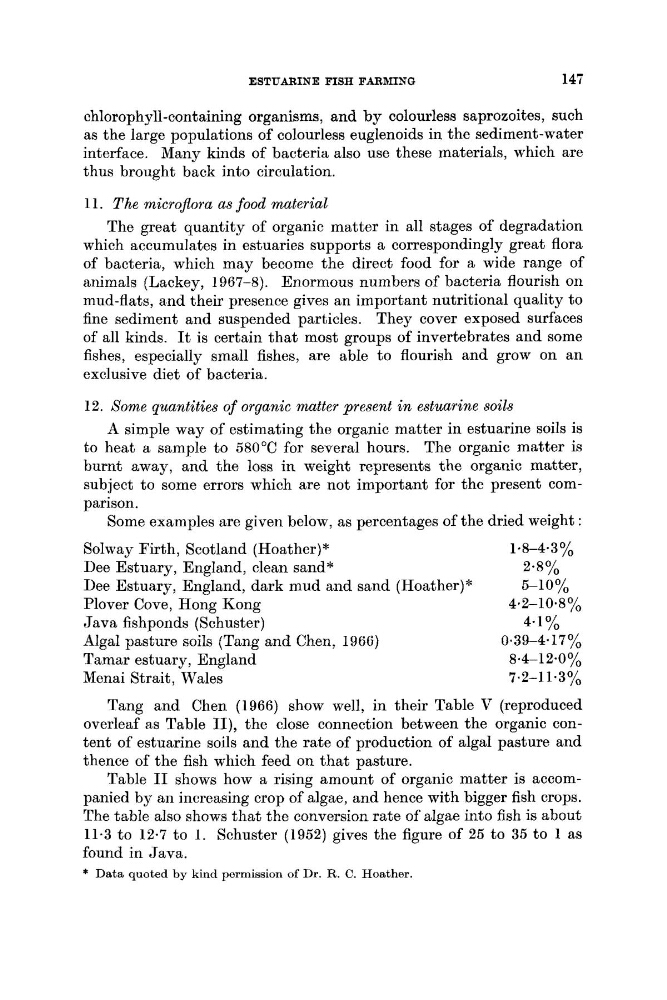
Some examples are given below, as percentages of the dried weight :
Solway Firth, Scotland (Heather)*
Dee Estuary, England, clean sand*
Dee Estuary, England, dark mud and sand (Hoather)"
Plover Cove, Hong Kong
Java fishponds (Schuster)
Algal pasture soils (Tang and Chen, 1966)
Tamar estuary, England
Menai Strait, Wales
1 4-4-3 yo
2.8%
5-10%
4.2-10.8y0
4.1%
0.39-4.17 yo
8.4-12.0y0
7.2-11*3y0
Tang and Chen (1966) show well, in their Table V (reproduced
overleaf as Table 11), the close connection between the organic content of estuarine soils and the rate of production of algal pasture and
thence of the fish which feed on that pasture.
Table I1 shows how a rising amount of organic matter is accompanied by an increasing crop of algae, and hence with bigger fish crops.
The table also shows that the conversion rate of algae into fish is about
11.3 t o 12-7 to 1. Schuster (1952) gives the figure of 25 to 35 to 1 as
found in Java.
* Data quoted by kind permission of Dr. R. C. Hoather.
14i
chlorophyll-containing organisms, and by colourless saprozoites, such
as the large populations of colourless euglenoids in the sediment-water
interface. Many kinds of bacteria also use these materials, which are
thus brought back into circulation.
11. The microjlora as food material
The great quantity of organic matter in all stages of degradation
which accumulates in estuaries supports a correspondingly great flora
of bacteria, which may become the direct food for a wide range of
animals (Lackey, 1967-8). Enormous numbers of bacteria flourish on
mud-flats, and their presence gives an important nutritional quality to
fine sediment and suspended particles. They cover exposed surfaces
of all kinds. It is certain that most groups of invertebrates and some
fishes, especially small fishes, are able to flourish and grow on an
exclusive diet of bacteria.
12. Some quantities of organic matter present in estuarine soils
A simple way of estimating the organic matter in estuarine soils is
to heat a sample to 580°C for several hours. The organic matter is
burnt away, and the loss in weight represents the organic matter,
subject to some errors which are not important for the present comparison.
Some examples are given below, as percentages of the dried weight :
Solway Firth, Scotland (Heather)*
Dee Estuary, England, clean sand*
Dee Estuary, England, dark mud and sand (Hoather)"
Plover Cove, Hong Kong
Java fishponds (Schuster)
Algal pasture soils (Tang and Chen, 1966)
Tamar estuary, England
Menai Strait, Wales
1 4-4-3 yo
2.8%
5-10%
4.2-10.8y0
4.1%
0.39-4.17 yo
8.4-12.0y0
7.2-11*3y0
Tang and Chen (1966) show well, in their Table V (reproduced
overleaf as Table 11), the close connection between the organic content of estuarine soils and the rate of production of algal pasture and
thence of the fish which feed on that pasture.
Table I1 shows how a rising amount of organic matter is accompanied by an increasing crop of algae, and hence with bigger fish crops.
The table also shows that the conversion rate of algae into fish is about
11.3 t o 12-7 to 1. Schuster (1952) gives the figure of 25 to 35 to 1 as
found in Java.
* Data quoted by kind permission of Dr. R. C. Hoather.