

ESTUARINE FISH FARMING
133
ment which separates the ponds from the river branches may be 6-8 ft
high, 10-12 ft wide at the base, and 6-7 ft wide at the top. The soil
is obtained from the borrow pit on the inside of the embankment,
which makes a deep canal 4-5ft below the level of the pond floor.
There may be several compartments within the peripheral embankment. Pakrasi et al. (1964) state that there may be small nursery ponds
where the young fish are kept for a period. The same ponds may, after
" 1 -I
0
A
B
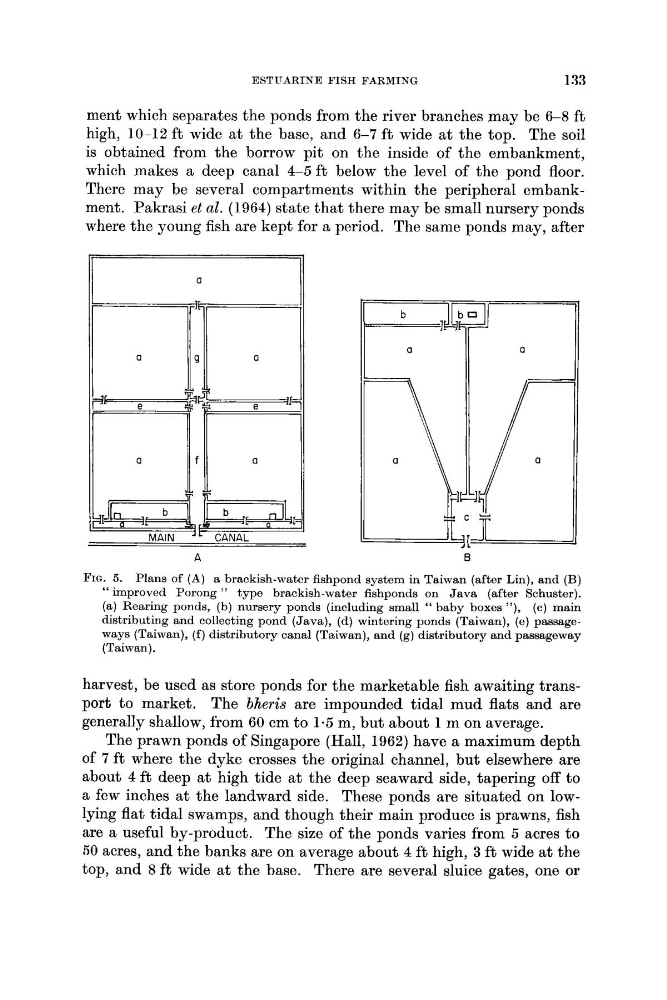
FIG. 5. Plans of (A) a brackish-water fishpond system in Taiwan (after Lin), and (B)
" improved Porong " type brackish-water fishponds on Java (after Schuster).
(a) Rearing ponds, (b) nursery ponds (including small '' baby boxes "), (c) main
distributing and collecting pond (Java), (d) wintering ponds (Taiwan), (e) passageways (Taiwan), (f) distributory canal (Taiwan), and (8) distributory and passageway
(Taiwan).
harvest, be used as store ponds for the marketable fish awaiting transport to market. The bheris are impounded tidal mud flats and are
generally shallow, from 60 cm to 1.5 m, but about 1 m on average.
The prawn ponds of Singapore (Hall, 1962) have a maximum depth
of 7 ft where the dyke crosses the original channel, but elsewhere are
about 4 f t deep at high tide at the deep seaward side, tapering off to
a few inches at the landward side. These ponds are situated on lowlying flat tidal swamps, and though their main produce is prawns, fish
are a useful by-product. The size of the ponds varies from 5 acres to
50 acres, and the banks are on average about 4 ft high, 3 ft wide at the
top, and 8 ft wide at the base. There are several sluice gates, one or
133
ment which separates the ponds from the river branches may be 6-8 ft
high, 10-12 ft wide at the base, and 6-7 ft wide at the top. The soil
is obtained from the borrow pit on the inside of the embankment,
which makes a deep canal 4-5ft below the level of the pond floor.
There may be several compartments within the peripheral embankment. Pakrasi et al. (1964) state that there may be small nursery ponds
where the young fish are kept for a period. The same ponds may, after
" 1 -I
0
A
B
FIG. 5. Plans of (A) a brackish-water fishpond system in Taiwan (after Lin), and (B)
" improved Porong " type brackish-water fishponds on Java (after Schuster).
(a) Rearing ponds, (b) nursery ponds (including small '' baby boxes "), (c) main
distributing and collecting pond (Java), (d) wintering ponds (Taiwan), (e) passageways (Taiwan), (f) distributory canal (Taiwan), and (8) distributory and passageway
(Taiwan).
harvest, be used as store ponds for the marketable fish awaiting transport to market. The bheris are impounded tidal mud flats and are
generally shallow, from 60 cm to 1.5 m, but about 1 m on average.
The prawn ponds of Singapore (Hall, 1962) have a maximum depth
of 7 ft where the dyke crosses the original channel, but elsewhere are
about 4 f t deep at high tide at the deep seaward side, tapering off to
a few inches at the landward side. These ponds are situated on lowlying flat tidal swamps, and though their main produce is prawns, fish
are a useful by-product. The size of the ponds varies from 5 acres to
50 acres, and the banks are on average about 4 ft high, 3 ft wide at the
top, and 8 ft wide at the base. There are several sluice gates, one or