

130
C. F. HICKLING
at high tide, draw water from the bottom of the canal, where the salinity
is highest, thus creating, as de Angelis says, an artificial tide.
5. Construction of the ponds
Most of the existing brackish-water ponds were put up in days
gone by with cheap hand labour, or even, as in Hawaii, with forced
labour. Nowadays, pond construction has become very expensive.
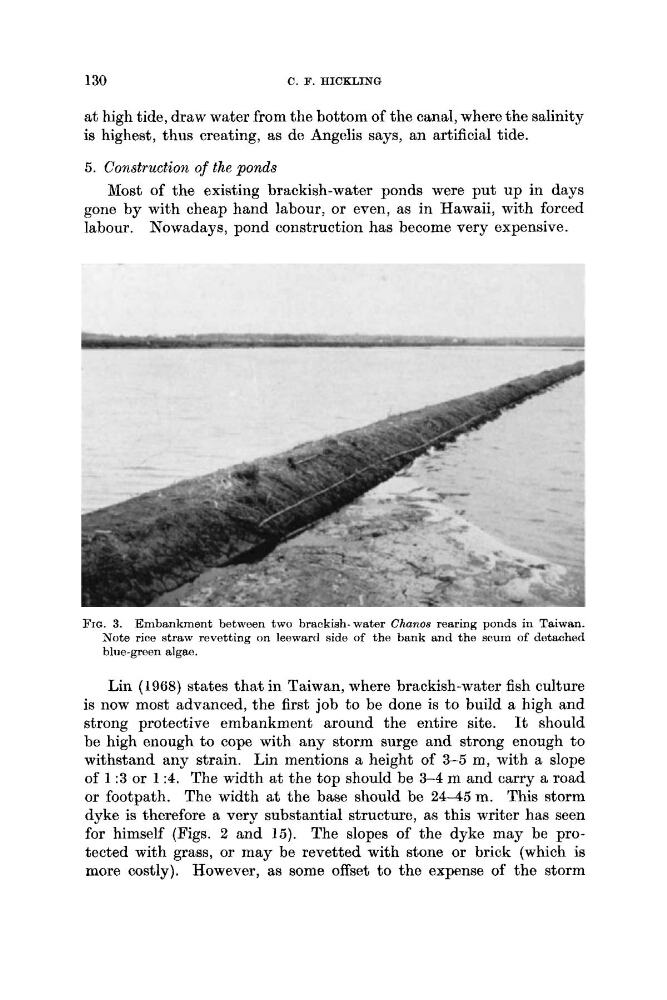
FIG. 3. Embankment between two brackish- water Chanos rearing ponds in Taiwan.
Note rice straw revetting on leeward side of the bank and the scum of detached
blue-green algae.
Lin (1968) states that in Taiwan, where brackish-water fish culture
is now most advanced, the first job to be done is to build a high and
strong protective embankment around the entire site. It should
be high enough to cope with any storm surge and strong enough to
withstand any strain. Lin mentions a height of 3-5 m, with a slope
of 1 :3 or 1 :4. The width at the top should be 3-4 m and carry a road
or footpath. The width at the base should be 24-45 m. This storm
dyke is therefore a very substantial structure, as this writer has seen
for himself (Figs. 2 and 15). The slopes of the dyke may be protected with grass, or may be revetted with stone or brick (which is
more costly). However, as some offset to the expense of the storm
C. F. HICKLING
at high tide, draw water from the bottom of the canal, where the salinity
is highest, thus creating, as de Angelis says, an artificial tide.
5. Construction of the ponds
Most of the existing brackish-water ponds were put up in days
gone by with cheap hand labour, or even, as in Hawaii, with forced
labour. Nowadays, pond construction has become very expensive.
FIG. 3. Embankment between two brackish- water Chanos rearing ponds in Taiwan.
Note rice straw revetting on leeward side of the bank and the scum of detached
blue-green algae.
Lin (1968) states that in Taiwan, where brackish-water fish culture
is now most advanced, the first job to be done is to build a high and
strong protective embankment around the entire site. It should
be high enough to cope with any storm surge and strong enough to
withstand any strain. Lin mentions a height of 3-5 m, with a slope
of 1 :3 or 1 :4. The width at the top should be 3-4 m and carry a road
or footpath. The width at the base should be 24-45 m. This storm
dyke is therefore a very substantial structure, as this writer has seen
for himself (Figs. 2 and 15). The slopes of the dyke may be protected with grass, or may be revetted with stone or brick (which is
more costly). However, as some offset to the expense of the storm