

ESTUARINE FISII FARMING
129
of continuous pumping, yet also make good losses of 0.5 cm/day in
only half an hour’s pumping. Over an assumed exploitation period of
180 days, expenses would be the cost of 276 litres of fuel, plus an
allowance for depreciation. The fuel should be cheap, since many
countries allow a drawback of duty on fuels used in agriculture.
Certainly, just after the last War, the possibility of opening up new
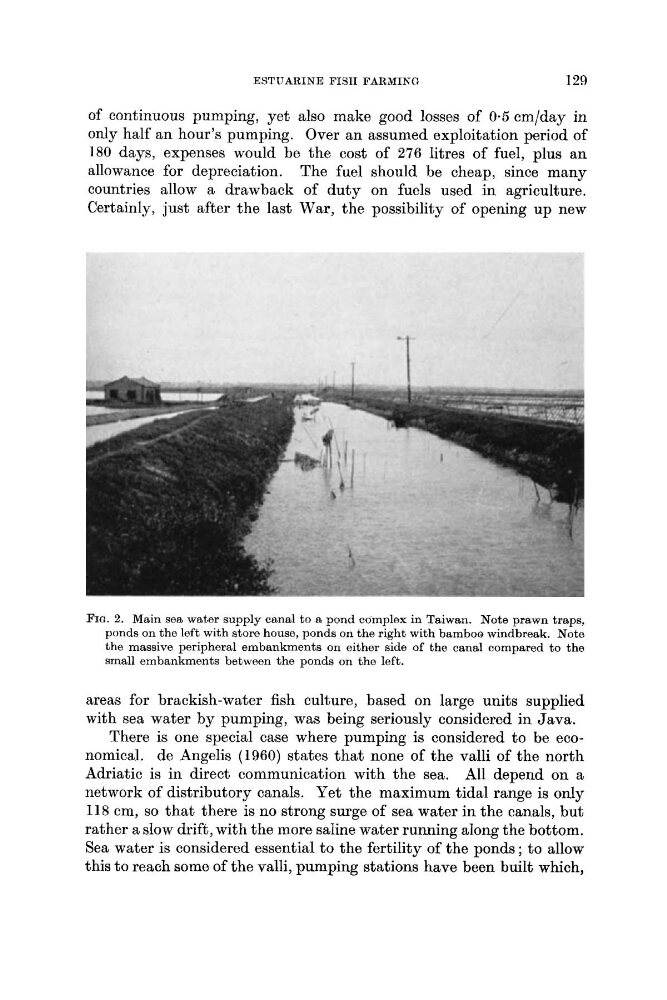
FIG. 2. Main sea water supply canal to a pond complex in Taiwan. Note prawn traps,
ponds on the left with store house, ponds on the right with bamboo windbreak. Note
the massive peripheral embankments on either side of the canal compared to the
small embankments between the ponds on the left.
areas for brackish-water fish culture, based on large units supplied
with sea water by pumping, was being seriously considered in Java.
There is one special case where pumping is considered t o be economical. de Angelis (1960) states that none of the valli of the north
Adriatic is in direct communication with the sea. All depend on a
network of distributory canals. Yet the maximum tidal range is only
118 cm, so that there is no strong surge of sea water in the canals, but
rather a slow drift, with the more saIine water running along the bottom.
Sea water is considered essential to the fertility of the ponds ; t o allow
this to reach some of the valli, pumping stations have been built which,
129
of continuous pumping, yet also make good losses of 0.5 cm/day in
only half an hour’s pumping. Over an assumed exploitation period of
180 days, expenses would be the cost of 276 litres of fuel, plus an
allowance for depreciation. The fuel should be cheap, since many
countries allow a drawback of duty on fuels used in agriculture.
Certainly, just after the last War, the possibility of opening up new
FIG. 2. Main sea water supply canal to a pond complex in Taiwan. Note prawn traps,
ponds on the left with store house, ponds on the right with bamboo windbreak. Note
the massive peripheral embankments on either side of the canal compared to the
small embankments between the ponds on the left.
areas for brackish-water fish culture, based on large units supplied
with sea water by pumping, was being seriously considered in Java.
There is one special case where pumping is considered t o be economical. de Angelis (1960) states that none of the valli of the north
Adriatic is in direct communication with the sea. All depend on a
network of distributory canals. Yet the maximum tidal range is only
118 cm, so that there is no strong surge of sea water in the canals, but
rather a slow drift, with the more saIine water running along the bottom.
Sea water is considered essential to the fertility of the ponds ; t o allow
this to reach some of the valli, pumping stations have been built which,