

372
THE BIOLOGY OF EUPHAUSIIDS
classed by some authorities as fungi, by others as dinoflagellates and
still others as belonging to the rhizopod protozoans.
Jones (1964) found Thalassomyces fagei parasitizing a male
Euphausia psezcdogibba that had normally developed secondary sexual
characteristics. Einarsson (1945), on the other hand, states that
No 3
O l
-
l
t
No 5
r
-
-
1
No 5 1
No 5 r
y - T z April
1965
March
! 1
p-7 5 April
t
6-29Aprii
' 1 _
3 I
5.1
7.1
Coraaace length (mml
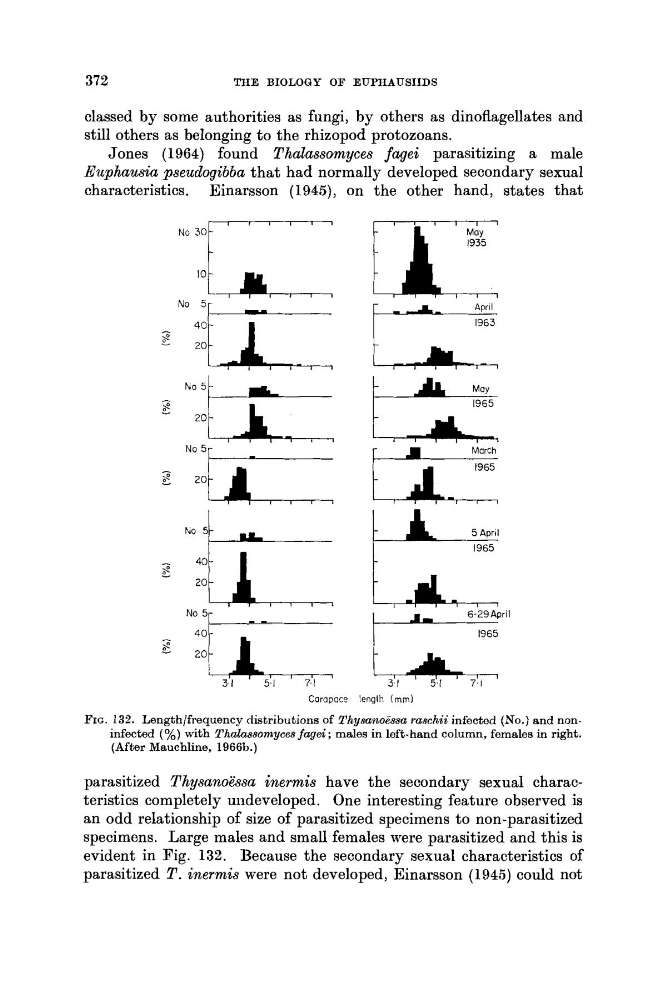
FIG. 132. Length/frequency distributions of Thysanoema wschii infected (No.) and noninfected (yo) with Thalassomyces fagei ; males in left-hand column, females in right.
(After Mauchline, 1966b.)
parasitized Thysanoessa inermis have the secondary sexual characteristics completely undeveloped. One interesting feature observed is
an odd relationship of size of parasitized specimens to non-parasitized
specimens. Large males and small females were parasitized and this is
evident in Fig. 132. Because the secondary sexual characteristics of
parasitized T. inermis were not, developed, Einarsson (1945) could not
THE BIOLOGY OF EUPHAUSIIDS
classed by some authorities as fungi, by others as dinoflagellates and
still others as belonging to the rhizopod protozoans.
Jones (1964) found Thalassomyces fagei parasitizing a male
Euphausia psezcdogibba that had normally developed secondary sexual
characteristics. Einarsson (1945), on the other hand, states that
No 3
O l
-
l
t
No 5
r
-
-
1
No 5 1
No 5 r
y - T z April
1965
March
! 1
p-7 5 April
t
6-29Aprii
' 1 _
3 I
5.1
7.1
Coraaace length (mml
FIG. 132. Length/frequency distributions of Thysanoema wschii infected (No.) and noninfected (yo) with Thalassomyces fagei ; males in left-hand column, females in right.
(After Mauchline, 1966b.)
parasitized Thysanoessa inermis have the secondary sexual characteristics completely undeveloped. One interesting feature observed is
an odd relationship of size of parasitized specimens to non-parasitized
specimens. Large males and small females were parasitized and this is
evident in Fig. 132. Because the secondary sexual characteristics of
parasitized T. inermis were not, developed, Einarsson (1945) could not