

12. PREDATORS AND PARASITES
363
norvegica. Hake may also feed heavily on the squid Loligo which also
feeds on Meganyctiphanes norvegica. Among the clupeoids, it has
already been shown that herring feed on M . norvegica and other
euphausiids and Lebour (1924, 1926a) reported that the pi1 chard
Sardina pilchardus (Walbaum), also eats euphausiids. The last item in
the hake’s diet is the horse mackerel, Trachurus trachurus (L.), and
Hickling (1927) found that it fed chiefly on Meganyctiphanes norvegica
in the early summer and again in October. Thus, there is little doubt
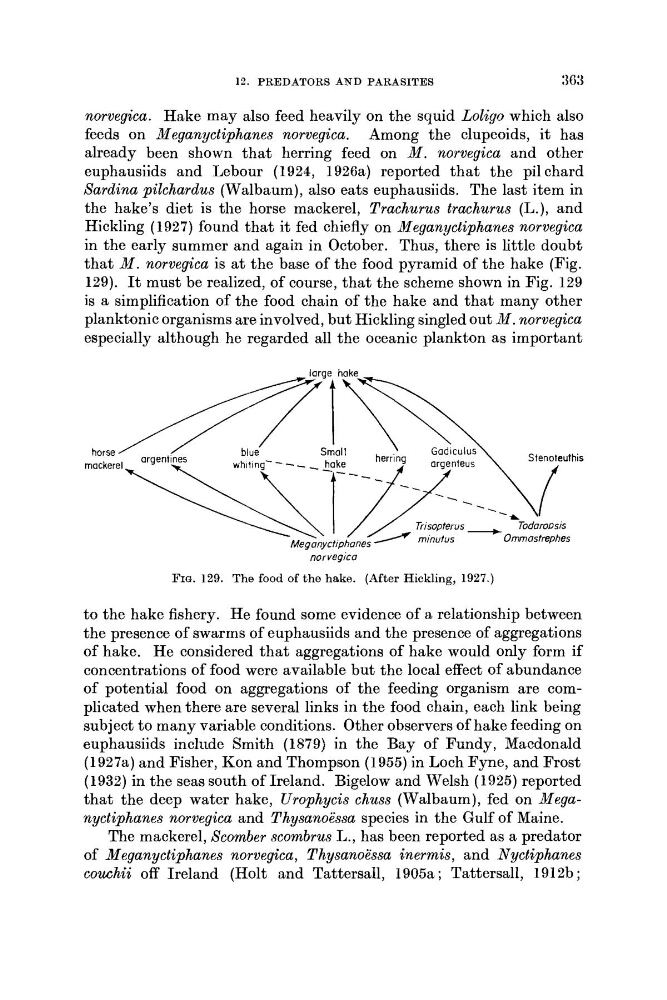
that M . norvegica is a t the base of the food pyramid of the hake (Fig.
129). It must be realized, of course, that the scheme shown in Fig. 129
is a simplification of the food chain of the hake and that many other
planktonic organisms are involved, but Hickling singled out M . norvegica
especially although he regarded all the oceanic plankton as important
Stenoleuthis
horse
nor vegica
FIG. 129. The food of the hake. (After Hickling, 1927.)
to the hake fishery. He found some evidence of a relationship between
the presence of swarms of euphausiids and the presence of aggregations
of hake. He considered that aggregations of hake would only form if
concentrations of food were available but the local effect of abundance
of potential food on aggregations of the feeding organism are complicated when there are several links in the food chain, each link being
subject to many variable conditions. Other observers of hake feeding on
euphausiids include Smith (1879) in the Bay of Fundy, Macdonald
(1927a) and Fisher, Kon and Thompson (1955) in Loch Fyne, and Frost
(1932) in the seas south of Ireland. Bigelow and Welsh (1925) reported
that the deep water hake, Urophycis chuss (Walbaum), fed on Meganyctiphanes norvegica and Thysanoessa species in the Gulf of Maine.
The mackerel, Scomber scombrus L., has been reported as a predator
of Meganyctiphanes norvegica, Thysanoessa inermis, and Nyctiphanes
couchii off Ireland (Holt and Tattersall, 1905a; Tattersall, 1912b ;
363
norvegica. Hake may also feed heavily on the squid Loligo which also
feeds on Meganyctiphanes norvegica. Among the clupeoids, it has
already been shown that herring feed on M . norvegica and other
euphausiids and Lebour (1924, 1926a) reported that the pi1 chard
Sardina pilchardus (Walbaum), also eats euphausiids. The last item in
the hake’s diet is the horse mackerel, Trachurus trachurus (L.), and
Hickling (1927) found that it fed chiefly on Meganyctiphanes norvegica
in the early summer and again in October. Thus, there is little doubt
that M . norvegica is a t the base of the food pyramid of the hake (Fig.
129). It must be realized, of course, that the scheme shown in Fig. 129
is a simplification of the food chain of the hake and that many other
planktonic organisms are involved, but Hickling singled out M . norvegica
especially although he regarded all the oceanic plankton as important
Stenoleuthis
horse
nor vegica
FIG. 129. The food of the hake. (After Hickling, 1927.)
to the hake fishery. He found some evidence of a relationship between
the presence of swarms of euphausiids and the presence of aggregations
of hake. He considered that aggregations of hake would only form if
concentrations of food were available but the local effect of abundance
of potential food on aggregations of the feeding organism are complicated when there are several links in the food chain, each link being
subject to many variable conditions. Other observers of hake feeding on
euphausiids include Smith (1879) in the Bay of Fundy, Macdonald
(1927a) and Fisher, Kon and Thompson (1955) in Loch Fyne, and Frost
(1932) in the seas south of Ireland. Bigelow and Welsh (1925) reported
that the deep water hake, Urophycis chuss (Walbaum), fed on Meganyctiphanes norvegica and Thysanoessa species in the Gulf of Maine.
The mackerel, Scomber scombrus L., has been reported as a predator
of Meganyctiphanes norvegica, Thysanoessa inermis, and Nyctiphanes
couchii off Ireland (Holt and Tattersall, 1905a; Tattersall, 1912b ;