

308
THE BIOLOGY OF EUPHAUSIIDS
then the rate of growth in length may be able to increase during the
later stages of maturation when the metabolic demands of the gonads
have decreased.
Marr (1962) studied the growth rate in swarms of Euphausia
superba. These are in fact almost equivalent to isolated populations
because, as will be discussed in the following chapter, this species after
hatching spends its whole existence within a swarm. Nauplii or
metanauplii form a swarm which retains its status throughout the
larval development, adolescence and adulthood of the individuals.
Consequently, individuals in any swarm are approximately a t the same
stage of development and the dominant larval or adult stage is easily
recognized in any one swarm. Marr examined the dominance of larval
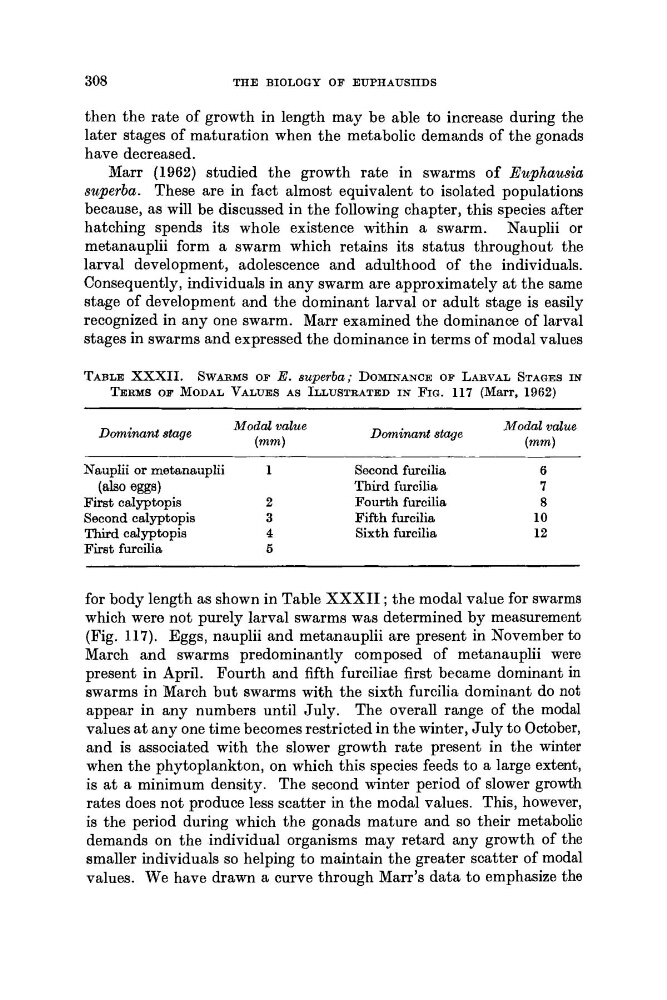
stages in swarms and expressed the dominance in terms of modal values
TABLE XXxII. SWARMS OF E . superba; DOMINANCE OF LARVAL STAGES IN
TERMS OF MODAL VALUES AS ILLUSTRATED IN FIG. 117 (Marr, 1962)
Modal value
Dominant stage
( m m )
Modal value
Dominant stuge
(mm)
Nauplii or metanauplii
1
Second furcilia
6
(ah0 eggs)
Third furcilia
7
First calyptopis
2
Fourth furcilia
8
Second calyptopis
3
Fifth furcilia
10
Third calyptopis
4
Sixth furcilia
12
First furcilia
6
for body length as shown in Table XXXII ; the modal value for swarms
which were not purely larval swarms was determined by measurement
(Fig. 117). Eggs, nauplii and metanauplii are present in November to
March and swarms predominantly composed of metanauplii were
present in April. Fourth and fifth furciliae first became dominant in
swarms in March but swarms with the sixth furcilia dominant do not
appear in any numbers until July. The overall range of the modal
values a t any one time becomes restricted in the winter, July to October,
and is associated with the slower growth rate present in the winter
when the phytoplankton, on which this species feeds t o a large extent,
is at a minimum density. The second winter period of slower growth
rates does not produce less scatter in the modal values. This, however,
is the period during which the gonads mature and so their metabolic
demands on the individual organisms may retard any growth of the
smaller individuals so helping to maintain the greater scatter of modal
values. We have drawn a curve through Marr’s data to emphasize the
THE BIOLOGY OF EUPHAUSIIDS
then the rate of growth in length may be able to increase during the
later stages of maturation when the metabolic demands of the gonads
have decreased.
Marr (1962) studied the growth rate in swarms of Euphausia
superba. These are in fact almost equivalent to isolated populations
because, as will be discussed in the following chapter, this species after
hatching spends its whole existence within a swarm. Nauplii or
metanauplii form a swarm which retains its status throughout the
larval development, adolescence and adulthood of the individuals.
Consequently, individuals in any swarm are approximately a t the same
stage of development and the dominant larval or adult stage is easily
recognized in any one swarm. Marr examined the dominance of larval
stages in swarms and expressed the dominance in terms of modal values
TABLE XXxII. SWARMS OF E . superba; DOMINANCE OF LARVAL STAGES IN
TERMS OF MODAL VALUES AS ILLUSTRATED IN FIG. 117 (Marr, 1962)
Modal value
Dominant stage
( m m )
Modal value
Dominant stuge
(mm)
Nauplii or metanauplii
1
Second furcilia
6
(ah0 eggs)
Third furcilia
7
First calyptopis
2
Fourth furcilia
8
Second calyptopis
3
Fifth furcilia
10
Third calyptopis
4
Sixth furcilia
12
First furcilia
6
for body length as shown in Table XXXII ; the modal value for swarms
which were not purely larval swarms was determined by measurement
(Fig. 117). Eggs, nauplii and metanauplii are present in November to
March and swarms predominantly composed of metanauplii were
present in April. Fourth and fifth furciliae first became dominant in
swarms in March but swarms with the sixth furcilia dominant do not
appear in any numbers until July. The overall range of the modal
values a t any one time becomes restricted in the winter, July to October,
and is associated with the slower growth rate present in the winter
when the phytoplankton, on which this species feeds t o a large extent,
is at a minimum density. The second winter period of slower growth
rates does not produce less scatter in the modal values. This, however,
is the period during which the gonads mature and so their metabolic
demands on the individual organisms may retard any growth of the
smaller individuals so helping to maintain the greater scatter of modal
values. We have drawn a curve through Marr’s data to emphasize the