

274
THE BIOLOGY OF EUPHAUSIIDS
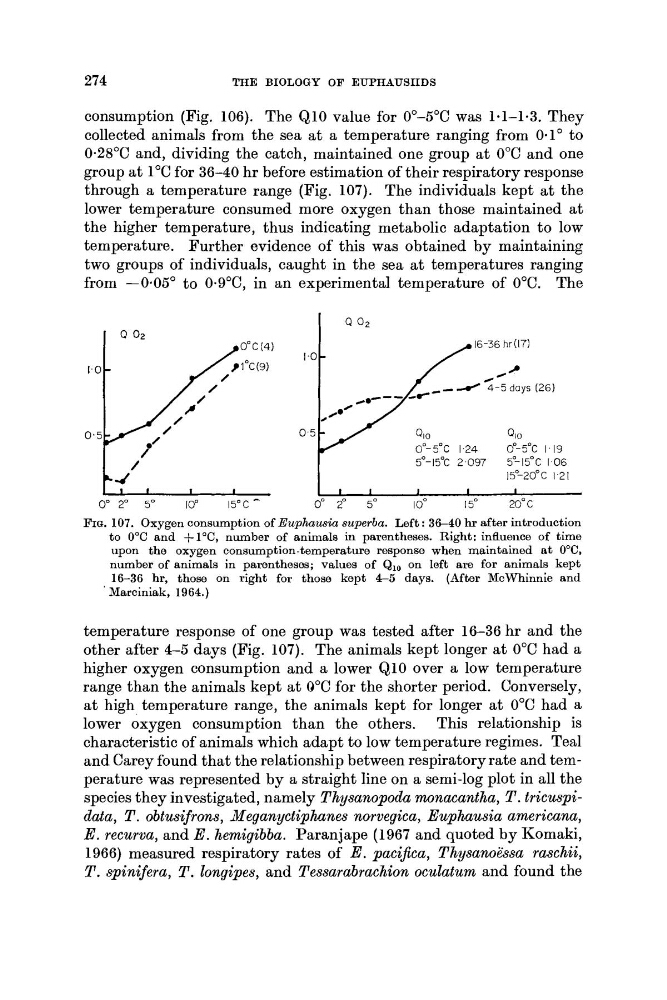
consumption (Fig. 106). The QlO value for 0"-5"C was 1-1-1.3. They
collected animals from the sea at a temperature ranging from 0.1" to
0.28OC and, dividing the catch, maintained one group at 0°C and one
group at 1°C for 36-40 hr before estimation of their respiratory response
through a temperature range (Fig. 107). The individuals kept a t the
lower temperature consumed more oxygen than those maintained at
the higher temperature, thus indicating metabolic adaptation to low
temperature. Further evidence of this was obtained by maintaining
two groups of individuals, caught in the sea a t temperatures ranging
from -0.05" to 0-9"C, in an experimental temperature of 0°C. The
J
I
I
1
I
0" 2" 5"
10"
15°C -
-& 4-5days (26)
0 5
O"5"C
1.24
Oo-5' C I 19
5O-I5OC 2 097
5"15"C I 0 6
15"-2O0C 1.21
I
I
I
0" 2"
5O
loo
15'
20'C
FIG. 107. Oxygen consumption of Euphausia superba. Left : 36-40 hr after introduction
to 0°C and +lac, number of animals in parentheses. Right: influence of time
upon the oxygen consumption-temperature response when maintained a t O"C,
number of animals in parentheses; values of Qlo on left are for animals kept
16-36 hr, those on right for those kept 4-5 days. (After McWhinnie and
' Marciniak, 1964.)
temperature response of one group was tested after 16-36 hr and the
other after 4-5 days (Fig. 107). The animals kept longer at 0°C had a
higher oxygen consumption and a lower QlO over a low temperature
range than the animals kept a t 0°C for the shorter period. Conversely,
a t high temperature range, the animals kept for longer a t 0°C had a
lower oxygen consumption than the others. This relationship is
characteristic of animals which adapt to low temperature regimes. Teal
and Carey found that the relationship between respiratory rate and temperature was represented by a straight line on a semi-log plot in all the
species they investigated, namely Thysanopoda monacantha, T . tricuspidata, T . obtusifrons, Meganyctiphanes norvegica, Euphausia americana,
E. recurva, and E. hemigibba. Paranjape (1967 and quoted by Komaki,
1966) measured respiratory rates of E. pacijca, Thysanoessa raschii,
T . spinifera, T . longipes, and Tessarabrachion oculatum and found the
THE BIOLOGY OF EUPHAUSIIDS
consumption (Fig. 106). The QlO value for 0"-5"C was 1-1-1.3. They
collected animals from the sea at a temperature ranging from 0.1" to
0.28OC and, dividing the catch, maintained one group at 0°C and one
group at 1°C for 36-40 hr before estimation of their respiratory response
through a temperature range (Fig. 107). The individuals kept a t the
lower temperature consumed more oxygen than those maintained at
the higher temperature, thus indicating metabolic adaptation to low
temperature. Further evidence of this was obtained by maintaining
two groups of individuals, caught in the sea a t temperatures ranging
from -0.05" to 0-9"C, in an experimental temperature of 0°C. The
J
I
I
1
I
0" 2" 5"
10"
15°C -
-& 4-5days (26)
0 5
O"5"C
1.24
Oo-5' C I 19
5O-I5OC 2 097
5"15"C I 0 6
15"-2O0C 1.21
I
I
I
0" 2"
5O
loo
15'
20'C
FIG. 107. Oxygen consumption of Euphausia superba. Left : 36-40 hr after introduction
to 0°C and +lac, number of animals in parentheses. Right: influence of time
upon the oxygen consumption-temperature response when maintained a t O"C,
number of animals in parentheses; values of Qlo on left are for animals kept
16-36 hr, those on right for those kept 4-5 days. (After McWhinnie and
' Marciniak, 1964.)
temperature response of one group was tested after 16-36 hr and the
other after 4-5 days (Fig. 107). The animals kept longer at 0°C had a
higher oxygen consumption and a lower QlO over a low temperature
range than the animals kept a t 0°C for the shorter period. Conversely,
a t high temperature range, the animals kept for longer a t 0°C had a
lower oxygen consumption than the others. This relationship is
characteristic of animals which adapt to low temperature regimes. Teal
and Carey found that the relationship between respiratory rate and temperature was represented by a straight line on a semi-log plot in all the
species they investigated, namely Thysanopoda monacantha, T . tricuspidata, T . obtusifrons, Meganyctiphanes norvegica, Euphausia americana,
E. recurva, and E. hemigibba. Paranjape (1967 and quoted by Komaki,
1966) measured respiratory rates of E. pacijca, Thysanoessa raschii,
T . spinifera, T . longipes, and Tessarabrachion oculatum and found the