

7. CHEMICAL COMPOSITION
221
about the same level. During another period, July to September 1951
(Fig. 76, Meganyctiphanes norvegica) the relative values of vitamin A
remained almost constant while those of astaxanthin decreased. The
concentrations of astaxanthin in these species ranged, on average, from
about 30 to 80 pg/g wet wt. Relatively more vitamin A and astaxanthin is present in larger adult euphausiids than in smaller, neglecting
the very high concentrations found in larval stages.
Vitamin A and astaxanthin are not evenly distributed throughout
the tissues of euphausiids. Analyses of the eyes and the rest of the
bodies separately has shown (Table XVIII) that most of the vitamin A
and astaxanthin is located in the eyes. The results for Meganyctiphanes
norvegica and ThysanoEssa raschii show that the eyes contain 92-98yo
of the vitamin A in the former and 82-98yo in the latter (Fisher et al.,
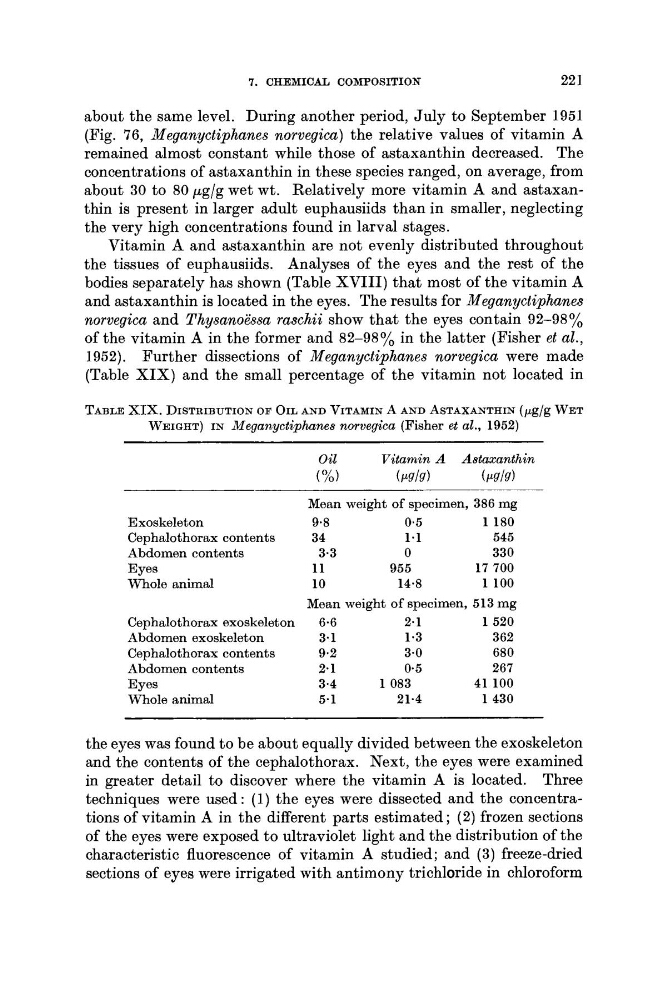
1952). Further dissections of Meganyctiphanes norvegica were made
(Table XIX) and the small percentage of the vitamin not located in
TABLE XIX. DISTRIBUTION OF OIL AND VITAMIN A AND ASTAXANTHIN (pg/g WET
WEIGHT) IN Meganyctiphanes norvegica (Fisher et al., 1952)
Oil
Vitamin A Astaxanthin
(%)
(CLsl9)
(P9/9)
Exoskeleton
Cephalothorax contents
Abdomen contents
Eyes
Whole animal
Cephalothorax exoskeleton
Abdomen exoskeleton
Cephalothorax contents
Abdomen contents
Eyes
Whole animal
Mean weight of specimen, 386 mg
9.8
0.5
1 1 8 0
34
1.1
545
3.3
0
330
11
955
17 700
10
14-8
1 1 0 0
Mean weight of specimen, 513 mg
6.6
2.1
1520
3.1
1.3
362
9.2
3.0
680
2.1
0.5
267
3.4
1 0 8 3
41 100
5-1
21.4
1 4 3 0
the eyes was found to be about equally divided between the exoskeleton
and the contents of the cephalothorax. Next, the eyes were examined
in greater detail to discover where the vitamin A is located. Three
techniques were used : (1) the eyes were dissected and the concentrations of vitamin A in the different parts estimated; (2) frozen sections
of the eyes were exposed to ultraviolet light and the distribution of the
characteristic fluorescence of vitamin A studied; and (3) freeze-dried
sections of eyes were irrigated with antimony trichloride in chloroform
221
about the same level. During another period, July to September 1951
(Fig. 76, Meganyctiphanes norvegica) the relative values of vitamin A
remained almost constant while those of astaxanthin decreased. The
concentrations of astaxanthin in these species ranged, on average, from
about 30 to 80 pg/g wet wt. Relatively more vitamin A and astaxanthin is present in larger adult euphausiids than in smaller, neglecting
the very high concentrations found in larval stages.
Vitamin A and astaxanthin are not evenly distributed throughout
the tissues of euphausiids. Analyses of the eyes and the rest of the
bodies separately has shown (Table XVIII) that most of the vitamin A
and astaxanthin is located in the eyes. The results for Meganyctiphanes
norvegica and ThysanoEssa raschii show that the eyes contain 92-98yo
of the vitamin A in the former and 82-98yo in the latter (Fisher et al.,
1952). Further dissections of Meganyctiphanes norvegica were made
(Table XIX) and the small percentage of the vitamin not located in
TABLE XIX. DISTRIBUTION OF OIL AND VITAMIN A AND ASTAXANTHIN (pg/g WET
WEIGHT) IN Meganyctiphanes norvegica (Fisher et al., 1952)
Oil
Vitamin A Astaxanthin
(%)
(CLsl9)
(P9/9)
Exoskeleton
Cephalothorax contents
Abdomen contents
Eyes
Whole animal
Cephalothorax exoskeleton
Abdomen exoskeleton
Cephalothorax contents
Abdomen contents
Eyes
Whole animal
Mean weight of specimen, 386 mg
9.8
0.5
1 1 8 0
34
1.1
545
3.3
0
330
11
955
17 700
10
14-8
1 1 0 0
Mean weight of specimen, 513 mg
6.6
2.1
1520
3.1
1.3
362
9.2
3.0
680
2.1
0.5
267
3.4
1 0 8 3
41 100
5-1
21.4
1 4 3 0
the eyes was found to be about equally divided between the exoskeleton
and the contents of the cephalothorax. Next, the eyes were examined
in greater detail to discover where the vitamin A is located. Three
techniques were used : (1) the eyes were dissected and the concentrations of vitamin A in the different parts estimated; (2) frozen sections
of the eyes were exposed to ultraviolet light and the distribution of the
characteristic fluorescence of vitamin A studied; and (3) freeze-dried
sections of eyes were irrigated with antimony trichloride in chloroform