

212
THE BIOLOGY OF EUPHAUSIIDS
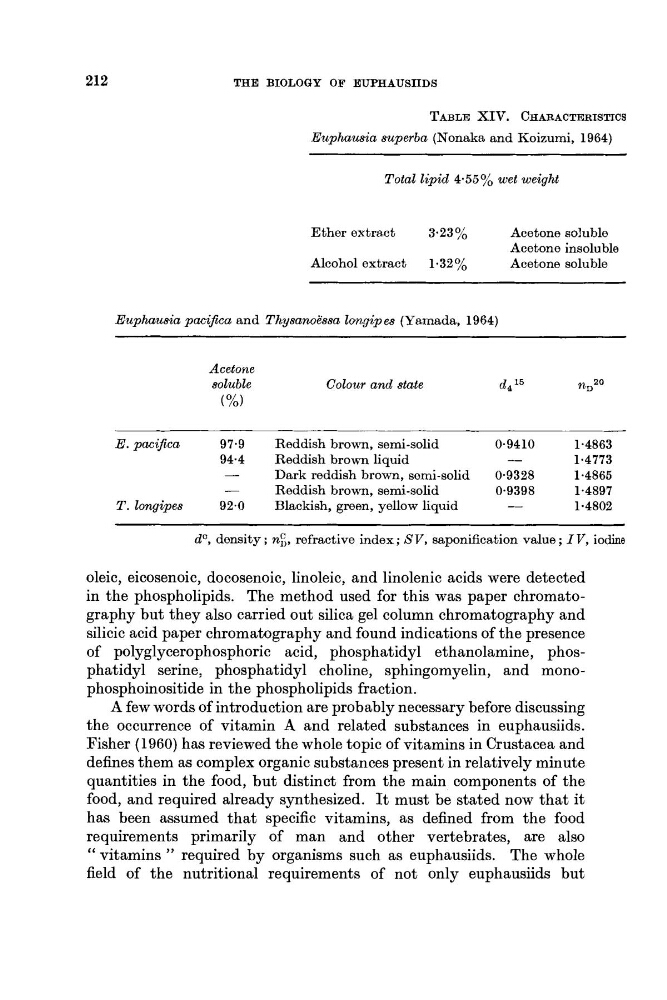
TABLE XIV. CHARACTERISTICS
Euphausia superba (Nonaka and Koizumi, 1964)
Total lipid 4.55% wet weight
Ether extract
3.23y0
Acetone soluble
Alcohol extract
1.32%
Acetone soluble
Acetone insoluble
Euphausia pacifica and ThysanoEssa longip es (Yamada, 1964)
Acetone
soluble
Colour and state
d,I5
nD20
(%)
E. pacifica
97.9
Reddish brown, semi-solid
0.9410
1.4863
94.4
Reddish brown liquid
-
1-4773
-
Dark reddish brown, semi-solid
0.9328
1.4865
-
Reddish brown, semi-solid
0.9398
1.4897
T . Zongipes
92.0
Blackish, green, yellow liquid
-
1.4802
do, density ; ng, refractive index ; S V , saponification value ; I V , iodine
oleic, eicosenoic, docosenoic, linoleic, and linolenic acids were detected
in the phospholipids. The method used for this was paper chromatography but they also carried out silica gel column chromatography and
silicic acid paper chromatography and found indications of the presence
of polyglycerophosphoric acid, phosphatidyl ethanolamine, phosphatidyl serine, phosphatidyl choline, sphingomyelin, and monophosphoinositide in the phospholipids fraction.
A few words of introduction are probably necessary before discussing
the occurrence of vitamin A and related substances in euphausiids.
Fisher (1960) has reviewed the whole topic of vitamins in Crustacea and
defines them as complex organic substances present in relatively minute
quantities in the food, but distinct from the main components of the
food, and required already synthesized. It must be stated now that it
has been assumed that specific vitamins, as defined from the food
requirements primarily of man and other vertebrates, are also
" vitamins ') required by organisms such as euphausiids. The whole
field of the nutritional requirements of not only euphausiids but
THE BIOLOGY OF EUPHAUSIIDS
TABLE XIV. CHARACTERISTICS
Euphausia superba (Nonaka and Koizumi, 1964)
Total lipid 4.55% wet weight
Ether extract
3.23y0
Acetone soluble
Alcohol extract
1.32%
Acetone soluble
Acetone insoluble
Euphausia pacifica and ThysanoEssa longip es (Yamada, 1964)
Acetone
soluble
Colour and state
d,I5
nD20
(%)
E. pacifica
97.9
Reddish brown, semi-solid
0.9410
1.4863
94.4
Reddish brown liquid
-
1-4773
-
Dark reddish brown, semi-solid
0.9328
1.4865
-
Reddish brown, semi-solid
0.9398
1.4897
T . Zongipes
92.0
Blackish, green, yellow liquid
-
1.4802
do, density ; ng, refractive index ; S V , saponification value ; I V , iodine
oleic, eicosenoic, docosenoic, linoleic, and linolenic acids were detected
in the phospholipids. The method used for this was paper chromatography but they also carried out silica gel column chromatography and
silicic acid paper chromatography and found indications of the presence
of polyglycerophosphoric acid, phosphatidyl ethanolamine, phosphatidyl serine, phosphatidyl choline, sphingomyelin, and monophosphoinositide in the phospholipids fraction.
A few words of introduction are probably necessary before discussing
the occurrence of vitamin A and related substances in euphausiids.
Fisher (1960) has reviewed the whole topic of vitamins in Crustacea and
defines them as complex organic substances present in relatively minute
quantities in the food, but distinct from the main components of the
food, and required already synthesized. It must be stated now that it
has been assumed that specific vitamins, as defined from the food
requirements primarily of man and other vertebrates, are also
" vitamins ') required by organisms such as euphausiids. The whole
field of the nutritional requirements of not only euphausiids but