

6. FOOD AND FEEDING
183
of several species; the distances between the setules were 5-7 p in
Euphausia superba and E. mucronata, 7-12 p in E. pacifica, 8-11 p in
Thysanoessa raschii, 9-15 p in T . longipes, 15-2Op in T . gregaria,
20-30 p in Thysanopoda monacantha, 30-60 p in T . tricuspidata, and
60-65 p in Bentheupkausia amblyops. This means that the species
living in or near the surface layers of the sea tend to have the setae
that are most efficient for filtering material from the water.
The food, having been procured by the appendages, enters the gut
or alimentary tract of the animal. This consists of an oesophagus,
stomach, mid-gut, and hind-gut. The anus is situated on the ventral
side of the caudal plate. The oesophagus and stomach of the following
euphausiids have been described in considerable detail and once
again we shall restrict ourselves to a relatively brief summary of the
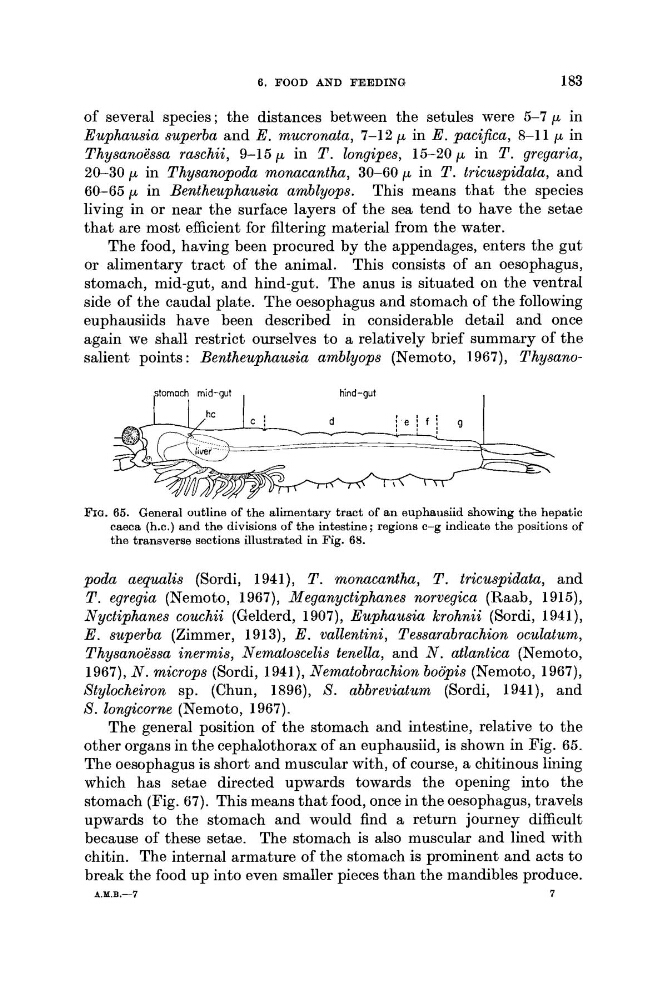
salient points Bentheuphausia amblyops (Nemoto, 1967), ThysanoFIQ. 65. General outline of the alimentary tract of an euphausiid showing the hepatic
caeca (h.c.) and the divisions of the intestine; regions c-g indicate the positions of
the transverse sections illustrated in Fig. 68.
poda aequalis (Sordi, 1941), T . monacantha, T . tricuspidata, and
T . egregia (Nemoto, 1967), Meganyctiphanes norvegica (Raab, 1915),
Nyctiphanes couchii (Gelderd, 1907), Euphausia krohnii (Sordi, 1941),
E. superba (Zimmer, 1913), E. vallentini, Tessarabrachion oculatum,
Thysanoessa inermis, Nematoscelis tenella, and N. atlantica (Nemoto,
1967), N. microps (Sordi, 1941), Nematobrachion boopis (Nemoto, 19671,
Stylocheiron sp. (Chun, 1896), S. abbreviatum (Sordi, 1941), and
8. longicorne (Nemoto, 1967).
The general position of the stomach and intestine, relative to the
other organs in the cephalothorax of an euphausiid, is shown in Fig. 65.
The oesophagus is short and muscular with, of course, a chitinous lining
which has setae directed upwards towards the opening into the
stomach (Fig. 67). This means that food, once in the oesophagus, travels
upwards to the stomach and would find a return journey difficult
because of these setae. The stomach is also muscular and lined with
chitin. The internal armature of the stomach is prominent and acts to
break the food up into even smaller pieces than the mandibles produce.
A.MI.B.-7
7
183
of several species; the distances between the setules were 5-7 p in
Euphausia superba and E. mucronata, 7-12 p in E. pacifica, 8-11 p in
Thysanoessa raschii, 9-15 p in T . longipes, 15-2Op in T . gregaria,
20-30 p in Thysanopoda monacantha, 30-60 p in T . tricuspidata, and
60-65 p in Bentheupkausia amblyops. This means that the species
living in or near the surface layers of the sea tend to have the setae
that are most efficient for filtering material from the water.
The food, having been procured by the appendages, enters the gut
or alimentary tract of the animal. This consists of an oesophagus,
stomach, mid-gut, and hind-gut. The anus is situated on the ventral
side of the caudal plate. The oesophagus and stomach of the following
euphausiids have been described in considerable detail and once
again we shall restrict ourselves to a relatively brief summary of the
salient points Bentheuphausia amblyops (Nemoto, 1967), ThysanoFIQ. 65. General outline of the alimentary tract of an euphausiid showing the hepatic
caeca (h.c.) and the divisions of the intestine; regions c-g indicate the positions of
the transverse sections illustrated in Fig. 68.
poda aequalis (Sordi, 1941), T . monacantha, T . tricuspidata, and
T . egregia (Nemoto, 1967), Meganyctiphanes norvegica (Raab, 1915),
Nyctiphanes couchii (Gelderd, 1907), Euphausia krohnii (Sordi, 1941),
E. superba (Zimmer, 1913), E. vallentini, Tessarabrachion oculatum,
Thysanoessa inermis, Nematoscelis tenella, and N. atlantica (Nemoto,
1967), N. microps (Sordi, 1941), Nematobrachion boopis (Nemoto, 19671,
Stylocheiron sp. (Chun, 1896), S. abbreviatum (Sordi, 1941), and
8. longicorne (Nemoto, 1967).
The general position of the stomach and intestine, relative to the
other organs in the cephalothorax of an euphausiid, is shown in Fig. 65.
The oesophagus is short and muscular with, of course, a chitinous lining
which has setae directed upwards towards the opening into the
stomach (Fig. 67). This means that food, once in the oesophagus, travels
upwards to the stomach and would find a return journey difficult
because of these setae. The stomach is also muscular and lined with
chitin. The internal armature of the stomach is prominent and acts to
break the food up into even smaller pieces than the mandibles produce.
A.MI.B.-7
7