

154
THE BIOLOGY OF EUPHAUYIIDY
22022
1 0
2
Average catch night
0
500
1000
1500
0
10
40
70
30
39
130 loo]
20
20
15
13
10
160
2 Ig01 20
250
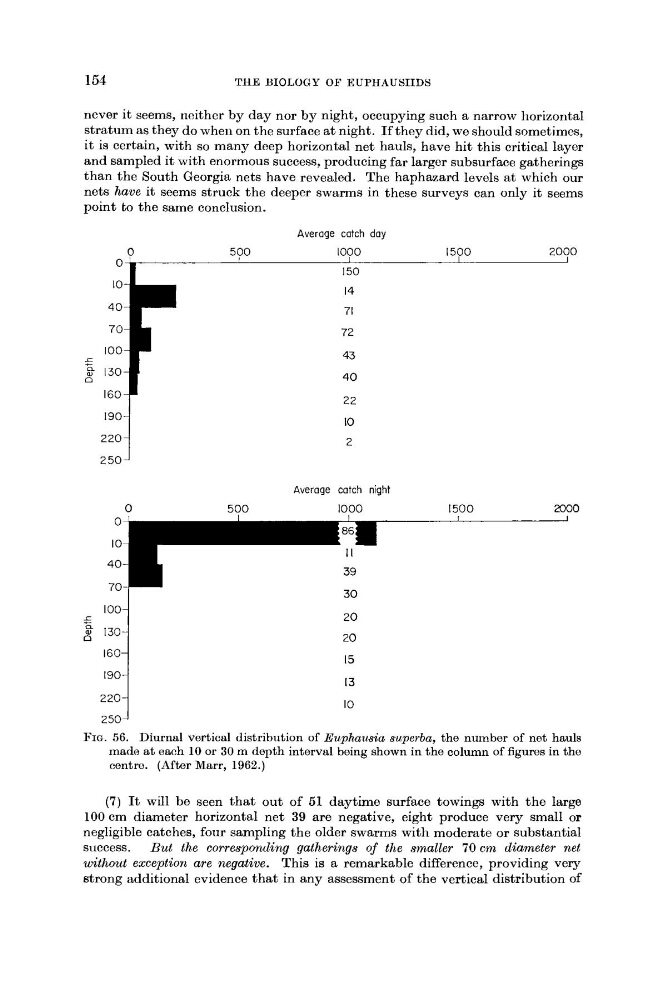
FIG. 56. Diurnal vertical distribution of Euphauaia auperba, the number of net hauls
made at each 10 or 30 m depth interval being shown in the column of figures in the
centre. (After Marr, 1962.)
(7) It will be seen that out of 51 daytime surface towings with the large
100 cm diameter horizontal net 39 are negative, eight produce very small or
negligible catches, four sampling the older swarms with moderate or substantial
success. But the corresponding gatherings of the smaller 70 cnz diameter net
without exception are negative. This is a remarkable difference, providing very
strong additional evidence that in any assessment of the vertical distribution of
never i t seems, neither by day nor by night, occupying such a narrow horizontal
stra,tiim as they do when on the surface a t night. If they did, we should sometimes,
it is certain, with so many deep horizontal net hauls, have hit this critical layer
and sampled it with enormous success, producing far larger subsurface gatherings
than the South Georgia nets have revealed. The haphazard levels at which our
nets have it seems struck the deeper swarms in these surveys can only it seems
point to the same conclusion.
THE BIOLOGY OF EUPHAUYIIDY
22022
1 0
2
Average catch night
0
500
1000
1500
0
10
40
70
30
39
130 loo]
20
20
15
13
10
160
2 Ig01 20
250
FIG. 56. Diurnal vertical distribution of Euphauaia auperba, the number of net hauls
made at each 10 or 30 m depth interval being shown in the column of figures in the
centre. (After Marr, 1962.)
(7) It will be seen that out of 51 daytime surface towings with the large
100 cm diameter horizontal net 39 are negative, eight produce very small or
negligible catches, four sampling the older swarms with moderate or substantial
success. But the corresponding gatherings of the smaller 70 cnz diameter net
without exception are negative. This is a remarkable difference, providing very
strong additional evidence that in any assessment of the vertical distribution of
never i t seems, neither by day nor by night, occupying such a narrow horizontal
stra,tiim as they do when on the surface a t night. If they did, we should sometimes,
it is certain, with so many deep horizontal net hauls, have hit this critical layer
and sampled it with enormous success, producing far larger subsurface gatherings
than the South Georgia nets have revealed. The haphazard levels at which our
nets have it seems struck the deeper swarms in these surveys can only it seems
point to the same conclusion.