

5. VERTICAL DISTRIBUTION AND MIGRATION
153
(1) There is a massive accumulation of swarms after nightfall in the surface
(0-5 m) layer, particularly conspicuous during the dark hours between 2200 and
0400.
(2) The same zone in daylight appears to be largely, but not entirely, deserted
by the older swarms, suggesting rather strongly a t first sight that most migrate
by day to deeper levels. Clearly, however, they do not all go down, or perhaps
I should say do not always go down, the frequency of occurrence of negative or
negligible daytime subsurface gatherings being in fact so very high that we
cannot it seems ignore the possibility that many more perhaps than our nets
reveal do remain on the surface throughout the daylight hours, successfully
avoiding, but again not alwaya, the stern net that is fishing there. Both
avoidance and vertical migration it seems could be contributing, equally perhaps,
to the daytime surface scarcity we record. If, however, avoidance is to be ruled
out and the majority of the swarms do in fact desert the surface by day, then it
can again only be concluded that such as go down become so widely scattered in
the vertical plane that they present a very difficult target for our deep horizontal
nets.
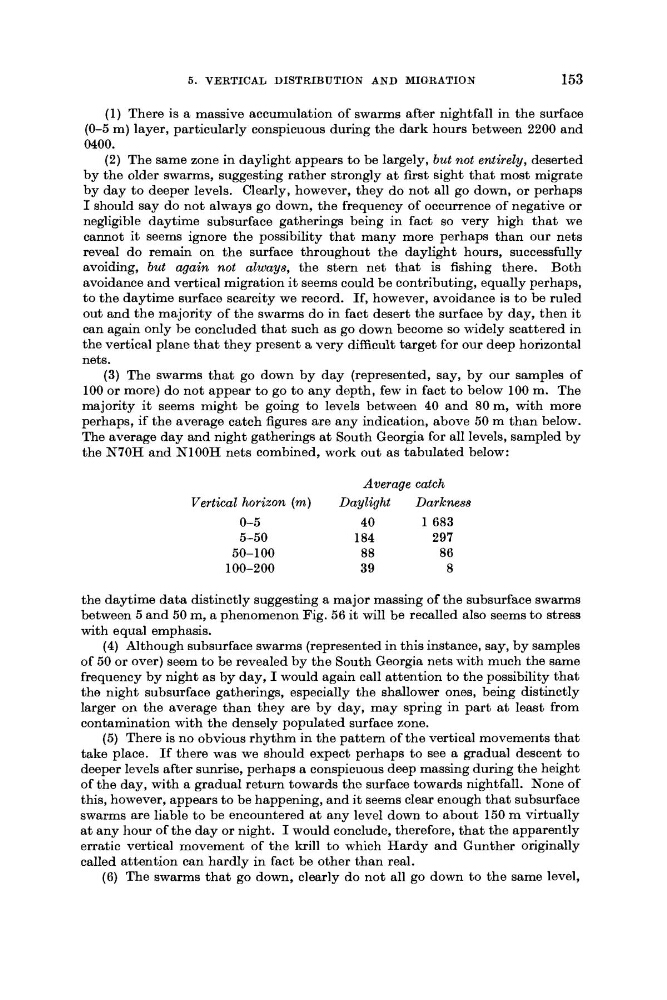
(3) The swarms that go down by day (represented, say, by our samples of
100 or more) do not appear to go to any depth, few in fact to below 100 m. The
majority it seems might be going to levels between 40 and 80m, with more
perhaps, if the average catch figures are any indication, above 50 m than below.
The average day and night gatherings a t South Georgia for all levels, sampled by
the N70H and NlOOH nets combined, work out as tabulated below:
Average catch
Vertical horizon (m)
Daylight
Darkness
0-5
40
1683
5-50
184
297
50-100
88
86
100-200
39
8
the daytime data distinctly suggesting a major massing of the subsurface swarms
between 5 and 50 m, a phenomenon Fig. 56 it will be recalled also seems to stress
with equal emphasis.
(4) Although subsurface swarms (represented in this instance, say, by samples
of 50 or over) seem to be revealed by the South Georgia nets with much the same
frequency by night as by day, I would again call attention to the possibility that
the night subsurface gatherings, especially the shallower ones, being distinctly
larger on the average than they are by day, may spring in part a t least from
contamination with the densely populated surface zone.
(5) There is no obvious rhythm in the pattern of the vertical movements that
take place. If there was we should expect perhaps to see a gradual descent to
deeper levels after sunrise, perhaps a conspicuous daep massing during the height
of the day, with a gradual return towards the surface towards nightfall. None of
this, however, appears to be happening, and it seems clear enough that subsurface
swarms are liable to be encountered at any level down to about 150 m virtually
at any hour of the day or night. I would conclude, therefore, that the apparently
erratic vertical movement of the krill to which Hardy and Gunther originally
called attention can hardly in fact be other than real.
(6) The swarms that go down, clearly do not all go down to the same level,
153
(1) There is a massive accumulation of swarms after nightfall in the surface
(0-5 m) layer, particularly conspicuous during the dark hours between 2200 and
0400.
(2) The same zone in daylight appears to be largely, but not entirely, deserted
by the older swarms, suggesting rather strongly a t first sight that most migrate
by day to deeper levels. Clearly, however, they do not all go down, or perhaps
I should say do not always go down, the frequency of occurrence of negative or
negligible daytime subsurface gatherings being in fact so very high that we
cannot it seems ignore the possibility that many more perhaps than our nets
reveal do remain on the surface throughout the daylight hours, successfully
avoiding, but again not alwaya, the stern net that is fishing there. Both
avoidance and vertical migration it seems could be contributing, equally perhaps,
to the daytime surface scarcity we record. If, however, avoidance is to be ruled
out and the majority of the swarms do in fact desert the surface by day, then it
can again only be concluded that such as go down become so widely scattered in
the vertical plane that they present a very difficult target for our deep horizontal
nets.
(3) The swarms that go down by day (represented, say, by our samples of
100 or more) do not appear to go to any depth, few in fact to below 100 m. The
majority it seems might be going to levels between 40 and 80m, with more
perhaps, if the average catch figures are any indication, above 50 m than below.
The average day and night gatherings a t South Georgia for all levels, sampled by
the N70H and NlOOH nets combined, work out as tabulated below:
Average catch
Vertical horizon (m)
Daylight
Darkness
0-5
40
1683
5-50
184
297
50-100
88
86
100-200
39
8
the daytime data distinctly suggesting a major massing of the subsurface swarms
between 5 and 50 m, a phenomenon Fig. 56 it will be recalled also seems to stress
with equal emphasis.
(4) Although subsurface swarms (represented in this instance, say, by samples
of 50 or over) seem to be revealed by the South Georgia nets with much the same
frequency by night as by day, I would again call attention to the possibility that
the night subsurface gatherings, especially the shallower ones, being distinctly
larger on the average than they are by day, may spring in part a t least from
contamination with the densely populated surface zone.
(5) There is no obvious rhythm in the pattern of the vertical movements that
take place. If there was we should expect perhaps to see a gradual descent to
deeper levels after sunrise, perhaps a conspicuous daep massing during the height
of the day, with a gradual return towards the surface towards nightfall. None of
this, however, appears to be happening, and it seems clear enough that subsurface
swarms are liable to be encountered at any level down to about 150 m virtually
at any hour of the day or night. I would conclude, therefore, that the apparently
erratic vertical movement of the krill to which Hardy and Gunther originally
called attention can hardly in fact be other than real.
(6) The swarms that go down, clearly do not all go down to the same level,