

5 . VERTICAL DISTRIBUTION AND MIGRATION
145
conical-shaped nets are lowered to the required depth and towed
through the water so that they filter the plankton. When it is desired
to bring them to the surface, a meta,l weight (messenger) is clipped to
the towing wire and allowed to slide down it and hit a trigger mechanism
on the net. When this happens, a loop of cord tightens round the net
and throttles it so that no plankton can get in or out and the net is
hauled to the surface. The messenger to the first net can set free a
further messenger which runs on down the wire to close a second net
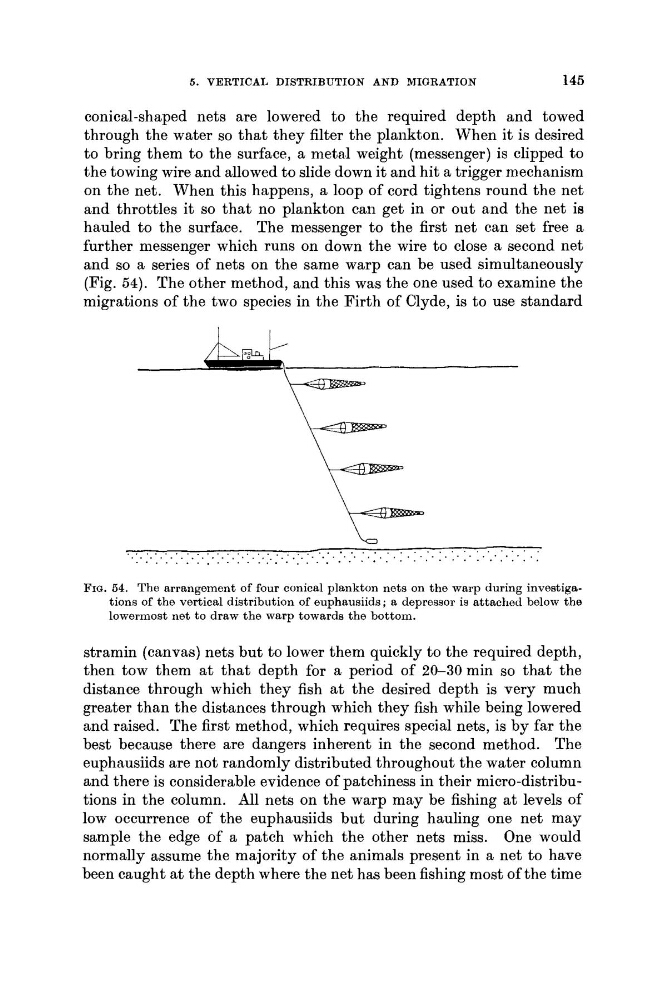
and so a series of nets on the same warp can be used simultaneously
(Fig. 54). The other method, and this was the one used to examine the
migrations of the two species in the Firth of Clyde, is t o use standard
. . . . . . . . . . . . . . . . . . . . . . . . . . . . . . . . . . . . . .
. . . . . . . . . . . . . . . . . . . . . . . . . . . . . . . . . . . . .
. . . . . . . . . . . . . . . . . . . . . . . . . . . . . . . . . . . . .
FIG. 54. The arrangement of four conical plankton nets on the warp during investigations of the vertical distribution of euphausiids ; a depressor is attached below the
lowermost net to draw the warp towards the bottom.
stramin (canvas) nets but to lower them quickly to the required depth,
then tow them a t that depth for a period of 20-30min so that the
distance through which they fish a t the desired depth is very much
greater than the distances through which they fish while being lowered
and raised. The first method, which requires special nets, is by far the
best because there are dangers inherent in the second method. The
euphausiids are not randomly distributed throughout the water column
and there is considerable evidence of patchiness in their micro-distributions in the column. All nets on the warp may be fishing a t levels of
low occurrence of the euphausiids but during hauling one net may
sample the edge of a patch which the other nets miss. One would
normally assume the majority of the animals present in a net t o have
been caught at the depth where the net has been fishing most of the time
145
conical-shaped nets are lowered to the required depth and towed
through the water so that they filter the plankton. When it is desired
to bring them to the surface, a meta,l weight (messenger) is clipped to
the towing wire and allowed to slide down it and hit a trigger mechanism
on the net. When this happens, a loop of cord tightens round the net
and throttles it so that no plankton can get in or out and the net is
hauled to the surface. The messenger to the first net can set free a
further messenger which runs on down the wire to close a second net
and so a series of nets on the same warp can be used simultaneously
(Fig. 54). The other method, and this was the one used to examine the
migrations of the two species in the Firth of Clyde, is t o use standard
. . . . . . . . . . . . . . . . . . . . . . . . . . . . . . . . . . . . . .
. . . . . . . . . . . . . . . . . . . . . . . . . . . . . . . . . . . . .
. . . . . . . . . . . . . . . . . . . . . . . . . . . . . . . . . . . . .
FIG. 54. The arrangement of four conical plankton nets on the warp during investigations of the vertical distribution of euphausiids ; a depressor is attached below the
lowermost net to draw the warp towards the bottom.
stramin (canvas) nets but to lower them quickly to the required depth,
then tow them a t that depth for a period of 20-30min so that the
distance through which they fish a t the desired depth is very much
greater than the distances through which they fish while being lowered
and raised. The first method, which requires special nets, is by far the
best because there are dangers inherent in the second method. The
euphausiids are not randomly distributed throughout the water column
and there is considerable evidence of patchiness in their micro-distributions in the column. All nets on the warp may be fishing a t levels of
low occurrence of the euphausiids but during hauling one net may
sample the edge of a patch which the other nets miss. One would
normally assume the majority of the animals present in a net t o have
been caught at the depth where the net has been fishing most of the time