

CHAPTER 5
VERTICAL DISTRIBUTION AND MIGRATION
The majority of species of euphausiids live in the surface layers of
the oceans or in coastal regions. Several species, however, live in subsurface layers (mesopelagic) and a few are bathypelagic, that is live in
the deep levels of the water column. Species that are known to be
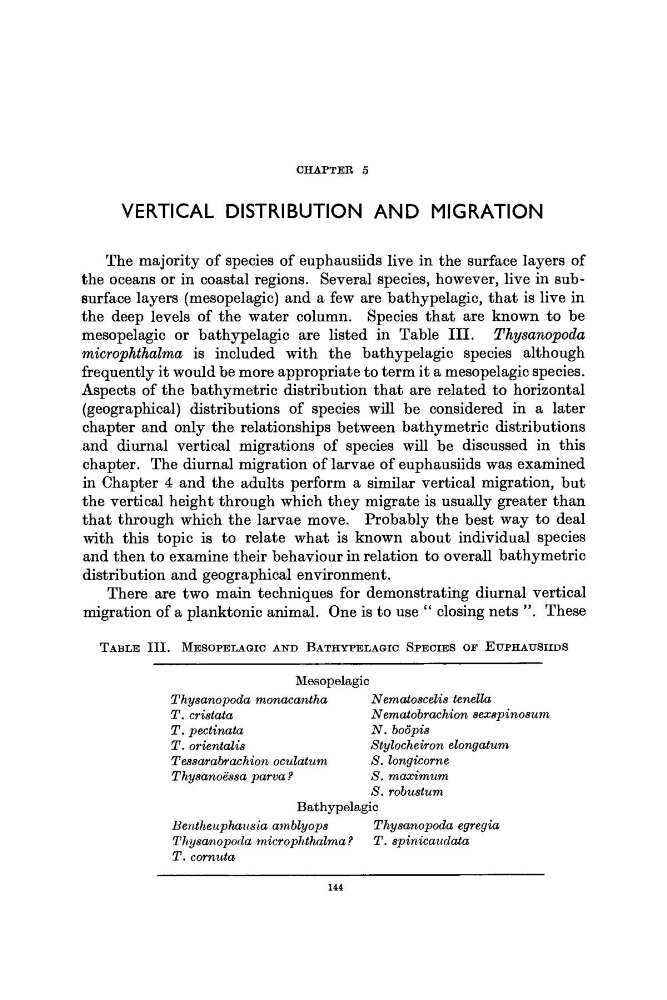
mesopelagic or bathypelagic are listed in Table 111. Thysanopoda
microphthalma is included with the bathypelagic species although
frequently it would be more appropriate to term it a mesopelagic species.
Aspects of the bathymetric distribution that are related to horizontal
(geographical) distributions of species will be considered in a later
chapter and only the relationships between bathymetric distributions
and diurnal vertical migrations of species will be discussed in this
chapter. The diurnal migration of larvae of euphausiids was examined
in Chapter 4 and the adults perform a similar vertical migration, but
the vertical height through which they migrate is usually greater than
that through which the larvae move. Probably the best way to deal
with this topic is to relate what is known about individual species
and then to examine their behaviour in relation to overall bathymetric
distribution and geographical environment.
There are two main techniques for demonstrating diurnal vertical
migration of a planktonic animal. One is to use “ closing nets ”. These
TABLE 111. MESOPELAQIC AND BATHYPELAQIC SPECIES OF EUPHAUSIIDS
Mesopelagic
Thysanopoda monacantha
Nematoscelis tenella
T . cristata
Nematobrachion sexapinosum
T . pectinata
N . boijpis
T . orientalis
Stylocheiron elongaturn
Tessarabrachion oculatum
S. longicorne
ThysanoEssa parva?
S. maximum
S . robustum
Bathypelagic
Be~theuphausia amblyops
Thy3anopoda egregia
Thysanopoda microphthalma? T . spinicaudata
T . cornuta
144
VERTICAL DISTRIBUTION AND MIGRATION
The majority of species of euphausiids live in the surface layers of
the oceans or in coastal regions. Several species, however, live in subsurface layers (mesopelagic) and a few are bathypelagic, that is live in
the deep levels of the water column. Species that are known to be
mesopelagic or bathypelagic are listed in Table 111. Thysanopoda
microphthalma is included with the bathypelagic species although
frequently it would be more appropriate to term it a mesopelagic species.
Aspects of the bathymetric distribution that are related to horizontal
(geographical) distributions of species will be considered in a later
chapter and only the relationships between bathymetric distributions
and diurnal vertical migrations of species will be discussed in this
chapter. The diurnal migration of larvae of euphausiids was examined
in Chapter 4 and the adults perform a similar vertical migration, but
the vertical height through which they migrate is usually greater than
that through which the larvae move. Probably the best way to deal
with this topic is to relate what is known about individual species
and then to examine their behaviour in relation to overall bathymetric
distribution and geographical environment.
There are two main techniques for demonstrating diurnal vertical
migration of a planktonic animal. One is to use “ closing nets ”. These
TABLE 111. MESOPELAQIC AND BATHYPELAQIC SPECIES OF EUPHAUSIIDS
Mesopelagic
Thysanopoda monacantha
Nematoscelis tenella
T . cristata
Nematobrachion sexapinosum
T . pectinata
N . boijpis
T . orientalis
Stylocheiron elongaturn
Tessarabrachion oculatum
S. longicorne
ThysanoEssa parva?
S. maximum
S . robustum
Bathypelagic
Be~theuphausia amblyops
Thy3anopoda egregia
Thysanopoda microphthalma? T . spinicaudata
T . cornuta
144