

114
THE BIOLOGY OF EUPIIADSIIDS
the calyptopis. In some species, Meganyctiphanes norvegica and
Thyanoessa raschii, a correlation is often present between the state of
development of the embryos and the depth at which they were caught.
In the Clyde, these species lay their eggs close to the surface and the
eggs, being heavier than sea water, tend to sink so that embryos at a
later stage of development tend to occur deeper than single, two or
four celled stages. This is not always evident because although the
majority of eggs of these species are laid close to the surface in the
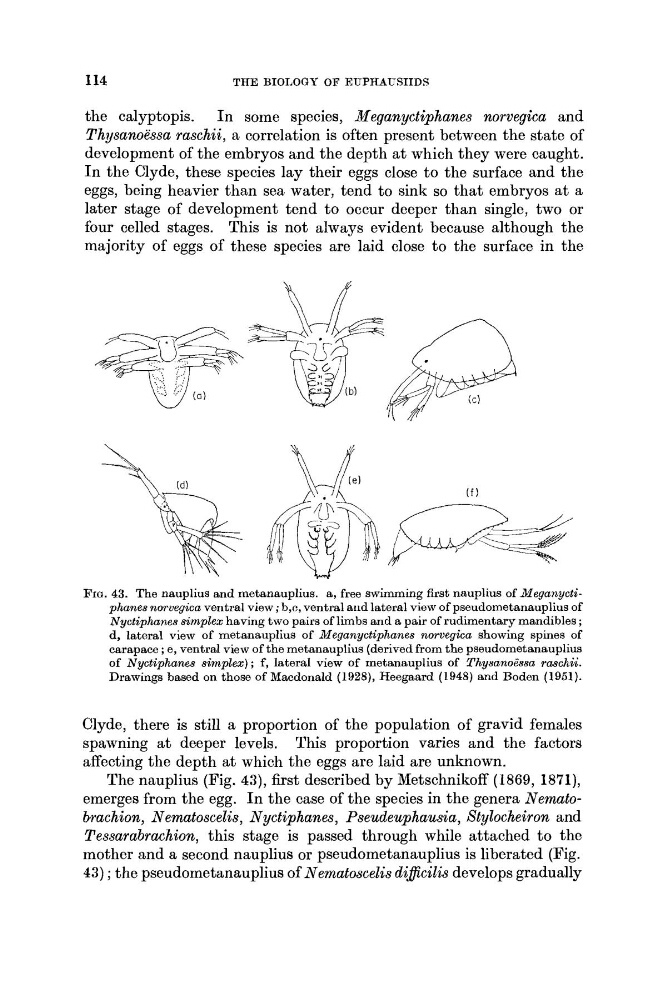
FIG. 43. The nauplius and metanauplius. a, free swimming first nauplius of Meganyctiphanes noiuegica ventral view ; b,c, ventral and lateral view of pseudometanauplius of
Nyctiphanes simplex having two pairs of limbs and a pair of rudimentary mandibles ;
d, lateral view of metanauplins of Meganyctiphanes norvegica showing spines of
carapace ; e, ventral view of the metanauplius (derived from the pseudometanauplius
of Nyctiphanes simplex) ; f, lateral view of metanauplius of Thysanoessa raschii.
Drawings based on those of Macdonald (1928), Heegaard (1948) and Boden (1951).
Clyde, there is still a proportion of the population of gravid females
spawning at deeper levels. This proportion varies and the factors
affecting the depth at which the eggs are laid are unknown.
The nauplius (Fig. 43), first described by Metschnikoff (1869, 1871),
emerges from the egg. In the case of the species in the genera Nematobrachion, Nernatoscelis, Nyctiphanes, Pseudeuphausia, Stylocheiron and
Tessarabrachion, this stage is passed through while attached to the
mother and a second nauplius or pseudometanauplius is liberated (Fig.
43) ; the pseudometanauplius of Nematoscelis dificilis develops gradually
THE BIOLOGY OF EUPIIADSIIDS
the calyptopis. In some species, Meganyctiphanes norvegica and
Thyanoessa raschii, a correlation is often present between the state of
development of the embryos and the depth at which they were caught.
In the Clyde, these species lay their eggs close to the surface and the
eggs, being heavier than sea water, tend to sink so that embryos at a
later stage of development tend to occur deeper than single, two or
four celled stages. This is not always evident because although the
majority of eggs of these species are laid close to the surface in the
FIG. 43. The nauplius and metanauplius. a, free swimming first nauplius of Meganyctiphanes noiuegica ventral view ; b,c, ventral and lateral view of pseudometanauplius of
Nyctiphanes simplex having two pairs of limbs and a pair of rudimentary mandibles ;
d, lateral view of metanauplins of Meganyctiphanes norvegica showing spines of
carapace ; e, ventral view of the metanauplius (derived from the pseudometanauplius
of Nyctiphanes simplex) ; f, lateral view of metanauplius of Thysanoessa raschii.
Drawings based on those of Macdonald (1928), Heegaard (1948) and Boden (1951).
Clyde, there is still a proportion of the population of gravid females
spawning at deeper levels. This proportion varies and the factors
affecting the depth at which the eggs are laid are unknown.
The nauplius (Fig. 43), first described by Metschnikoff (1869, 1871),
emerges from the egg. In the case of the species in the genera Nematobrachion, Nernatoscelis, Nyctiphanes, Pseudeuphausia, Stylocheiron and
Tessarabrachion, this stage is passed through while attached to the
mother and a second nauplius or pseudometanauplius is liberated (Fig.
43) ; the pseudometanauplius of Nematoscelis dificilis develops gradually