

336
ELVEZIO GHIRARDELLI
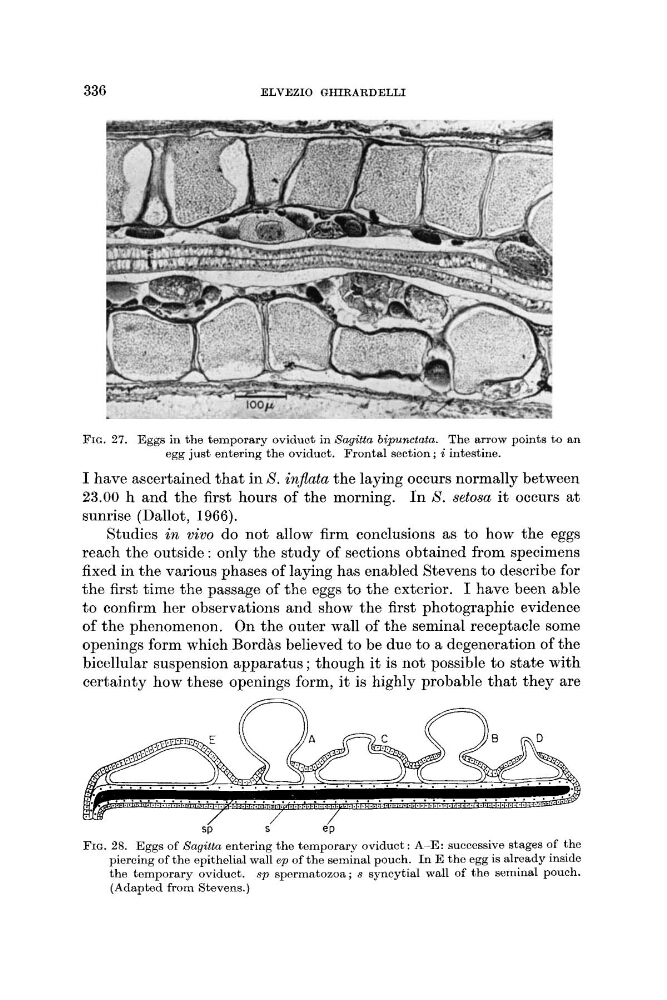
FIG. 27. Eggs in the temporary oviduct in Sugitta bipunctata. The arrow points to an
egg just entering the oviduct. Frontal section; i intestine.
I have ascertained that in S. inJlata the laying occurs normally between
23.00 h and the first hours of the morning. I n S. setosa it occurs at
sunrise (Dallot, 1966).
Studies in vivo do not allow firm conclusions as to how the eggs
reach the outside : only the study of sections obtained from specimens
fixed in the various phases of laying has enabled Stevens to describe for
the first time the passage of the eggs to the exterior. I have been able
t o confirm her observations and show the first photographic evidence
of the phenomenon. On the outer wall of the seminal receptacle some
openings form which BordAs believed to be due to a degeneration of the
bicellular suspension apparatus ; though it is not possible to state with
certainty how these openings form, it is highly probable that they are
S
FIG. 28. Eggs of Sugitta entering the temporary oviduct : A-E: successive stages of the
piercing of the epithelial wall ep of the seminal pouch. I n E the egg is already inside
the temporary oviduct. sp spermatozoa; s syncytial wall of the seminal pouch.
(Adapted from Stevens.)
ELVEZIO GHIRARDELLI
FIG. 27. Eggs in the temporary oviduct in Sugitta bipunctata. The arrow points to an
egg just entering the oviduct. Frontal section; i intestine.
I have ascertained that in S. inJlata the laying occurs normally between
23.00 h and the first hours of the morning. I n S. setosa it occurs at
sunrise (Dallot, 1966).
Studies in vivo do not allow firm conclusions as to how the eggs
reach the outside : only the study of sections obtained from specimens
fixed in the various phases of laying has enabled Stevens to describe for
the first time the passage of the eggs to the exterior. I have been able
t o confirm her observations and show the first photographic evidence
of the phenomenon. On the outer wall of the seminal receptacle some
openings form which BordAs believed to be due to a degeneration of the
bicellular suspension apparatus ; though it is not possible to state with
certainty how these openings form, it is highly probable that they are
S
FIG. 28. Eggs of Sugitta entering the temporary oviduct : A-E: successive stages of the
piercing of the epithelial wall ep of the seminal pouch. I n E the egg is already inside
the temporary oviduct. sp spermatozoa; s syncytial wall of the seminal pouch.
(Adapted from Stevens.)