

298
ELVEZIO CHIRARDELLI
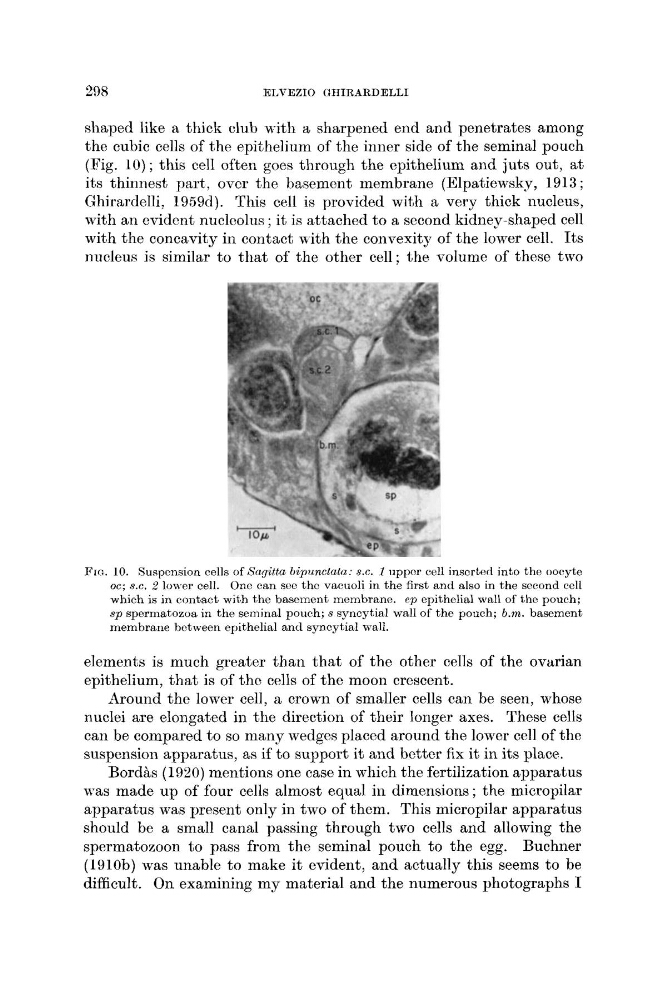
shaped like a thick club with a sharpened end and penetrates among
the cubic cells of the epithelium of the inner side of the seminal pouch
(Fig. 10) ; this cell often goes through the epithelium and juts out, at
its thinnest part, over the basement membrane (Elpatiewsky, 1913 ;
Ghirardelli. 1959d). This cell is provided with a very thick nucleus,
with an evident nucleolus ; it is attached to a second kidney-shaped cell
with the concavity in contact with the convexity of the lower cell. Its
nucleus is similar to that of the other cell; the volume of these two
FIG. 10. Suspension cells of Sagitta bipunctata: S. C. 7 uppcr cell inscrted into the oocyte
oc; S.C. 2 lower cell. One can see tho vacuoli in the first and also in the second cell
which is in contact with the basement membrane. ep epithelial wall of the pouch;
sp spermatozoa in the seminal pouch; s syncytial wall of the pouch; b.m. basement
membrane between epithelial and syncytial wall.
elements is much greater than that of the other cells of the ovarian
epithelium, that is of thc cells of the moon crescent.
Around the lower cell, a crown of smaller cells can be seen, whose
nuclei are elongated in the direction of their longer axes. These cells
can be compared to so many wedges placed around the lower cell of the
suspension apparatus, as if to support it and better fix it in its place.
BordAs (1920) ment,ions one case in which the fertilization apparatus
was made up of four cells almost equal in dimensions ; the micropilar
apparatus was present only in two of them. This micropilar apparatus
should be a small canal passing through two cells and allowing the
spermatozoon to pass from the seminal pouch to the egg. Buchner
(1910b) was unable to make it evident, and actually this seems to be
difficult. On examining my material and the numerous photographs I
ELVEZIO CHIRARDELLI
shaped like a thick club with a sharpened end and penetrates among
the cubic cells of the epithelium of the inner side of the seminal pouch
(Fig. 10) ; this cell often goes through the epithelium and juts out, at
its thinnest part, over the basement membrane (Elpatiewsky, 1913 ;
Ghirardelli. 1959d). This cell is provided with a very thick nucleus,
with an evident nucleolus ; it is attached to a second kidney-shaped cell
with the concavity in contact with the convexity of the lower cell. Its
nucleus is similar to that of the other cell; the volume of these two
FIG. 10. Suspension cells of Sagitta bipunctata: S. C. 7 uppcr cell inscrted into the oocyte
oc; S.C. 2 lower cell. One can see tho vacuoli in the first and also in the second cell
which is in contact with the basement membrane. ep epithelial wall of the pouch;
sp spermatozoa in the seminal pouch; s syncytial wall of the pouch; b.m. basement
membrane between epithelial and syncytial wall.
elements is much greater than that of the other cells of the ovarian
epithelium, that is of thc cells of the moon crescent.
Around the lower cell, a crown of smaller cells can be seen, whose
nuclei are elongated in the direction of their longer axes. These cells
can be compared to so many wedges placed around the lower cell of the
suspension apparatus, as if to support it and better fix it in its place.
BordAs (1920) ment,ions one case in which the fertilization apparatus
was made up of four cells almost equal in dimensions ; the micropilar
apparatus was present only in two of them. This micropilar apparatus
should be a small canal passing through two cells and allowing the
spermatozoon to pass from the seminal pouch to the egg. Buchner
(1910b) was unable to make it evident, and actually this seems to be
difficult. On examining my material and the numerous photographs I