

FAUNA AND FLORA O F MANGROVE SWAMPS
169
their habits is that they tend to be nocturnal, although they may
occasionally be seen during the day if it is cloudy and just after a high
spring tide.
Cardisonza carnqex occurs all round the Indo-west-Pacific in
suitable areas. The other Indo-Pacific species of the genus C. hirtipes
Dana occurs at a higher level and tends to be associated with freshwater
pools (Silas and Sankarankutty, 1960).
When the soil is heavy and clayey rather than sandy, and if it is
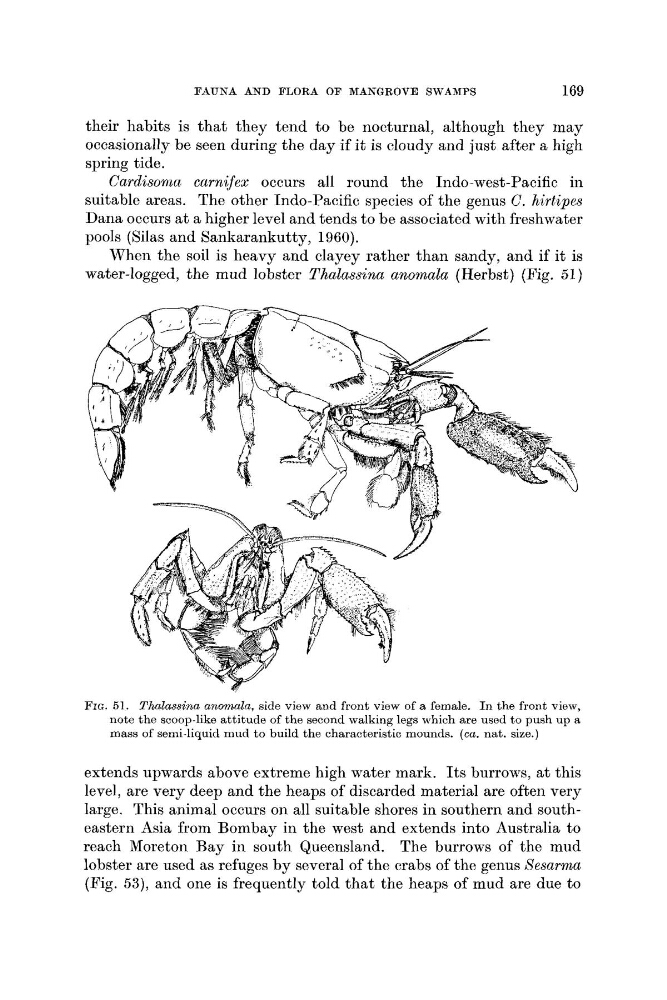
water-logged, the mud lobster Thalassina anomala (Herbst) (Fig. 51)
FIG. 51. Thalassina anornula, side view and front view of a female. I n the front view,
note the scoop-like attitude of the second walking legs which are used to push up a
mass of semi-liquid mud to build the characteristic mounds. (eu. nat. size.)
extends upwards above extreme high water mark. Its burrows, at this
level, are very deep and the heaps of discarded material are often very
large. This animal occurs on all suitable shores in southern and southeastern Asia from Bombay in the west and extends into Australia t o
reach Moreton Bay in south Queensland. The burrows of the mud
lobster are used as refuges by several of the crabs of the genus Sesarma
(Fig. 53), and one is frequently told that the heaps of mud are due to
169
their habits is that they tend to be nocturnal, although they may
occasionally be seen during the day if it is cloudy and just after a high
spring tide.
Cardisonza carnqex occurs all round the Indo-west-Pacific in
suitable areas. The other Indo-Pacific species of the genus C. hirtipes
Dana occurs at a higher level and tends to be associated with freshwater
pools (Silas and Sankarankutty, 1960).
When the soil is heavy and clayey rather than sandy, and if it is
water-logged, the mud lobster Thalassina anomala (Herbst) (Fig. 51)
FIG. 51. Thalassina anornula, side view and front view of a female. I n the front view,
note the scoop-like attitude of the second walking legs which are used to push up a
mass of semi-liquid mud to build the characteristic mounds. (eu. nat. size.)
extends upwards above extreme high water mark. Its burrows, at this
level, are very deep and the heaps of discarded material are often very
large. This animal occurs on all suitable shores in southern and southeastern Asia from Bombay in the west and extends into Australia t o
reach Moreton Bay in south Queensland. The burrows of the mud
lobster are used as refuges by several of the crabs of the genus Sesarma
(Fig. 53), and one is frequently told that the heaps of mud are due to