

168
WILLIAM MACNAE
around, sometimes those of land snails, such as species of Achatina,
sometimes cast up sea shells, are aIso terrestrial but seem t o be restricted
to the zone of the maritime scrub or of the barringtonia asiatica association. Species of Qeograpsus, a genus of land crabs, are of similar
habit.
On sandy shores just above extreme high water mark or between it
and that of ordinary spring tides the burrows may be found of Cardisoma
carnifex (Herbst). Very little is known about the habits of this crab
and nothing of its life history. They are large crabs, often more than
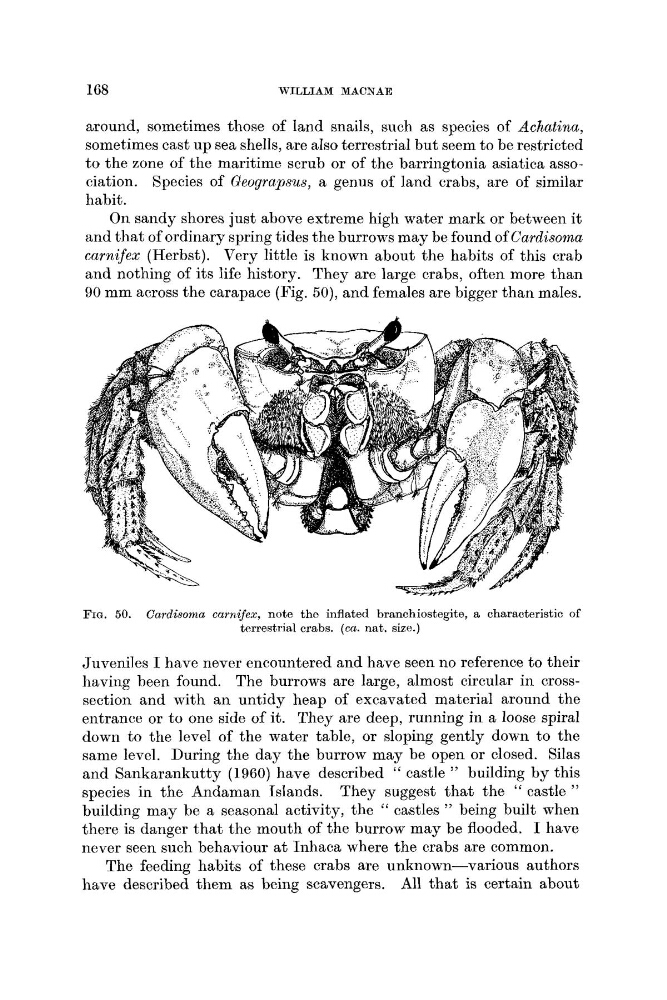
90 mm across the carapace (Fig. 50), and females are bigger than males.
FIG. 50. Cardisoma carnifex, note the inflated branchiostegite, a characteristic of
terrestrial crabs. (ca. nat. size.)
Juveniles I have never encountered and have seen no reference to their
having been found. The burrows are large, almost circular in crosssection and with an untidy heap of excavated material around the
entrance or to one side of it. They are deep, running in a loose spiral
down to the level of the water table, or sloping gently down to the
same level. During the day the burrow may be open or closed. Silas
and Sankarankutty (1960) have described ‘( castle ” building by this
species in the Andaman Islands. They suggest that the “ castle ”
building may be a seasonal activity, the ( ( castles ” being built when
there is danger that the mouth of the burrow may be flooded. I have
never seen such behaviour at Inhaca where the crabs are common.
The feeding habits of these crabs are unknown-various authors
have described them as being scavengers. All that is certain about
WILLIAM MACNAE
around, sometimes those of land snails, such as species of Achatina,
sometimes cast up sea shells, are aIso terrestrial but seem t o be restricted
to the zone of the maritime scrub or of the barringtonia asiatica association. Species of Qeograpsus, a genus of land crabs, are of similar
habit.
On sandy shores just above extreme high water mark or between it
and that of ordinary spring tides the burrows may be found of Cardisoma
carnifex (Herbst). Very little is known about the habits of this crab
and nothing of its life history. They are large crabs, often more than
90 mm across the carapace (Fig. 50), and females are bigger than males.
FIG. 50. Cardisoma carnifex, note the inflated branchiostegite, a characteristic of
terrestrial crabs. (ca. nat. size.)
Juveniles I have never encountered and have seen no reference to their
having been found. The burrows are large, almost circular in crosssection and with an untidy heap of excavated material around the
entrance or to one side of it. They are deep, running in a loose spiral
down to the level of the water table, or sloping gently down to the
same level. During the day the burrow may be open or closed. Silas
and Sankarankutty (1960) have described ‘( castle ” building by this
species in the Andaman Islands. They suggest that the “ castle ”
building may be a seasonal activity, the ( ( castles ” being built when
there is danger that the mouth of the burrow may be flooded. I have
never seen such behaviour at Inhaca where the crabs are common.
The feeding habits of these crabs are unknown-various authors
have described them as being scavengers. All that is certain about