

164
WILLIAM MACNAE
Polunin (personal communication) suggests that frequency of
flashing is temperature controlled. He mentions that considerable temperature variations have been shown t o occur a t night, simultaneously
at different distances from the ground in Malayan lowland forests.
What is the identity of the fireflies and their life cycle? I n Thailand,
near Singapore and in Borneo, the synchronous flashes are produced
- ? ! a
L L 7
"
6
"., "
" 1
s e
5
4 3
3
2
e
"
"
"
3 3
3
3
3
2
2
3
3
3
3
5
2
=
c
3
.
0
-
3
3
^
9
1
2
3
C
C
2
^
3
5
3
3
3
2
3
e
8
1 6
24
32
40 48
56
64
72
80
88
96 104
112
A 1
.A
16
#.
#...
6
,
.
n
h
#
.
A
l
r
a
"
"
I
"
I
"
I
"
-
a
-
Serial frame number
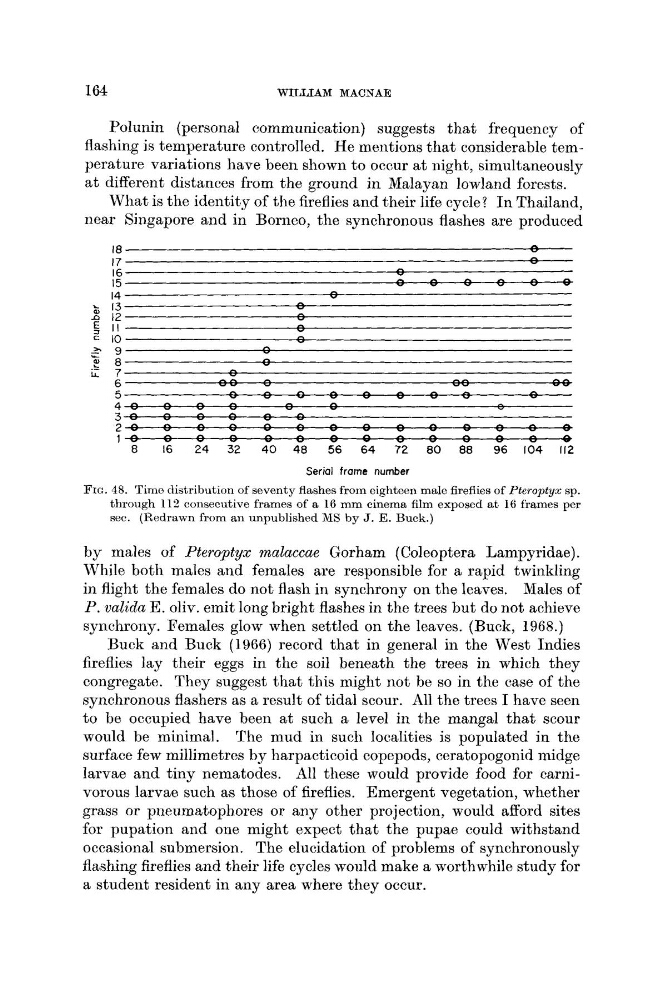
FIG. 48. Time distribution of seventy flashes from eighteen male fireflies of Pteroptyz sp.
through 112 consecutive frames of a 16 mm cinema film exposed at 16 frames per
sec. (Redrawn from an unpublished MS by J. E. Buck.)
by males of Pteroptyx malaccae Gorham (Coleoptera Lampyridae).
While both males and females are responsible for a rapid twinkling
in flight the females do not flash in synchrony on the leaves. Males of
P. valida E. oliv. emit long bright flashes in the trees but do not achieve
synchrony. Females glow when settled on the leaves. (Buck, 1968.)
Buck and Buck (19GG) record that in general in the West Indies
fireflies lay their eggs in the soil beneath the trees in which they
congregate. They suggest that this might not be so in the case of the
synchronous flashers as a result of tidal scour. All the trees I have seen
to be occupied have been a t such a level in the mangal that scour
would be minimal. The mud in such localities is populated in the
surface few millimetres by harpacticoid copepods, ceratopogonid midge
larvae and tiny nematodes. All these would provide food for carnivorous larvae such as those of fireflies. Emergent vegetation, whether
grass or pneumatophores or any other projection, would afford sites
for pupation and one might expect that the pupae could withstand
occasional submersion. The elucidation of problems of synchronously
flashing fireflies and their life cycles would make a worthwhile study for
a student resident in any area where they occur.
WILLIAM MACNAE
Polunin (personal communication) suggests that frequency of
flashing is temperature controlled. He mentions that considerable temperature variations have been shown t o occur a t night, simultaneously
at different distances from the ground in Malayan lowland forests.
What is the identity of the fireflies and their life cycle? I n Thailand,
near Singapore and in Borneo, the synchronous flashes are produced
- ? ! a
L L 7
"
6
"., "
" 1
s e
5
4 3
3
2
e
"
"
"
3 3
3
3
3
2
2
3
3
3
3
5
2
=
c
3
.
0
-
3
3
^
9
1
2
3
C
C
2
^
3
5
3
3
3
2
3
e
8
1 6
24
32
40 48
56
64
72
80
88
96 104
112
A 1
.A
16
#.
#...
6
,
.
n
h
#
.
A
l
r
a
"
"
I
"
I
"
I
"
-
a
-
Serial frame number
FIG. 48. Time distribution of seventy flashes from eighteen male fireflies of Pteroptyz sp.
through 112 consecutive frames of a 16 mm cinema film exposed at 16 frames per
sec. (Redrawn from an unpublished MS by J. E. Buck.)
by males of Pteroptyx malaccae Gorham (Coleoptera Lampyridae).
While both males and females are responsible for a rapid twinkling
in flight the females do not flash in synchrony on the leaves. Males of
P. valida E. oliv. emit long bright flashes in the trees but do not achieve
synchrony. Females glow when settled on the leaves. (Buck, 1968.)
Buck and Buck (19GG) record that in general in the West Indies
fireflies lay their eggs in the soil beneath the trees in which they
congregate. They suggest that this might not be so in the case of the
synchronous flashers as a result of tidal scour. All the trees I have seen
to be occupied have been a t such a level in the mangal that scour
would be minimal. The mud in such localities is populated in the
surface few millimetres by harpacticoid copepods, ceratopogonid midge
larvae and tiny nematodes. All these would provide food for carnivorous larvae such as those of fireflies. Emergent vegetation, whether
grass or pneumatophores or any other projection, would afford sites
for pupation and one might expect that the pupae could withstand
occasional submersion. The elucidation of problems of synchronously
flashing fireflies and their life cycles would make a worthwhile study for
a student resident in any area where they occur.