

9. THE CLASS CRUSTACEA
317
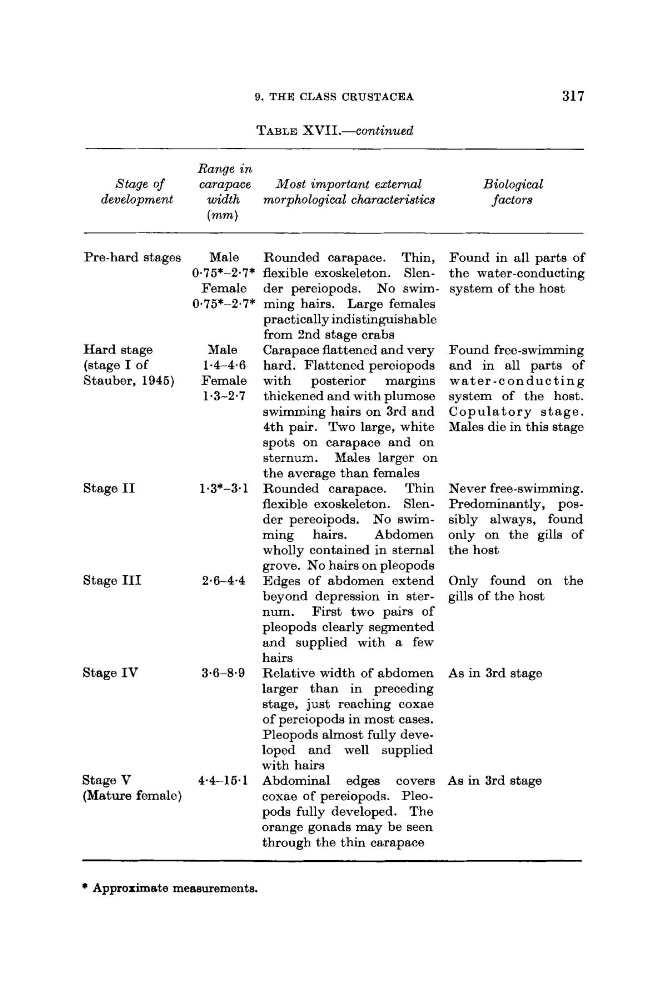
TABLE XVI1.-continued
Range in
Stage of
carapace
Most important external
Biological
development
width
morphological characteristics
factors
(mm)
Pre-hard stages
Male
Rounded carapace. Thin,
0*75*-2.7* flexible exoskeleton. SlenFemale der pereiopods. No swim0.75*-2*7* ming hairs. Large females
practically indistinguishable
from 2nd stage crabs
Hard stage
Male
Carapace flattened and very
(stage I of
1.4-4.6 hard. Flattened pereiopods
Stauber, 1945)
Female with posterior margins
1.3-2.7 thickened and with plumose
Stage I1
Stage I11
swimming hairs on 3rd and
4th pair. Two large, white
spots on carapace and on
sternum. Males larger on
the average than females
1.3*-3.1 Rounded carapace. Thin
flexible exoskeleton. Slender pereoipods. No swimming hairs.
Abdomen
wholly contained in sternal
grove. No hairs on pleopods
2.6-4.4
Edges of abdomen extend
beyond depression in sternum. First two pairs of
pleopods clearly segmented
and supplied with a few
Stage IV
hairs
3.6-84
Relative width of abdomen
larger than in preceding
stage, just reaching coxae
of pereiopods in most cases.
Pleopods almost fully developed and well supplied
with hairs
Stage V
4.4-15.1 Abdominal edges covers
(Mature female)
coxae of pereiopods. Pleopods fully developed. The
orange gonads may be seen
through the thin carapace
Found in all parts of
the water-conducting
system of the host
Found free-swimming
and in all parts of
w a t e r - c o n d u c t i n g
system of the host.
Copulatory stage.
Males die in this stage
Never free-swimming.
Predominantly, possibly always, found
only on the gills of
the host
Only found on the
gills of the host
As in 3rd stage
As in 3rd stage
* Approximate measurements.
317
TABLE XVI1.-continued
Range in
Stage of
carapace
Most important external
Biological
development
width
morphological characteristics
factors
(mm)
Pre-hard stages
Male
Rounded carapace. Thin,
0*75*-2.7* flexible exoskeleton. SlenFemale der pereiopods. No swim0.75*-2*7* ming hairs. Large females
practically indistinguishable
from 2nd stage crabs
Hard stage
Male
Carapace flattened and very
(stage I of
1.4-4.6 hard. Flattened pereiopods
Stauber, 1945)
Female with posterior margins
1.3-2.7 thickened and with plumose
Stage I1
Stage I11
swimming hairs on 3rd and
4th pair. Two large, white
spots on carapace and on
sternum. Males larger on
the average than females
1.3*-3.1 Rounded carapace. Thin
flexible exoskeleton. Slender pereoipods. No swimming hairs.
Abdomen
wholly contained in sternal
grove. No hairs on pleopods
2.6-4.4
Edges of abdomen extend
beyond depression in sternum. First two pairs of
pleopods clearly segmented
and supplied with a few
Stage IV
hairs
3.6-84
Relative width of abdomen
larger than in preceding
stage, just reaching coxae
of pereiopods in most cases.
Pleopods almost fully developed and well supplied
with hairs
Stage V
4.4-15.1 Abdominal edges covers
(Mature female)
coxae of pereiopods. Pleopods fully developed. The
orange gonads may be seen
through the thin carapace
Found in all parts of
the water-conducting
system of the host
Found free-swimming
and in all parts of
w a t e r - c o n d u c t i n g
system of the host.
Copulatory stage.
Males die in this stage
Never free-swimming.
Predominantly, possibly always, found
only on the gills of
the host
Only found on the
gills of the host
As in 3rd stage
As in 3rd stage
* Approximate measurements.