

316
MARINE MOLLUSCS AS HOSTS FOR SYMBIOSES
(Williams, 1965). According to Williams, its synonyms include P.
depresseum Say, 1817 and P. depressus Rathbun, 1918.
The combined contributions of Birge (1882), Hyman (1924),
Stauber (1945), Sandoz and Hopkins (1947) and Christensen and
McDermott (1958) have made this the best understood of all the species
of Pinnotheres. Due t o space limitations, it is not possible to give an
exhaustive treatment of all that is known about P. ostreum. Interested
readers are referred t,o the original papers cited for details.
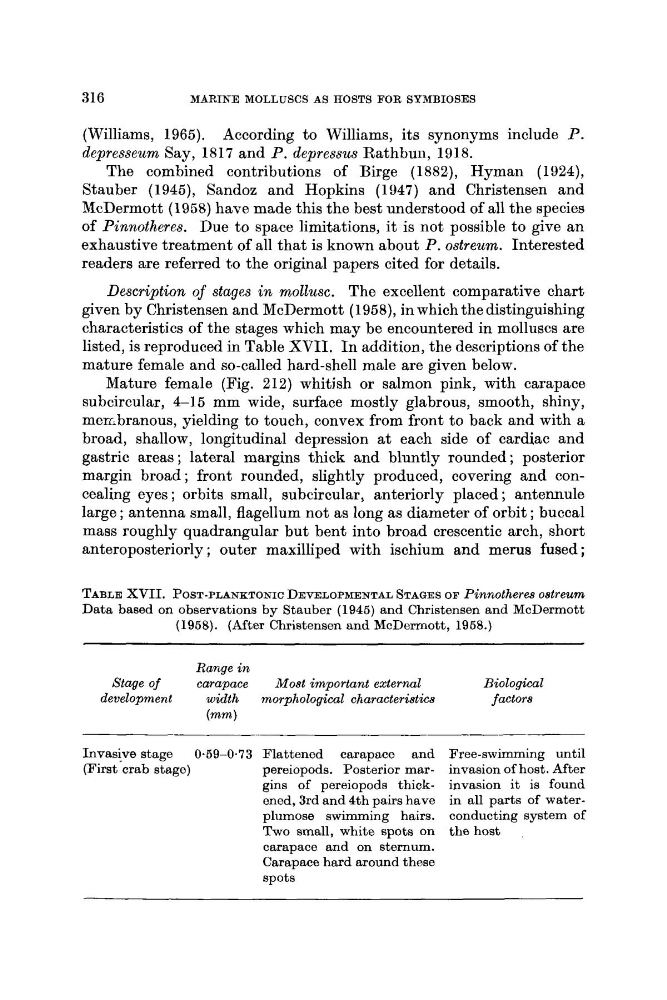
Description of stuges in mollusc. The excellent comparative chart
given by Christensen and McDermott (1958)) in which the distinguishing
characteristics of the stages which may be encountered in molluscs are
listed, is reproduced in Table XVII. In addition, the descriptions of the
mature female and so-called hard-shell male are given below.
Mature female (Fig. 212) whitish or salmon pink, with carapace
subcircular, 4-15 mm wide, surface mostly glabrous, smooth, shiny,
membranous, yielding to touch, convex from front to back and with a
broad, shallow, longitudinal depression at each side of cardiac and
gastric areas ; lateral margins thick and bluntly rounded ; posterior
margin broad ; front rounded, slightly produced, covering and concealing eyes ; orbits small, subcircular, anteriorly placed ; antennule
large ; antenna small, flagellum not as long as diameter of orbit ; buccal
mass roughly quadrangular but bent into broad crescentic arch, short
anteroposteriorly ; outer maxilliped with ischium and merus fused ;
TABLE XVII. POST-PLANKTONIC DEVELOPMENTAL STAGES OF Pinnotheres ostreum
Data based on observations by Stauber (1945) and Christensen and McDermott
(1958). (After Christensen and McDermott, 1958.)
Range in
Stage of
carapace
Most important external
Biological
development
width
morphological characteristics
factors
( m m )
Invasive stage 0-69-0.73 Flattened carapace and Free-swimming until
(First crab stage)
pereiopods. Posterior mar- invasion of host. After
gins of pereiopods thick- invasion it is found
ened, 3rd and 4th pairs have in all parts of waterplumose swimming hairs. conducting system of
Two small, white spots on the host
carapace and on sternum.
Carapace hard around these
spots
MARINE MOLLUSCS AS HOSTS FOR SYMBIOSES
(Williams, 1965). According to Williams, its synonyms include P.
depresseum Say, 1817 and P. depressus Rathbun, 1918.
The combined contributions of Birge (1882), Hyman (1924),
Stauber (1945), Sandoz and Hopkins (1947) and Christensen and
McDermott (1958) have made this the best understood of all the species
of Pinnotheres. Due t o space limitations, it is not possible to give an
exhaustive treatment of all that is known about P. ostreum. Interested
readers are referred t,o the original papers cited for details.
Description of stuges in mollusc. The excellent comparative chart
given by Christensen and McDermott (1958)) in which the distinguishing
characteristics of the stages which may be encountered in molluscs are
listed, is reproduced in Table XVII. In addition, the descriptions of the
mature female and so-called hard-shell male are given below.
Mature female (Fig. 212) whitish or salmon pink, with carapace
subcircular, 4-15 mm wide, surface mostly glabrous, smooth, shiny,
membranous, yielding to touch, convex from front to back and with a
broad, shallow, longitudinal depression at each side of cardiac and
gastric areas ; lateral margins thick and bluntly rounded ; posterior
margin broad ; front rounded, slightly produced, covering and concealing eyes ; orbits small, subcircular, anteriorly placed ; antennule
large ; antenna small, flagellum not as long as diameter of orbit ; buccal
mass roughly quadrangular but bent into broad crescentic arch, short
anteroposteriorly ; outer maxilliped with ischium and merus fused ;
TABLE XVII. POST-PLANKTONIC DEVELOPMENTAL STAGES OF Pinnotheres ostreum
Data based on observations by Stauber (1945) and Christensen and McDermott
(1958). (After Christensen and McDermott, 1958.)
Range in
Stage of
carapace
Most important external
Biological
development
width
morphological characteristics
factors
( m m )
Invasive stage 0-69-0.73 Flattened carapace and Free-swimming until
(First crab stage)
pereiopods. Posterior mar- invasion of host. After
gins of pereiopods thick- invasion it is found
ened, 3rd and 4th pairs have in all parts of waterplumose swimming hairs. conducting system of
Two small, white spots on the host
carapace and on sternum.
Carapace hard around these
spots