

6. THE PHYLA PORIFERA, CNIDARIA AND PLATYHELMINTHES
261
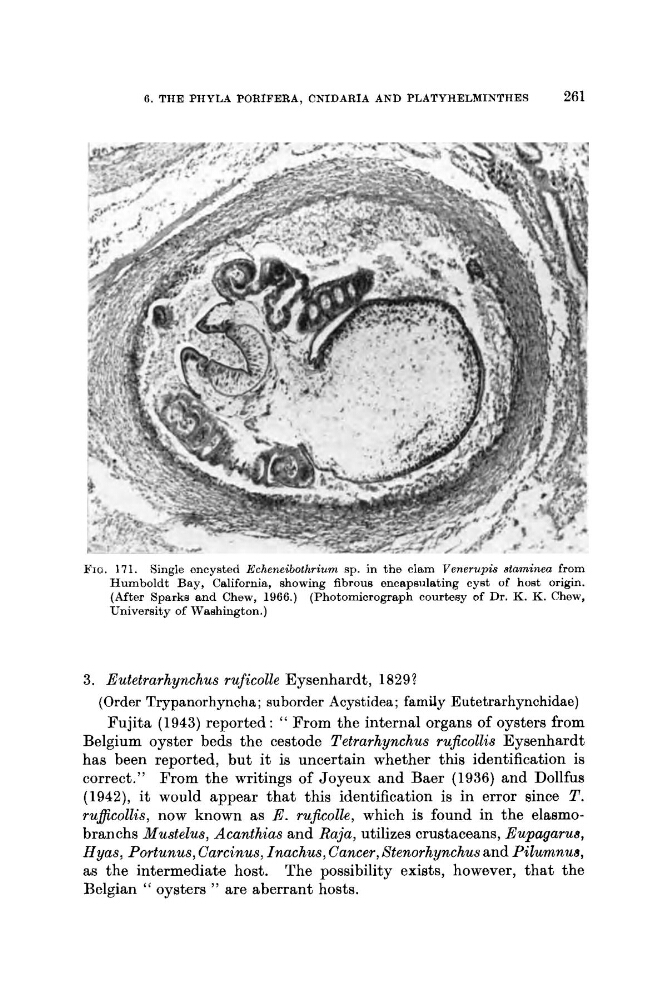
PIG. 171. Single encysted Eeheneibothrium sp. in the clam Ven,erupis stamilzetl from
Humboldt Bay, California, showing fibrous encapsulating cyst of host origin.
(After Sparks and Chew, 1966.) (Photomicrograph courtesy of Dr. K. K. Chew,
University of Washington.)
3. Eutetrarhynchus ruficolle Eysenhardt, 1829‘2
(Order Trypanorhyncha; suborder Acystidea; family Eutetrarhynchidae)
Fujita (1943) reported : “ From the internal organs of oysters from
Belgium oyster beds the cestode Tetrarhynchus rujicollis Eysenhardt
has been reported, but it is uncertain whether this identification is
correct.” From the writings of Joyeux and Baer (1936) and Dollfus
(1942), it would appear that this identification is in error since T.
ruficollis, now known as E. rujicolle, which is found in the elasmobranchs Mustelus, Acanthias and Raja, utilizes crustaceans, Eupagarus,
Hyas, Portunus, Carcinus, Inachus, Cancer, Stenorhynchus and Pilurnnus,
as the intermediate host. The possibility exists, however, that the
Belgian “ oysters ” are aberrant hosts.
261
PIG. 171. Single encysted Eeheneibothrium sp. in the clam Ven,erupis stamilzetl from
Humboldt Bay, California, showing fibrous encapsulating cyst of host origin.
(After Sparks and Chew, 1966.) (Photomicrograph courtesy of Dr. K. K. Chew,
University of Washington.)
3. Eutetrarhynchus ruficolle Eysenhardt, 1829‘2
(Order Trypanorhyncha; suborder Acystidea; family Eutetrarhynchidae)
Fujita (1943) reported : “ From the internal organs of oysters from
Belgium oyster beds the cestode Tetrarhynchus rujicollis Eysenhardt
has been reported, but it is uncertain whether this identification is
correct.” From the writings of Joyeux and Baer (1936) and Dollfus
(1942), it would appear that this identification is in error since T.
ruficollis, now known as E. rujicolle, which is found in the elasmobranchs Mustelus, Acanthias and Raja, utilizes crustaceans, Eupagarus,
Hyas, Portunus, Carcinus, Inachus, Cancer, Stenorhynchus and Pilurnnus,
as the intermediate host. The possibility exists, however, that the
Belgian “ oysters ” are aberrant hosts.