

6. THE PHYLA PORIFERA, CNIDARIA AND PLATYHELMINTHES
257
The intramolluscan larva of Tylocephalum could be considered a procercoid
although a distinct myzorhynchus, a holdfast organ, is present and hence
it is further along in its development than the typical procercoid. On the
other hand, this larva develops from the coracidium and hence is not a
plerocercoid according to the definition of Wardle and McLeod (1952). Until
the complete life cycle of this cestode is known, the intra-molluscan larva
is referred to herein as the metacestode according to the definition of Wardle
and McLeod (1 952).
I n recent years, Tylocephalum metacestodes have been reported
from the American oyster, Crassostrea virginica, from Pearl Harbor,
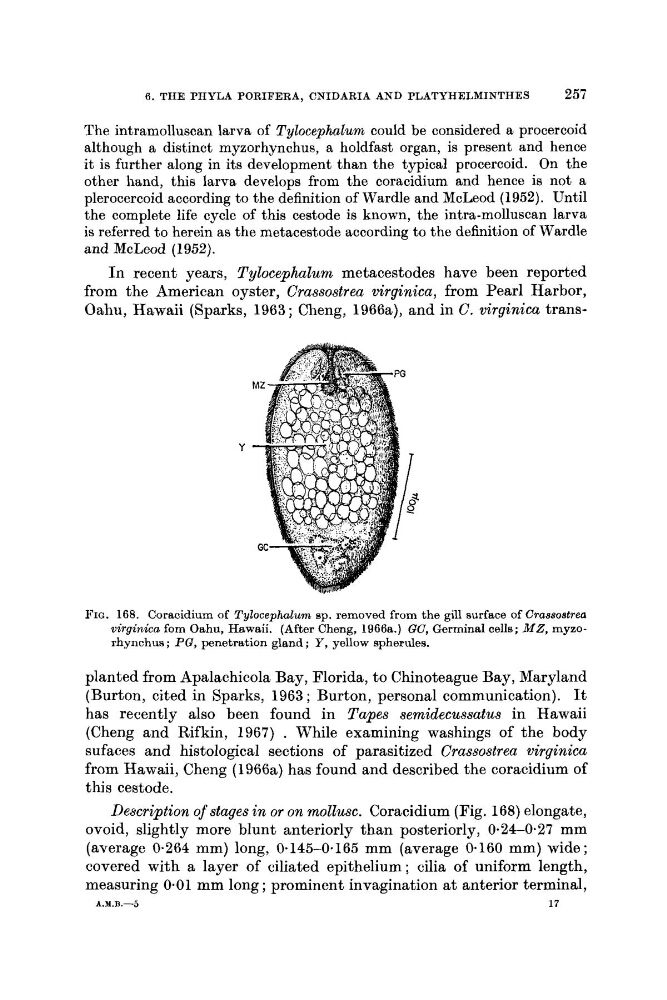
Oahu, Hawaii (Sparks, 1963 ; Cheng, 1966a), and in C . virginica transFIG. 168. Coracidium of Tylocephalum sp. removed from the gill surface of Crassostrea
wirginica fom Oahu, Hawaii. (After Cheng, 19661%) GC, Germinal cells; M Z , myzorhynchus ; PG, penetration gland ; Y , yellow spherules.
planted from Apalachicola Bay, Florida, to Chinoteague Bay, Maryland
(Burton, cited in Sparks, 1963 ; Burton, personal communication). It
has recently also been found in Tapes semidecussatus in Hawaii
(Cheng and Rifkin, 1967) . While examining washings of the body
sufaces and histological sections of parasitized Crassostrea virginica
from Hawaii, Cheng (1966a) has found and described the coracidium of
this cestode.
Description of stages in or on mollusc. Coracidium (Fig. 168) elongate,
ovoid, slightly more blunt anteriorly than posteriorly, 0.24-0.27 mm
(average 0.264 mm) long, 0.145-0.165 mm (average 0-160 mm) wide;
covered with a layer of ciliated epithelium; cilia of uniform length,
measuring 0.01 mm long ; prominent invagination a t anterior terminal,
A.M.B.-5
17
257
The intramolluscan larva of Tylocephalum could be considered a procercoid
although a distinct myzorhynchus, a holdfast organ, is present and hence
it is further along in its development than the typical procercoid. On the
other hand, this larva develops from the coracidium and hence is not a
plerocercoid according to the definition of Wardle and McLeod (1952). Until
the complete life cycle of this cestode is known, the intra-molluscan larva
is referred to herein as the metacestode according to the definition of Wardle
and McLeod (1 952).
I n recent years, Tylocephalum metacestodes have been reported
from the American oyster, Crassostrea virginica, from Pearl Harbor,
Oahu, Hawaii (Sparks, 1963 ; Cheng, 1966a), and in C . virginica transFIG. 168. Coracidium of Tylocephalum sp. removed from the gill surface of Crassostrea
wirginica fom Oahu, Hawaii. (After Cheng, 19661%) GC, Germinal cells; M Z , myzorhynchus ; PG, penetration gland ; Y , yellow spherules.
planted from Apalachicola Bay, Florida, to Chinoteague Bay, Maryland
(Burton, cited in Sparks, 1963 ; Burton, personal communication). It
has recently also been found in Tapes semidecussatus in Hawaii
(Cheng and Rifkin, 1967) . While examining washings of the body
sufaces and histological sections of parasitized Crassostrea virginica
from Hawaii, Cheng (1966a) has found and described the coracidium of
this cestode.
Description of stages in or on mollusc. Coracidium (Fig. 168) elongate,
ovoid, slightly more blunt anteriorly than posteriorly, 0.24-0.27 mm
(average 0.264 mm) long, 0.145-0.165 mm (average 0-160 mm) wide;
covered with a layer of ciliated epithelium; cilia of uniform length,
measuring 0.01 mm long ; prominent invagination a t anterior terminal,
A.M.B.-5
17