

168
MARINE MOLLUSCS AS HOSTS FOR SYMBIOSES
This extremely low incidence of spores leads us to suspect, however, that
they are not M . nelsoni spores but rather indicate double infections as
discussed by Canzonier (1963). Since late 1958 all attempts to transfer
infection to healthy oysters in the laboratory have failed. Failures in
effecting transmission and rarity of oysters with sporulation stages point
strongly to an alternate or reservoir host for the parasite.
The primary reason why the sporulating and spores stages given
above are being given serious consideration herein is because Barrow
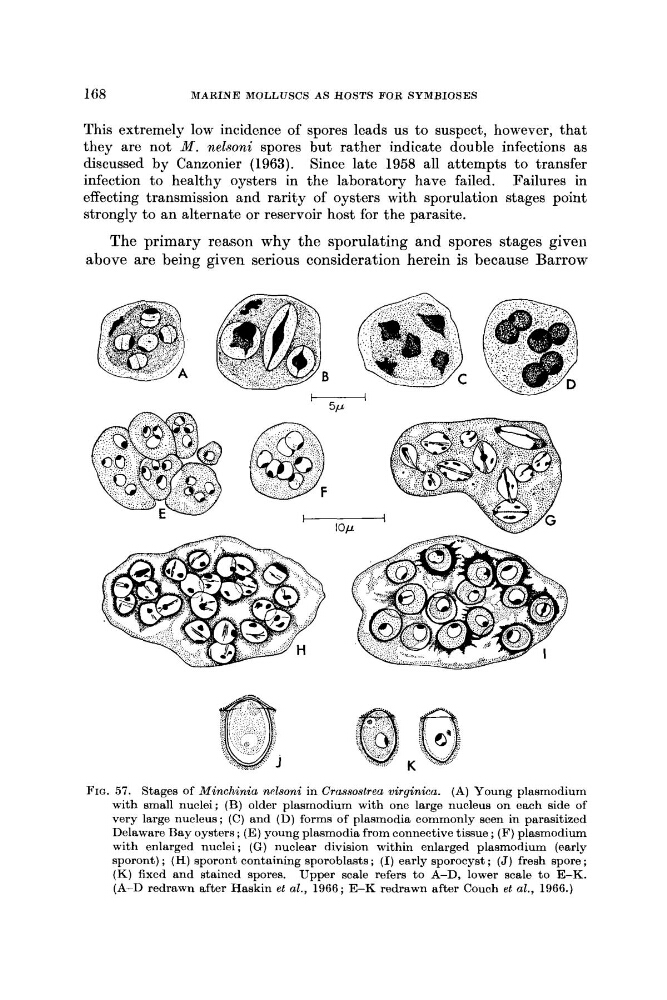
FIG. 57. Stages of Minchinia nrlsoni in Crassostrea virginica. (A) Young plasmodium
with small nuclei; (B) older plasmodium with one large nucleus on each side of
very large nucleus; (C) and (D) forms of plasmodia commonly seen in parasitized
Delaware Bay oysters ; (E) young plasmodia from connective tissue ; (F) plasmodium
with enlarged nuclei ; (G) nuclear division within enlarged plasmodium (early
sporont) ; (H) sporont containing sporoblasts ; (I) early sporocyst ; (J) fresh spore ;
(K) fixed and stained spores. Upper scale refers to A-D, lower scale to E-K.
(A-D redrawn after Haskin et al., 1966; E-K redrawn after Couch et al., 1966.)
MARINE MOLLUSCS AS HOSTS FOR SYMBIOSES
This extremely low incidence of spores leads us to suspect, however, that
they are not M . nelsoni spores but rather indicate double infections as
discussed by Canzonier (1963). Since late 1958 all attempts to transfer
infection to healthy oysters in the laboratory have failed. Failures in
effecting transmission and rarity of oysters with sporulation stages point
strongly to an alternate or reservoir host for the parasite.
The primary reason why the sporulating and spores stages given
above are being given serious consideration herein is because Barrow
FIG. 57. Stages of Minchinia nrlsoni in Crassostrea virginica. (A) Young plasmodium
with small nuclei; (B) older plasmodium with one large nucleus on each side of
very large nucleus; (C) and (D) forms of plasmodia commonly seen in parasitized
Delaware Bay oysters ; (E) young plasmodia from connective tissue ; (F) plasmodium
with enlarged nuclei ; (G) nuclear division within enlarged plasmodium (early
sporont) ; (H) sporont containing sporoblasts ; (I) early sporocyst ; (J) fresh spore ;
(K) fixed and stained spores. Upper scale refers to A-D, lower scale to E-K.
(A-D redrawn after Haskin et al., 1966; E-K redrawn after Couch et al., 1966.)