

5 . THE PHYLUM PROTOZOA
143
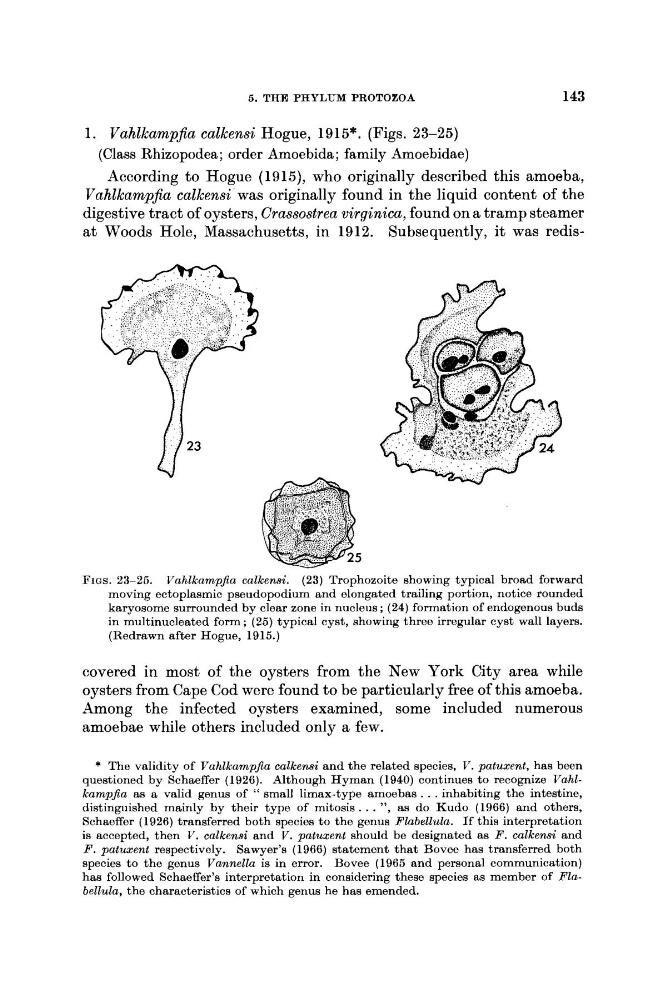
1. Vahlkampjia calkensi Hogue, 1915*. (Figs. 23-25)
(Class Rhizopodea; order Amoebida; family Amoebidae)
According to Hogue (1915), who originally described this amoeba,
Vahlkampjia calkensi was originally found in the liquid content of the
digestive tract of oysters, Crassostrea virginica, found on a tramp steamer
a t Woods Hole, Massachusetts, in 1912. Subsequently, it was redisFIGS. 23-26. Vahlkampfia calkensi. (23) Trophozoite showing typical broad forward
moving ectoplasmic pseudopodium and elongated trailing portion, notice rounded
karyosome surrounded by clear zone in nucleus ; (24) formation of endogenous buds
in multinucleated form ; (25) typical cyst, showing three irregular cyst wall layers.
(Redrawn after Hogue, 1915.)
covered in most of the oysters from the New York City area while
oysters from Cape Cod were found to be particularly free of this amoeba.
Among the infected oysters examined, some included numerous
amoebae while others included only a few.
* The validity of Vahlkampfia calkensi and the related species, V . patuxent, has been
questioned by Schaeffer (1926). Although Hyman (1940) continues to recognize Vahlkampfia as a valid genus of ‘‘ small limax-type amoebas. . . inhabiting the intestine,
distinguished mainly by their type of mitosis. . . ”, as do Kudo (1966) and others,
Schaeffer (1926) transferred both species to the genus FlabelZulu. If this interpretation
is accepted, then V . calkensi and V . patuxent should be designated as F. calkensi and
P. patuzent respectively. Sawyer’s (1966) statement that Bovee has transferred both
species to the genus Vannella is in error. Bovee (1966 and personal communication)
has followed Schaeffer’s interpretation in considering these species as member of Flubellula, the characteristics of which genus he has emended.
143
1. Vahlkampjia calkensi Hogue, 1915*. (Figs. 23-25)
(Class Rhizopodea; order Amoebida; family Amoebidae)
According to Hogue (1915), who originally described this amoeba,
Vahlkampjia calkensi was originally found in the liquid content of the
digestive tract of oysters, Crassostrea virginica, found on a tramp steamer
a t Woods Hole, Massachusetts, in 1912. Subsequently, it was redisFIGS. 23-26. Vahlkampfia calkensi. (23) Trophozoite showing typical broad forward
moving ectoplasmic pseudopodium and elongated trailing portion, notice rounded
karyosome surrounded by clear zone in nucleus ; (24) formation of endogenous buds
in multinucleated form ; (25) typical cyst, showing three irregular cyst wall layers.
(Redrawn after Hogue, 1915.)
covered in most of the oysters from the New York City area while
oysters from Cape Cod were found to be particularly free of this amoeba.
Among the infected oysters examined, some included numerous
amoebae while others included only a few.
* The validity of Vahlkampfia calkensi and the related species, V . patuxent, has been
questioned by Schaeffer (1926). Although Hyman (1940) continues to recognize Vahlkampfia as a valid genus of ‘‘ small limax-type amoebas. . . inhabiting the intestine,
distinguished mainly by their type of mitosis. . . ”, as do Kudo (1966) and others,
Schaeffer (1926) transferred both species to the genus FlabelZulu. If this interpretation
is accepted, then V . calkensi and V . patuxent should be designated as F. calkensi and
P. patuzent respectively. Sawyer’s (1966) statement that Bovee has transferred both
species to the genus Vannella is in error. Bovee (1966 and personal communication)
has followed Schaeffer’s interpretation in considering these species as member of Flubellula, the characteristics of which genus he has emended.