

142
MARINE MOLLUSCS AS HOSTS FOR SYMBIOSES
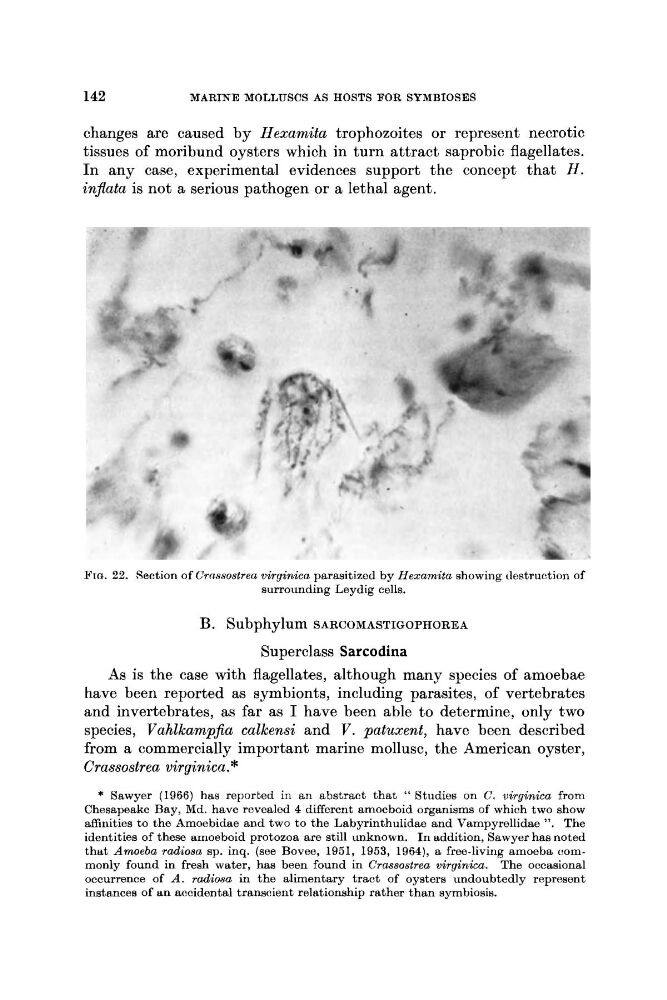
changes are caused by Hexarrhita trophozoites or represent necrotic
tissues of moribund oysters which in turn attract saprobic flagellates.
I n any case, experimental evidences support the concept that H .
inJlata is not a serious pathogen or a lethal agent.
FIG. 22. Section of Crnssostrea virginiea parasitized by Hexamita showing destruction of
surrounding Leydig cells.
B. Subphylum SARCOMASTIGOPHOREA
Superclass Sarcodina
As is the case with flagellates, although many species of amoebae
have been reported as symbionts, including parasites, of vertebrates
and invertebrates, as far as I have been able to determine, only t,wo
species, Vahlkampjia calkensi and V . patuxent, have been described
from a commercially important marine mollusc, the American oyster,
Crassostrea virginica."
* Sawyer (1966) has reported in an abstract that '' Studies on G. virginica from
Chesapeake Bay, Md. have revealed 4 different amoeboid organisms of which two show
affinities to the Amoebidae and two to the Labyrinthulidae and Vampyrellidae ". The
identities of these amoeboid protozoa are still unknown. I n addition, Sawyer has noted
that Amoeba radiosa sp. inq. (see Bovee, 1951, 1953, 1964), a free-living amoeba commonly found in fresh water, has been found in Crassostrea virginica. The occasional
occurrence of A . radiosa in the alimentary tract of oysters undoubtedly represent
instances of an accidental transcient relationship rather than symbiosis.
MARINE MOLLUSCS AS HOSTS FOR SYMBIOSES
changes are caused by Hexarrhita trophozoites or represent necrotic
tissues of moribund oysters which in turn attract saprobic flagellates.
I n any case, experimental evidences support the concept that H .
inJlata is not a serious pathogen or a lethal agent.
FIG. 22. Section of Crnssostrea virginiea parasitized by Hexamita showing destruction of
surrounding Leydig cells.
B. Subphylum SARCOMASTIGOPHOREA
Superclass Sarcodina
As is the case with flagellates, although many species of amoebae
have been reported as symbionts, including parasites, of vertebrates
and invertebrates, as far as I have been able to determine, only t,wo
species, Vahlkampjia calkensi and V . patuxent, have been described
from a commercially important marine mollusc, the American oyster,
Crassostrea virginica."
* Sawyer (1966) has reported in an abstract that '' Studies on G. virginica from
Chesapeake Bay, Md. have revealed 4 different amoeboid organisms of which two show
affinities to the Amoebidae and two to the Labyrinthulidae and Vampyrellidae ". The
identities of these amoeboid protozoa are still unknown. I n addition, Sawyer has noted
that Amoeba radiosa sp. inq. (see Bovee, 1951, 1953, 1964), a free-living amoeba commonly found in fresh water, has been found in Crassostrea virginica. The occasional
occurrence of A . radiosa in the alimentary tract of oysters undoubtedly represent
instances of an accidental transcient relationship rather than symbiosis.