

REVIEW OF THE SYSTEMATICS AND ECOLOGY OF OCEANIC SQUIDS
261
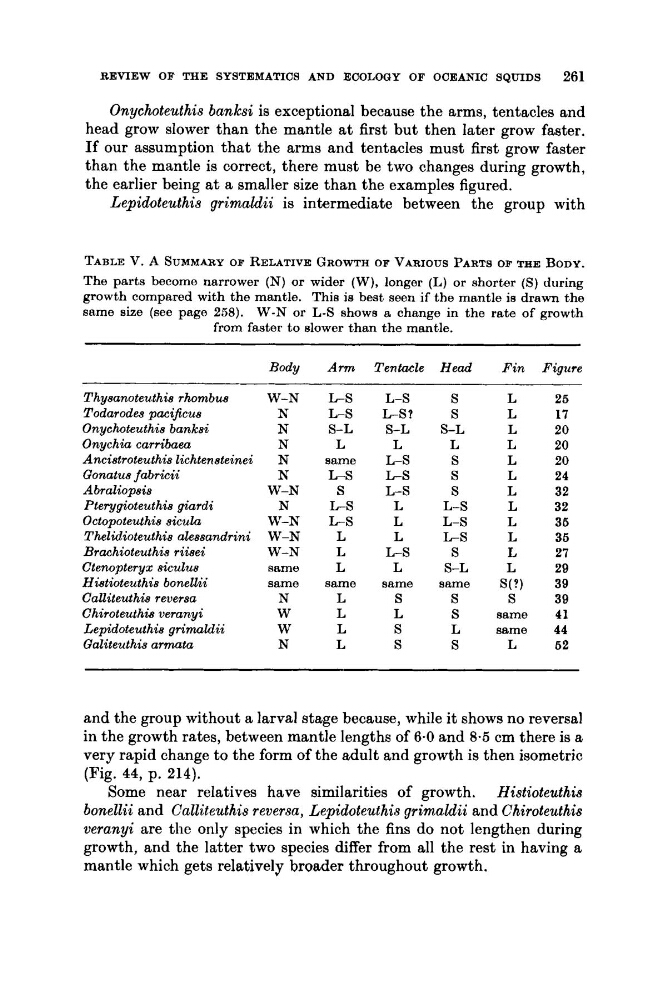
Onychoteuthis banksi is exceptional because the arms, tentacles and
head grow slower than the mantle a t first but then later grow faster.
If our assumption that the arms and tentacles must first grow faster
than the mantle is correct, there must be two changes during growth,
the earlier being a t a smaller size than the examples figured.
Lepidoteuthis grimaldii is intermediate between the group with
TABLE V. A SUMMARY OF RELATIVE GROWTH OF VARIOUS PARTS OF THE BODY.
The parts become narrower (N) or wider (W), longer (L) or shorter (S) during
growth compared with the mantle. This is best seen if the mantle is drawn the
same size (see page 258). W-N or L-S shows a change in the rate of growth
from faster to slower than the mantle.
~
Thysanoteu.this rhombus
Todarodes paci$cus
Onychoteuthis banksi
Onychia carribaea
Ancistroteuthis lichtensteinei
Ghatus fabricii
Abraliopsis
Pterygioteuthis giardi
Octopoteuthis sicula
Thelidioteuthie alessandrini
Brachioteuthis riisei
Ctenopteryx siculus
Histioteuthis bonellii
Calliteuthis reversa
Chiroteuthb veranyi
Lepidoteuthis grimaldii
Galiteuthis armata
Body
Arm Tentacle
W-N
G S
L-S
N
L-s
L S ?
N
s-L
s-L
N
L
L
N
same
L-S
N
L-s
L-S
W-N
S
L-s
N
G S
L
W-N
G S
L
W-N
L
L
W-N
L
L-s
same
L
L
same
same
same
N
L
S
W
L
L
W
L
S
N
L
S
Head
S
S
s-L
L
S
S
S
L-s
L-s
L-S
S
s-L
same
S
S
L
S
~~
~
Fin Figure
L
25
L
17
L
20
L
20
L
20
L
24
L
32
L
32
L
36
L
35
L
27
L
29
S(?)
39
S
39
same
41
same
44
L
62
and the group without a larval stage because, while it shows no reversal
in the growth rates, between mantle lengths of 6.0 and 8.6 cm there is a
very rapid change to the form of the adult and growth is then isometric
(Fig. 44, p. 214).
Histioteuthis
bonellii and Calliteuthis reversa, Lepidoteuthis grimaldii and Chiroteuthis
veranyi are the only species in which the fins do not Iengthen during
growth, and the latter two species differ from all the rest in having a
mantle which gets relatively broader throughout growth.
Some near relatives have similarities of growth.
261
Onychoteuthis banksi is exceptional because the arms, tentacles and
head grow slower than the mantle a t first but then later grow faster.
If our assumption that the arms and tentacles must first grow faster
than the mantle is correct, there must be two changes during growth,
the earlier being a t a smaller size than the examples figured.
Lepidoteuthis grimaldii is intermediate between the group with
TABLE V. A SUMMARY OF RELATIVE GROWTH OF VARIOUS PARTS OF THE BODY.
The parts become narrower (N) or wider (W), longer (L) or shorter (S) during
growth compared with the mantle. This is best seen if the mantle is drawn the
same size (see page 258). W-N or L-S shows a change in the rate of growth
from faster to slower than the mantle.
~
Thysanoteu.this rhombus
Todarodes paci$cus
Onychoteuthis banksi
Onychia carribaea
Ancistroteuthis lichtensteinei
Ghatus fabricii
Abraliopsis
Pterygioteuthis giardi
Octopoteuthis sicula
Thelidioteuthie alessandrini
Brachioteuthis riisei
Ctenopteryx siculus
Histioteuthis bonellii
Calliteuthis reversa
Chiroteuthb veranyi
Lepidoteuthis grimaldii
Galiteuthis armata
Body
Arm Tentacle
W-N
G S
L-S
N
L-s
L S ?
N
s-L
s-L
N
L
L
N
same
L-S
N
L-s
L-S
W-N
S
L-s
N
G S
L
W-N
G S
L
W-N
L
L
W-N
L
L-s
same
L
L
same
same
same
N
L
S
W
L
L
W
L
S
N
L
S
Head
S
S
s-L
L
S
S
S
L-s
L-s
L-S
S
s-L
same
S
S
L
S
~~
~
Fin Figure
L
25
L
17
L
20
L
20
L
20
L
24
L
32
L
32
L
36
L
35
L
27
L
29
S(?)
39
S
39
same
41
same
44
L
62
and the group without a larval stage because, while it shows no reversal
in the growth rates, between mantle lengths of 6.0 and 8.6 cm there is a
very rapid change to the form of the adult and growth is then isometric
(Fig. 44, p. 214).
Histioteuthis
bonellii and Calliteuthis reversa, Lepidoteuthis grimaldii and Chiroteuthis
veranyi are the only species in which the fins do not Iengthen during
growth, and the latter two species differ from all the rest in having a
mantle which gets relatively broader throughout growth.
Some near relatives have similarities of growth.