

260
MALCOLM R. CLARKE
fabricii, Abraliopsis, Pterygioteuthis giardi, Octopoteuthis sicula, Thelidioteuthis nlessandrini some of the dimensions considered a t first
increase faster than the mantle length but then their rate of growth
falls behind that of the mantle length. I n the early juvenile the young
arms and tentacles must be formed by their growth being faster than
that of the mantle so that if, in later life, the structure becomes smaller
Cumulative
I
2 0
4 0
6 0
8 0
100
Mantle lenqth
(cm)
- -
% .
5 0
2 0
4 0
6 0
8 0
100
Mantle lenqth
(cm)
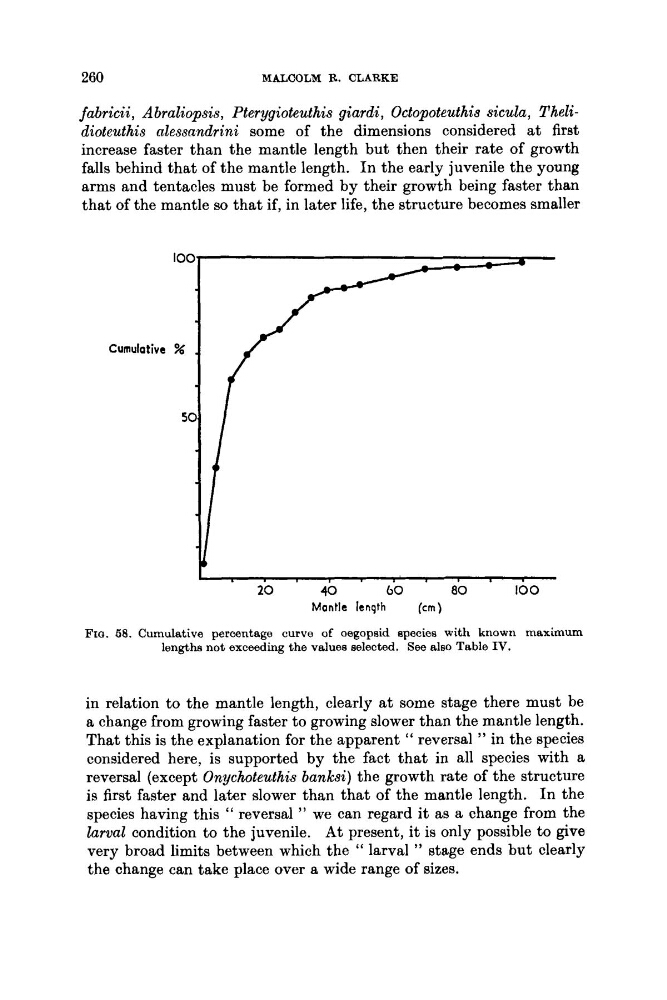
Fro. 58. Cumulative percentage curve of oegopsid species with known maximum
lengths not exceeding the values selected. See also Table IV.
in relation to the mantle length, clearly a t some stage there must be
a change from growing faster to growing slower than the mantle length.
That this is the explanation for the apparent ‘( reversal ” in the species
considered here, is supported by the fact that in all species with a
reversal (except Onychoteuthis banksi) the growth rate of the structure
is first faster and later slower than that of the mantle length. I n the
species having this “ reversal ” we can regard it as a change from the
larval condition to the juvenile. At present, it is only possible to give
very broad limits between which the ‘( larval ” stage ends but clearly
the change can take place over a wide range of sizes.
MALCOLM R. CLARKE
fabricii, Abraliopsis, Pterygioteuthis giardi, Octopoteuthis sicula, Thelidioteuthis nlessandrini some of the dimensions considered a t first
increase faster than the mantle length but then their rate of growth
falls behind that of the mantle length. I n the early juvenile the young
arms and tentacles must be formed by their growth being faster than
that of the mantle so that if, in later life, the structure becomes smaller
Cumulative
I
2 0
4 0
6 0
8 0
100
Mantle lenqth
(cm)
- -
% .
5 0
2 0
4 0
6 0
8 0
100
Mantle lenqth
(cm)
Fro. 58. Cumulative percentage curve of oegopsid species with known maximum
lengths not exceeding the values selected. See also Table IV.
in relation to the mantle length, clearly a t some stage there must be
a change from growing faster to growing slower than the mantle length.
That this is the explanation for the apparent ‘( reversal ” in the species
considered here, is supported by the fact that in all species with a
reversal (except Onychoteuthis banksi) the growth rate of the structure
is first faster and later slower than that of the mantle length. I n the
species having this “ reversal ” we can regard it as a change from the
larval condition to the juvenile. At present, it is only possible to give
very broad limits between which the ‘( larval ” stage ends but clearly
the change can take place over a wide range of sizes.