

DISEASES OF MARlNE FISHES
15
infections and, beyond a certain dosage, the appearance of acute
infections (Sindermann, 1963). Experimental epizootics that have
been produccd in large sea water aquaria duplicate many of the events
observed in nature. Herring varied individually in responses to
identical spore doses ; some acquired acute infections, some acquired
chronic infections, aiid some remained uninfected.
A more complex life cycle for Zchthyophonus has been described from
mackerel by Sproston (1944). This is the only study in which indications of sexual reproduction, in the form of liyphal fusions, were
observed. Other authors have described the occasional appearance of
conidia-like bodies, and the occurrence of macro- aiid micro-hyphae.
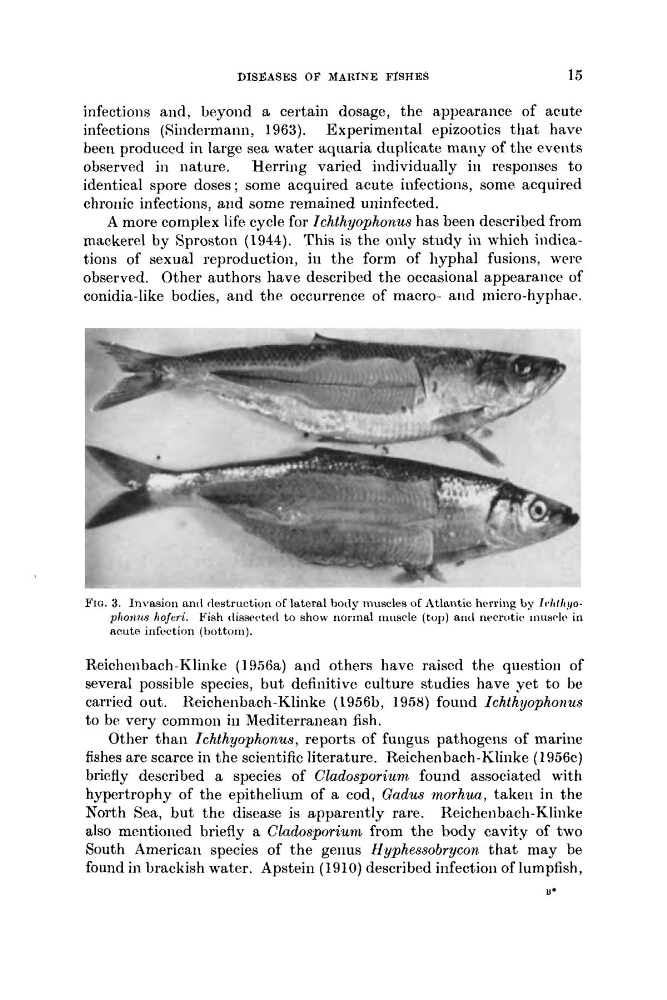
F I G . 3. Invasion ant1 destruction of lateral body niuscles of Atlantic herring by Ic.hl/t!loplromrs h o j c ~ i . Fish dissected t o show tiorinal muscle (top) and necrotic inriaclc in
acute infection (bottom).
Reiclienbach-Iilinke ( 1 9Fi6a) aiid others have raised the question of
several possible species, but definitive culture studies have yet to be
carried out. Reichenbach-Klinke (1956b, 1958) found Ichthyophonm
to be very comnion in Mediterranean fish.
Other than Zchthyophonus, reports of fungus pathogens of marine
fishes are scarce in the scientific literature. Reichenbach-Klinke ( 1 9 5 6 ~ )
briefly described a species of Cladosporium found associated with
hypertrophy of the epithelium of a cod, Gadus morhua, taken in the
North Sea, but the disease is apparently rare. Reichenbach-Klinke
also mentioned briefly a Cladosporium from the body cavity of two
South American species of the genus Hyphessobrycon that may be
found in brackish water. Apstein (1910) described infection of lumpfish,
L I '
15
infections and, beyond a certain dosage, the appearance of acute
infections (Sindermann, 1963). Experimental epizootics that have
been produccd in large sea water aquaria duplicate many of the events
observed in nature. Herring varied individually in responses to
identical spore doses ; some acquired acute infections, some acquired
chronic infections, aiid some remained uninfected.
A more complex life cycle for Zchthyophonus has been described from
mackerel by Sproston (1944). This is the only study in which indications of sexual reproduction, in the form of liyphal fusions, were
observed. Other authors have described the occasional appearance of
conidia-like bodies, and the occurrence of macro- aiid micro-hyphae.
F I G . 3. Invasion ant1 destruction of lateral body niuscles of Atlantic herring by Ic.hl/t!loplromrs h o j c ~ i . Fish dissected t o show tiorinal muscle (top) and necrotic inriaclc in
acute infection (bottom).
Reiclienbach-Iilinke ( 1 9Fi6a) aiid others have raised the question of
several possible species, but definitive culture studies have yet to be
carried out. Reichenbach-Klinke (1956b, 1958) found Ichthyophonm
to be very comnion in Mediterranean fish.
Other than Zchthyophonus, reports of fungus pathogens of marine
fishes are scarce in the scientific literature. Reichenbach-Klinke ( 1 9 5 6 ~ )
briefly described a species of Cladosporium found associated with
hypertrophy of the epithelium of a cod, Gadus morhua, taken in the
North Sea, but the disease is apparently rare. Reichenbach-Klinke
also mentioned briefly a Cladosporium from the body cavity of two
South American species of the genus Hyphessobrycon that may be
found in brackish water. Apstein (1910) described infection of lumpfish,
L I '