

124
MALCOLM R. CLARKE
period probably extends from February to October and the main
hatching takes place from March to November (Mangold-Wirz, 1963b).
Mangold-Wirz considers that the catch at any time can be arranged in
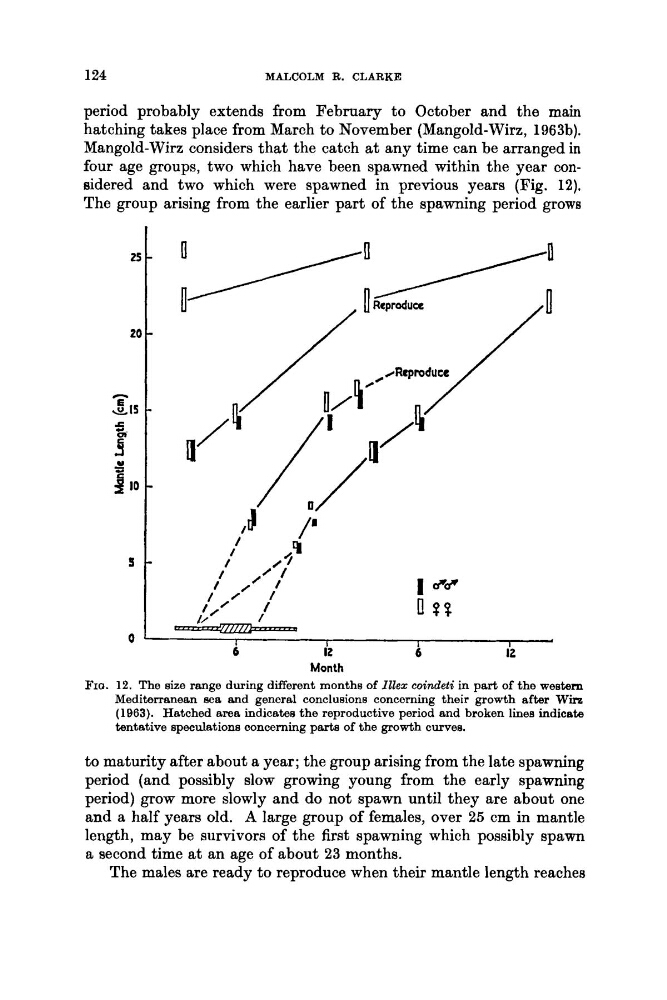
four age groups, two which have been spawned within the year considered and two which were spawned in previous years (Fig. 12).
The group arising from the earlier part of the spawning period grows
I
I
I
I
6
I2
6
12
Month
FIG. 12. The size range during different months of Illex coindeti in part of the western
Mediterranean sea and general conclusions concerning their growth after Wire
(1963). Hatched area indicates the reproductive period and broken lines indicate
tentative speculations concerning parts of the growth curves.
to maturity after about a year; the group arising from the late spawning
period (and possibly slow growing young from the early spawning
period) grow more slowly and do not spawn until they are about one
and a half years old. A large group of females, over 25 cm in mantle
length, may be survivors of the first spawning which possibly spawn
a second time at an age of about 23 months.
The males are ready to reproduce when their mantle length reaches
MALCOLM R. CLARKE
period probably extends from February to October and the main
hatching takes place from March to November (Mangold-Wirz, 1963b).
Mangold-Wirz considers that the catch at any time can be arranged in
four age groups, two which have been spawned within the year considered and two which were spawned in previous years (Fig. 12).
The group arising from the earlier part of the spawning period grows
I
I
I
I
6
I2
6
12
Month
FIG. 12. The size range during different months of Illex coindeti in part of the western
Mediterranean sea and general conclusions concerning their growth after Wire
(1963). Hatched area indicates the reproductive period and broken lines indicate
tentative speculations concerning parts of the growth curves.
to maturity after about a year; the group arising from the late spawning
period (and possibly slow growing young from the early spawning
period) grow more slowly and do not spawn until they are about one
and a half years old. A large group of females, over 25 cm in mantle
length, may be survivors of the first spawning which possibly spawn
a second time at an age of about 23 months.
The males are ready to reproduce when their mantle length reaches