

REVIEW OF THE SYSTEMATICS AND ECOLOGY OF OCEANIC SQUIDS
105
0 . bartrami which are certainly different from 0. caroli and 0. pteropus.
This problem can only be resolved by a study of the Ommastrephes
species living in the western North Atlantic t o determine whether it is
identical with 0. caroli or 0. pteropus. If it should prove the same as
either, then the name 0. bartrami would take priority and another
name would have to be found for the Pacific so-called 0. bartrami.
With these reservations we can now consider the known distribution
of the three species.
0. caroli was described from a head and two females stranded in
Portugal; the mantles measured 57-0 cm and 61.0 cm in length (Furtado,
1887). Since then, a number of similarly large specimens have been
recorded, usually after stranding, from the British Isles (Goodrich,
70 F
W A U L MANTLE LENGTH em
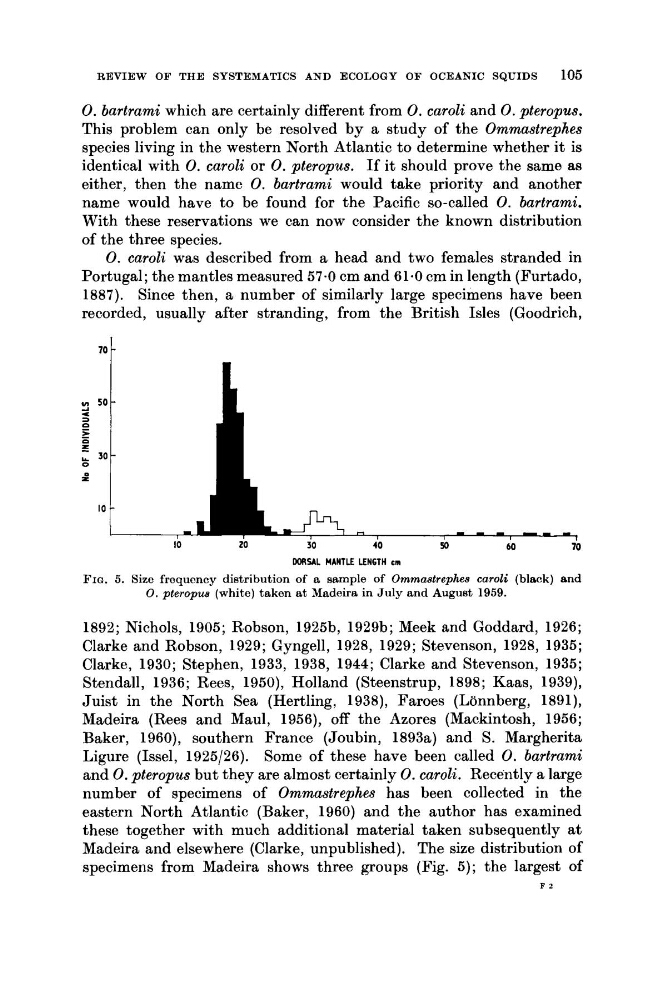
FIG. 5. Size frequency distribution of a sample of Ornmastrephea caroli (black) and
0. pteropus (white) taken at Madeira, in July and August 1959.
1892; Nichols, 1905; Robson, 1925b, 192913; Meek and Goddard, 1926;
Clarke and Robson, 1929; Gyngell, 1928, 1929; Stevenson, 1928, 1935;
Clarke, 1930; Stephen, 1933, 1938, 1944; Clarke and Stevenson, 1935;
Stendall, 1936; Rees, 1950), Holland (Steenstrup, 1898; Kaas, 1939),
Juist in the North Sea (Hertling, 1938), Faroes (Liinnberg, 1891),
Madeira (Rees and Maul, 1956), off the Azores (Mackintosh, 1956;
Baker, 1960), southern France (Joubin, 1893a) and S. Margherita
Ligure (Issel, 1925126). Some of these have been called 0. bartrami
and 0. pteropus but they are almost certainly 0. caroli. Recently a large
number of specimens of Ommastrephes has been collected in the
eastern North Atlantic (Baker, 1960) and the author has examined
these together with much additional material taken subsequently at
Madeira and elsewhere (Clarke, unpublished). The size distribution of
specimens from Madeira shows three groups (Fig. 5); the largest of
F 2
105
0 . bartrami which are certainly different from 0. caroli and 0. pteropus.
This problem can only be resolved by a study of the Ommastrephes
species living in the western North Atlantic t o determine whether it is
identical with 0. caroli or 0. pteropus. If it should prove the same as
either, then the name 0. bartrami would take priority and another
name would have to be found for the Pacific so-called 0. bartrami.
With these reservations we can now consider the known distribution
of the three species.
0. caroli was described from a head and two females stranded in
Portugal; the mantles measured 57-0 cm and 61.0 cm in length (Furtado,
1887). Since then, a number of similarly large specimens have been
recorded, usually after stranding, from the British Isles (Goodrich,
70 F
W A U L MANTLE LENGTH em
FIG. 5. Size frequency distribution of a sample of Ornmastrephea caroli (black) and
0. pteropus (white) taken at Madeira, in July and August 1959.
1892; Nichols, 1905; Robson, 1925b, 192913; Meek and Goddard, 1926;
Clarke and Robson, 1929; Gyngell, 1928, 1929; Stevenson, 1928, 1935;
Clarke, 1930; Stephen, 1933, 1938, 1944; Clarke and Stevenson, 1935;
Stendall, 1936; Rees, 1950), Holland (Steenstrup, 1898; Kaas, 1939),
Juist in the North Sea (Hertling, 1938), Faroes (Liinnberg, 1891),
Madeira (Rees and Maul, 1956), off the Azores (Mackintosh, 1956;
Baker, 1960), southern France (Joubin, 1893a) and S. Margherita
Ligure (Issel, 1925126). Some of these have been called 0. bartrami
and 0. pteropus but they are almost certainly 0. caroli. Recently a large
number of specimens of Ommastrephes has been collected in the
eastern North Atlantic (Baker, 1960) and the author has examined
these together with much additional material taken subsequently at
Madeira and elsewhere (Clarke, unpublished). The size distribution of
specimens from Madeira shows three groups (Fig. 5); the largest of
F 2