

EFFECTS OF HEATED EFFLUENTS
69
tures like other physical factors fluctuate to a greater extent in estuaries
than in the sea (Kinne, 1963; Hedgpeth, 1957; Moore, 1958; Naylor
and Slinn, 1958 ; Tarzwell, 1962). Thamdrup (1935), for instance,
showed that optimal temperatures for respiration were higher in uppershore and brackish-water species than in lower-shore forms where less
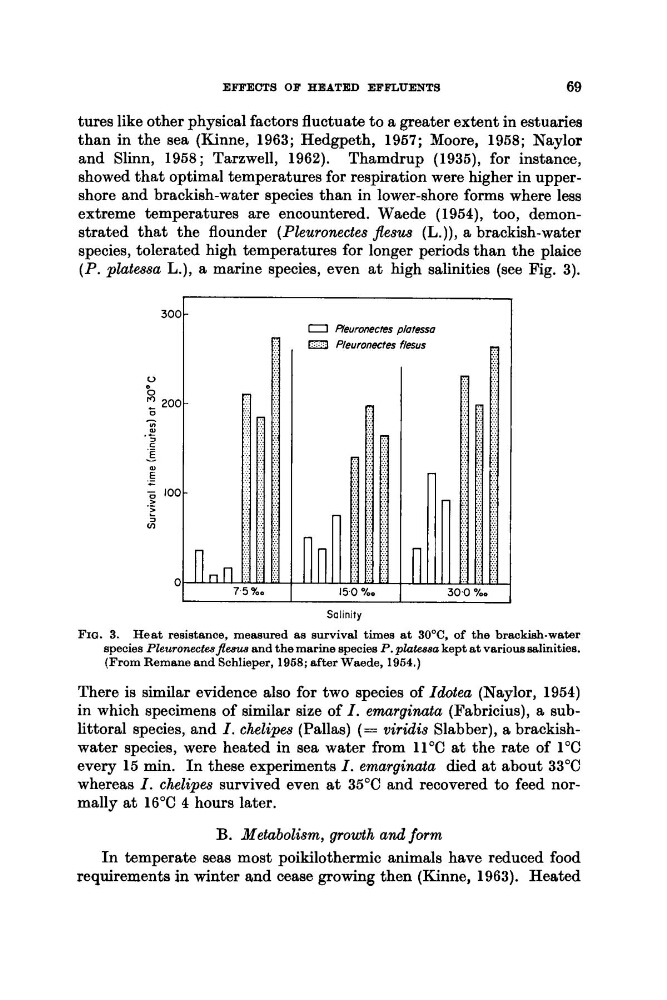
extreme temperatures are encountered. Waede (1954), too, demonstrated that the flounder (Pleuronectes Jesus (L.)), a brackish-water
species, tolerated high temperatures for longer periods than the plaice
( P . platessa L.), a marine species, even at high salinities (see Fig. 3).
300t
0 Pleuronectes ploresso
1 3 Pleuronectes News
Iln
150%.
I
30.0 %e
I
Salinity
Heat resistance, measured as survival times at 30°C, of the brackish-water
species PleuronectesflaPwr and the marine species P . platesaa kept at various salinities.
(From Remane and Schlieper, 1968; after Waede, 1964.)
FIG. 3.
There is similar evidence also for two species of Idotea (Naylor, 1954)
in which specimens of similar size of I . emarginuta (Fabricius), a sublittoral species, and I . chelipes (Pallas) (= viridis Slabber), a brackishwater species, were heated in sea water from 11°C at the rate of 1°C
every 15 min. I n these experiments I . emarginuta died at about 33°C
whereas I . chelipes survived even at 35OC and recovered to feed normally at 16°C 4 hours later.
B. Metabolism, growth and form
I n temperate seas most poikilothermic animals have reduced food
requirements in winter and cease growing then (Kinne, 1963). Heated
69
tures like other physical factors fluctuate to a greater extent in estuaries
than in the sea (Kinne, 1963; Hedgpeth, 1957; Moore, 1958; Naylor
and Slinn, 1958 ; Tarzwell, 1962). Thamdrup (1935), for instance,
showed that optimal temperatures for respiration were higher in uppershore and brackish-water species than in lower-shore forms where less
extreme temperatures are encountered. Waede (1954), too, demonstrated that the flounder (Pleuronectes Jesus (L.)), a brackish-water
species, tolerated high temperatures for longer periods than the plaice
( P . platessa L.), a marine species, even at high salinities (see Fig. 3).
300t
0 Pleuronectes ploresso
1 3 Pleuronectes News
Iln
150%.
I
30.0 %e
I
Salinity
Heat resistance, measured as survival times at 30°C, of the brackish-water
species PleuronectesflaPwr and the marine species P . platesaa kept at various salinities.
(From Remane and Schlieper, 1968; after Waede, 1964.)
FIG. 3.
There is similar evidence also for two species of Idotea (Naylor, 1954)
in which specimens of similar size of I . emarginuta (Fabricius), a sublittoral species, and I . chelipes (Pallas) (= viridis Slabber), a brackishwater species, were heated in sea water from 11°C at the rate of 1°C
every 15 min. I n these experiments I . emarginuta died at about 33°C
whereas I . chelipes survived even at 35OC and recovered to feed normally at 16°C 4 hours later.
B. Metabolism, growth and form
I n temperate seas most poikilothermic animals have reduced food
requirements in winter and cease growing then (Kinne, 1963). Heated