

68
E. NAYLOR
5o -
I
- P .
?
-
e
-
2 405
-
c
W
(u
o
c
-
2
30 -
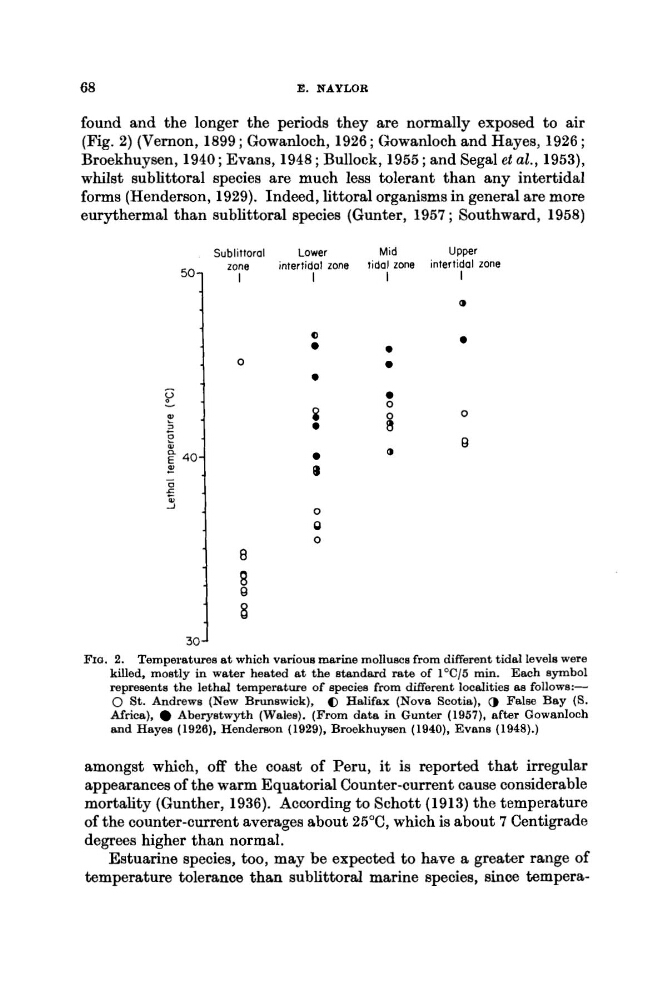
found and the longer the periods they are normally exposed to air
(Fig. 2) (Vernon, 1899; Gowanloch, 1926; Gowanloch and Hayes, 1926;
Broekhuysen, 1940; Evans, 1948; Bullock, 1955; and Segal et aZ., 1953),
whilst sublittoral species are much less tolerant than any intertidal
forms (Henderson, 1929). Indeed, littoral organisms in general are more
eurythermal than sublittoral species (Gunter, 1957 ; Southward, 1958)
zone
intertidol zone
tidal zone intertidal zone
I
I
I
I
a
0
8
Q
8
8
0
a
8
8
0
0
0
a
0
Q
0
0
amongst which, off the coast of Peru, it is reported that irregular
appearances of the warm Equatorial Counter-current cause considerable
mortality (Gunther, 1936). According to Schott (1913) the temperature
of the counter-current averages about 25"C, which is about 7 Centigrade
degrees higher than normal.
Estuarine species, too, may be expected to have a greater range of
temperature tolerance than sublittoral marine species, since temperaFIO. 2. Temperatures a t which various marine molluscs from different tidal levels were
killed, mostly in water heated at the standard rate of loC/5 min. Each symbol
represents the lethal temperature of species from different localities as follows:0 St. Andrews (New Brunswick), (> Halifax (Nova Scotia), @ False Bay (S.
Africa),
Aberystwyth (Wales). (From data in Gunter (1957), after Gowanloch
and Hayes (1926), Henderson (1929). Broekhuysen (1940), Evans (1948).)
E. NAYLOR
5o -
I
- P .
?
-
e
-
2 405
-
c
W
(u
o
c
-
2
30 -
found and the longer the periods they are normally exposed to air
(Fig. 2) (Vernon, 1899; Gowanloch, 1926; Gowanloch and Hayes, 1926;
Broekhuysen, 1940; Evans, 1948; Bullock, 1955; and Segal et aZ., 1953),
whilst sublittoral species are much less tolerant than any intertidal
forms (Henderson, 1929). Indeed, littoral organisms in general are more
eurythermal than sublittoral species (Gunter, 1957 ; Southward, 1958)
zone
intertidol zone
tidal zone intertidal zone
I
I
I
I
a
0
8
Q
8
8
0
a
8
8
0
0
0
a
0
Q
0
0
amongst which, off the coast of Peru, it is reported that irregular
appearances of the warm Equatorial Counter-current cause considerable
mortality (Gunther, 1936). According to Schott (1913) the temperature
of the counter-current averages about 25"C, which is about 7 Centigrade
degrees higher than normal.
Estuarine species, too, may be expected to have a greater range of
temperature tolerance than sublittoral marine species, since temperaFIO. 2. Temperatures a t which various marine molluscs from different tidal levels were
killed, mostly in water heated at the standard rate of loC/5 min. Each symbol
represents the lethal temperature of species from different localities as follows:0 St. Andrews (New Brunswick), (> Halifax (Nova Scotia), @ False Bay (S.
Africa),
Aberystwyth (Wales). (From data in Gunter (1957), after Gowanloch
and Hayes (1926), Henderson (1929). Broekhuysen (1940), Evans (1948).)