

LEARNING BY MARINE INVER!I!EBRATES
43
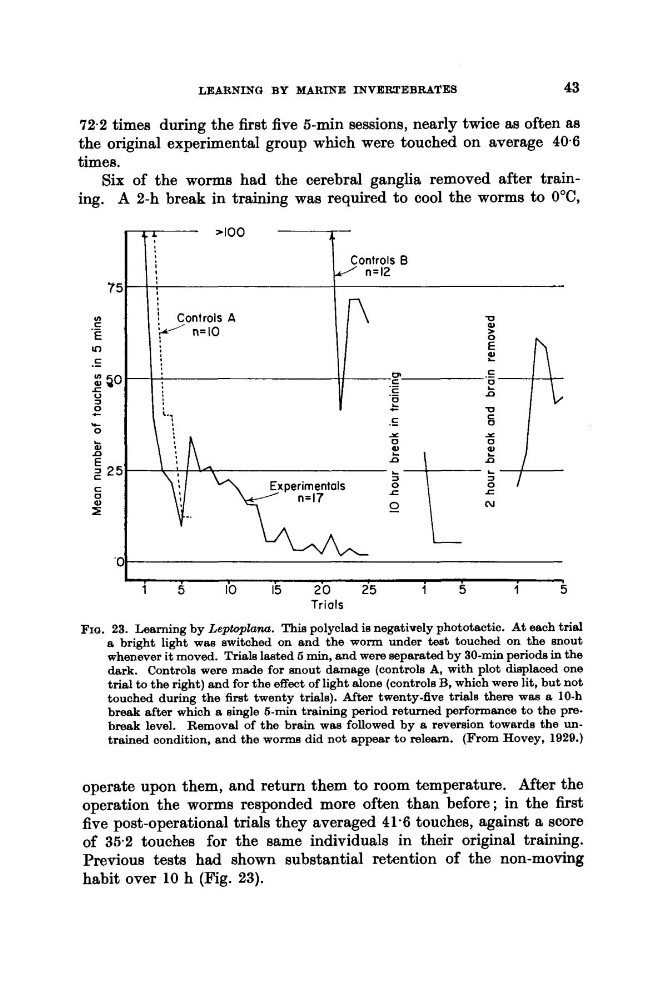
72.2 times during the first five 5-min sessions, nearly twice as often as
the original experimental group which were touched on average 40.6
times.
Six of the worms had the cerebral ganglia removed after training. A 2-h break in training was required to cool the worms to O'C,
I ,
I
1
5
(0
I5
2.0
25
1
5
1
5
Trials
Fro. 23. Learning by Leptoplana. This polyclad is negatively phototactic. At each trial
a bright light was switched on and the worm under test touched on the snout
whenever it moved. Trials lasted 5 min, and were separated by 30-min periods in the
dark. Controls were made for snout damage (controls A, with plot displaced one
trial to the right) and for the effect of light alone (controls B, which were lit, but not
touched during the first twenty trials). After twenty-five trials there was a 10-h
break after which a single 5-min training period returned performance to the pmbreak level. Removal of the brain was followed by a reversion towards the untrained condition, and the worms did not appear to relearn. (From Hovey, 1929.)
operate upon them, and return them to room temperature. After the
operation the worms responded more often than before; in the first
five post-operational trials they averaged 41.6 touches, against a score
of 35.2 touches for the same individuals in their original training.
Previous tests had shown substantial retention of the non-moving
habit over 10 h (Fig. 23).
43
72.2 times during the first five 5-min sessions, nearly twice as often as
the original experimental group which were touched on average 40.6
times.
Six of the worms had the cerebral ganglia removed after training. A 2-h break in training was required to cool the worms to O'C,
I ,
I
1
5
(0
I5
2.0
25
1
5
1
5
Trials
Fro. 23. Learning by Leptoplana. This polyclad is negatively phototactic. At each trial
a bright light was switched on and the worm under test touched on the snout
whenever it moved. Trials lasted 5 min, and were separated by 30-min periods in the
dark. Controls were made for snout damage (controls A, with plot displaced one
trial to the right) and for the effect of light alone (controls B, which were lit, but not
touched during the first twenty trials). After twenty-five trials there was a 10-h
break after which a single 5-min training period returned performance to the pmbreak level. Removal of the brain was followed by a reversion towards the untrained condition, and the worms did not appear to relearn. (From Hovey, 1929.)
operate upon them, and return them to room temperature. After the
operation the worms responded more often than before; in the first
five post-operational trials they averaged 41.6 touches, against a score
of 35.2 touches for the same individuals in their original training.
Previous tests had shown substantial retention of the non-moving
habit over 10 h (Fig. 23).