

28
M. J. WELLS
r 6V. dr. shocks
(a)
lb)
(C)
I I D ' . . 5.0 . ' . . 100 ' *
Trjals
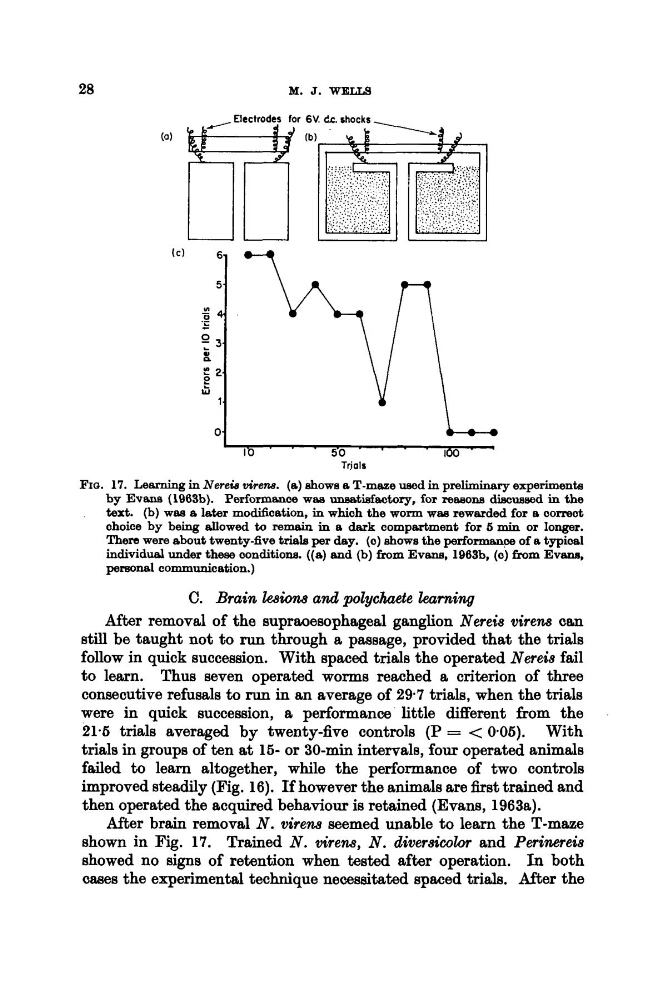
FIG. 17. Leaxning i n Nereb virena. (a) shows a T-maze used in preliminary experiments
by Evans (1963b). Performance waa unsatisffaotory, for reaeona discweed i n the
text. (b) was a later modiiication, in which the worm waa rewarded for a correct
ohoice by being allowed to remain in a dark compartment for 6 min or longer.
There were about twenty-five trials per day. ( 0 ) shows the performanpe of a typical
individual under these conditions. ((a) and (b) from Evens, 1963b, ( 0 ) from Evens,
personal communication.)
C . Brain lesions and polychuete learning
After removal of the supraoesophageal ganglion Nereis virens can
still be taught not to run through a passage, provided that the trials
follow in quick succession. With spaced trials the operated Nereis fail
to learn. Thus seven operated worms reached a criterion of three
consecutive refusals to run in an average of 29.7 trials, when the trials
were in quick succession, a performance little different from the
21.6 trials averaged by twenty-five controls (P = < 0.06). With
trials in groups of ten at 16- or 30-min intervals, four operated animals
failed to learn altogether, while the performance of two controls
improved steadily (Fig. 16). If however the animals are &st trained and
then operated the acquired behaviour is retained (Evans, 1963a).
After brain removal N . virew seemed unable to learn the T-maae
shown in Fig. 17. Trained N. virens, N. diversicolor and Perinereis
showed no signs of retention when tested after operation. In both
cases the experimental technique necessitated spaced trials. After the
M. J. WELLS
r 6V. dr. shocks
(a)
lb)
(C)
I I D ' . . 5.0 . ' . . 100 ' *
Trjals
FIG. 17. Leaxning i n Nereb virena. (a) shows a T-maze used in preliminary experiments
by Evans (1963b). Performance waa unsatisffaotory, for reaeona discweed i n the
text. (b) was a later modiiication, in which the worm waa rewarded for a correct
ohoice by being allowed to remain in a dark compartment for 6 min or longer.
There were about twenty-five trials per day. ( 0 ) shows the performanpe of a typical
individual under these conditions. ((a) and (b) from Evens, 1963b, ( 0 ) from Evens,
personal communication.)
C . Brain lesions and polychuete learning
After removal of the supraoesophageal ganglion Nereis virens can
still be taught not to run through a passage, provided that the trials
follow in quick succession. With spaced trials the operated Nereis fail
to learn. Thus seven operated worms reached a criterion of three
consecutive refusals to run in an average of 29.7 trials, when the trials
were in quick succession, a performance little different from the
21.6 trials averaged by twenty-five controls (P = < 0.06). With
trials in groups of ten at 16- or 30-min intervals, four operated animals
failed to learn altogether, while the performance of two controls
improved steadily (Fig. 16). If however the animals are &st trained and
then operated the acquired behaviour is retained (Evans, 1963a).
After brain removal N . virew seemed unable to learn the T-maae
shown in Fig. 17. Trained N. virens, N. diversicolor and Perinereis
showed no signs of retention when tested after operation. In both
cases the experimental technique necessitated spaced trials. After the