

LEARNING BY MARINE RYVERTEBRATES
27
into the wrong arm of the T. His first maze is shown in Fig. 17a.
Trials followed in quick succession, the worm being manoeuvred round
to the entrance runway with a paintbrush as soon as it had emerged
from the correct arm of the maze. As before, Nereis virens learned more
rapidly than the others, but even this species made many errors,
typically showing an initial improvement in performance followed by a
reversion to random choices and finally to a refusal to run the maze at
all (cf. results with flatworms, Best and Rubenstein (1962)). Evans
Ic Entrance
40uI 30.
s
x 20.
E
i =
10.
n
v
c
.Decerebrote
0
n
c
A
c
"
v
v
-
@
0
1
2
3
4
5
6
7
Groups of 1 0 trials
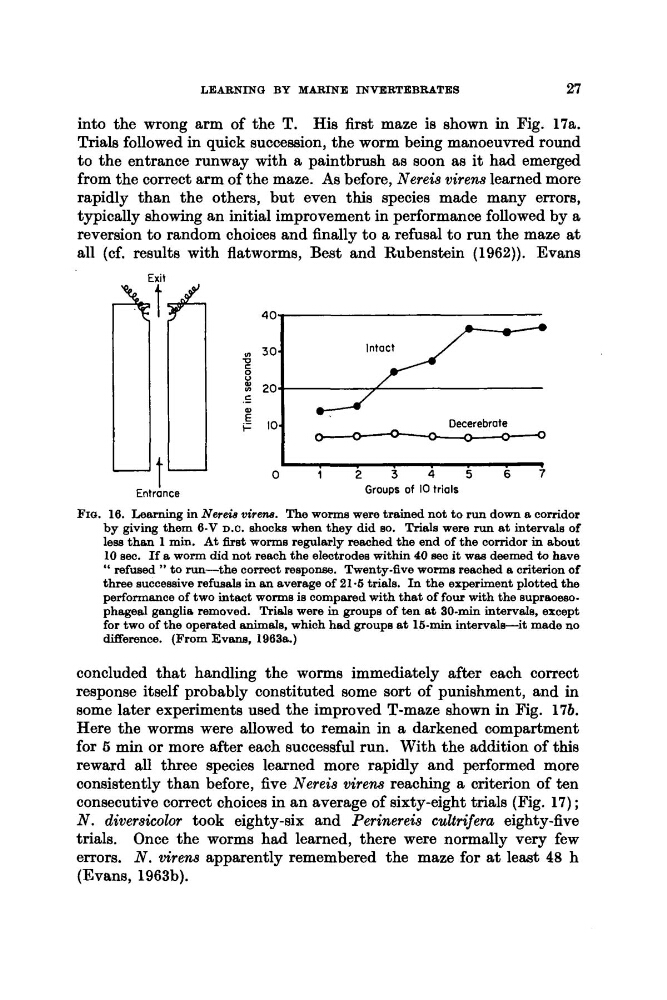
FIG. 16. Learning in Nereia virew. The worms were trained not to run down a corridor
by giving them 6-V D.C. shocks when they did so. Trials were run a t intervals of
lese than 1 min. At e s t worms regularly reached the end of the corridor in about
10 sec. If a worm did not reach the electrodes within 40 sec it was deemed to have
" refused " to run-the correct response. Twenty-five worms reached a criterion of
three successive refusals in an average of 21.6 trials. In the experiment plotted the
performance of two intact worms is compared with that of four with the supreoeaophageal ganglia removed. Trials were in groups of ten at 30-min intervals, except
for two of the operated animals, which had groups at 16-min intervels-it made no
difference. (From Evans, 1963a.)
concluded that handling the worms immediately after each correct
response itself probably constituted some sort of punishment, and in
some later experiments used the improved T-maze shown in Fig. 17b.
Here the worms were allowed to remain in a darkened compartment
for 5 min or more after each successful run. With the addition of this
reward all three species learned more rapidly and performed more
consistently than before, five Nereis virens reaching a criterion of ten
consecutive correct choices in an average of sixty-eight trials (Fig. 17) ;
N. diversicolor took eighty-six and Perinereis cultrifera eighty-five
trials. Once the worms had learned, there were normally very few
errors. N . virens apparently remembered the maze for at least 48 h
(Evans, 1963b).
27
into the wrong arm of the T. His first maze is shown in Fig. 17a.
Trials followed in quick succession, the worm being manoeuvred round
to the entrance runway with a paintbrush as soon as it had emerged
from the correct arm of the maze. As before, Nereis virens learned more
rapidly than the others, but even this species made many errors,
typically showing an initial improvement in performance followed by a
reversion to random choices and finally to a refusal to run the maze at
all (cf. results with flatworms, Best and Rubenstein (1962)). Evans
Ic Entrance
40uI 30.
s
x 20.
E
i =
10.
n
v
c
.Decerebrote
0
n
c
A
c
"
v
v
-
@
0
1
2
3
4
5
6
7
Groups of 1 0 trials
FIG. 16. Learning in Nereia virew. The worms were trained not to run down a corridor
by giving them 6-V D.C. shocks when they did so. Trials were run a t intervals of
lese than 1 min. At e s t worms regularly reached the end of the corridor in about
10 sec. If a worm did not reach the electrodes within 40 sec it was deemed to have
" refused " to run-the correct response. Twenty-five worms reached a criterion of
three successive refusals in an average of 21.6 trials. In the experiment plotted the
performance of two intact worms is compared with that of four with the supreoeaophageal ganglia removed. Trials were in groups of ten at 30-min intervals, except
for two of the operated animals, which had groups at 16-min intervels-it made no
difference. (From Evans, 1963a.)
concluded that handling the worms immediately after each correct
response itself probably constituted some sort of punishment, and in
some later experiments used the improved T-maze shown in Fig. 17b.
Here the worms were allowed to remain in a darkened compartment
for 5 min or more after each successful run. With the addition of this
reward all three species learned more rapidly and performed more
consistently than before, five Nereis virens reaching a criterion of ten
consecutive correct choices in an average of sixty-eight trials (Fig. 17) ;
N. diversicolor took eighty-six and Perinereis cultrifera eighty-five
trials. Once the worms had learned, there were normally very few
errors. N . virens apparently remembered the maze for at least 48 h
(Evans, 1963b).