

358
FINDLAY E. RUSSELL
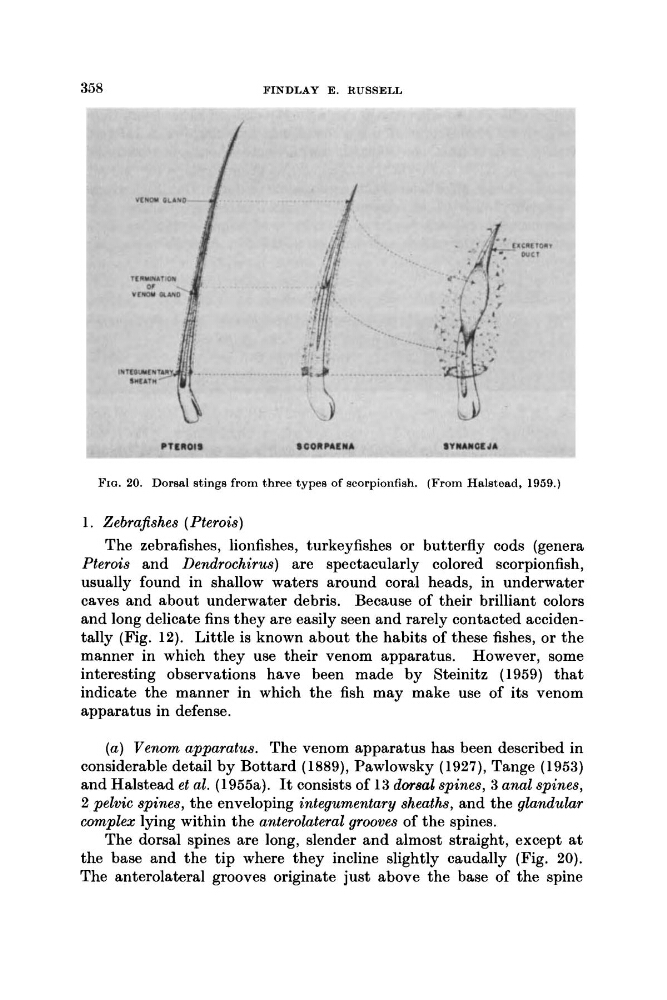
FIG. 20. Dorsal stings from three types of scorpionfish. (From Halstead, 1959.)
1. ZebraJishes (Pterois)
The zebrafishes, lionfishes, turkeyfishes or butterfly cods (genera
Pterois and Dendrochirus) are spectacularly colored scorpionfish,
usually found in shallow waters around coral heads, in underwater
caves and about underwater debris. Because of their brilliant colors
and long delicate fins they are easily seen and rarely contacted accidentally (Fig. 12). Little is known about the habits of these fishes, or the
manner in which they use their venom apparatus. However, some
interesting observations have been made by Steinitz (1959) that
indicate the manner in which the fish may make use of its venom
apparatus in defense.
( a ) Venom apparatus. The venom apparatus has been described in
considerable detail by Bottard (1889), Pawlowsky (1927), Tange (1953)
and Halstead et al. (1955a). It consists of 13 dorsal spines, 3 anal spines,
2 pelvic spines, the enveloping integumentary sheaths, and the glandular
complex lying within the anterolateral grooves of the spines.
The dorsal spines are long, slender and almost straight, except at
the base and the tip where they incline slightly caudally (Fig. 20).
The anterolateral grooves originate just above the base of the spine
FINDLAY E. RUSSELL
FIG. 20. Dorsal stings from three types of scorpionfish. (From Halstead, 1959.)
1. ZebraJishes (Pterois)
The zebrafishes, lionfishes, turkeyfishes or butterfly cods (genera
Pterois and Dendrochirus) are spectacularly colored scorpionfish,
usually found in shallow waters around coral heads, in underwater
caves and about underwater debris. Because of their brilliant colors
and long delicate fins they are easily seen and rarely contacted accidentally (Fig. 12). Little is known about the habits of these fishes, or the
manner in which they use their venom apparatus. However, some
interesting observations have been made by Steinitz (1959) that
indicate the manner in which the fish may make use of its venom
apparatus in defense.
( a ) Venom apparatus. The venom apparatus has been described in
considerable detail by Bottard (1889), Pawlowsky (1927), Tange (1953)
and Halstead et al. (1955a). It consists of 13 dorsal spines, 3 anal spines,
2 pelvic spines, the enveloping integumentary sheaths, and the glandular
complex lying within the anterolateral grooves of the spines.
The dorsal spines are long, slender and almost straight, except at
the base and the tip where they incline slightly caudally (Fig. 20).
The anterolateral grooves originate just above the base of the spine