

MARINE TOXINS AND VENOMOUS AND POISONOUS MARINE ANIMALS
357
equally effective in alleviating the severe pain and other symptoms
provoked by the venom of the weeverfishes. The reader is referred
to page 346 of this contribution for a more thorough review on
this treatment. Maretid (1957) has used intravenous calcium gluconate
with good success for relieving the pain of the injury. Local injections
of procaine may be of some value in less severe poisonings, and
intramuscular or intravenous meperidine is of definite value in those
cases in which there is severe pain after the first hour following the
injury.
C. ScorpionJish
At least 80 members of the family Scorpaenidae, the scorpionfishes
or rockfishes, have been implicated in poisonings to man, or have
been studied by venomologists. Included in this group are the zebrafishes, sculpins, stonefishes, bullrout and waspfish (Fig. 12, 13). They
are widely distributed throughout all tropical and most temperate
seas. A few scorpionfishes are found in Arctic waters. Many species
are strikingly colored, and several are of unusual shape. They are
most often found in or around rocks, coral reefs or kelp beds, with
which they often blend very favorably. Some species bury themselves
in the sand, and almost all species have the habit of lying motionless
and partially concealed for long periods of time. Thus, they are
often handled or trod upon unknowingly, that is, until envenomation
occurs.
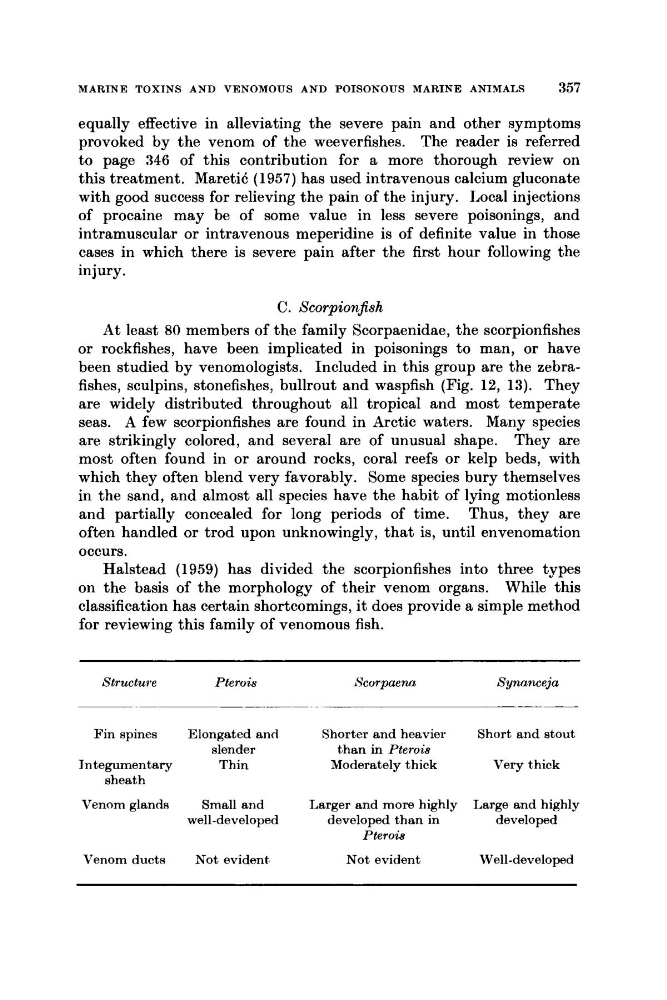
Halstead (1959) has divided the scorpionfishes into three types
on the basis of the morphology of their venom organs. While this
classification has certain shortcomings, it does provide a simple method
for reviewing this family of venomous fish.
Structuve
Pterois
Scorpaena
Synanceja
Fin spines
Elongated and
Shorter and heavier
Short and stout
slender
than i n Pterois
Integumentary
Thin
Moderately thick
Very t,hick
sheath
Venom glands
Small and
Larger and more highly Large and highly
well-developed
developed than in
developed
Pterois
Venom ducts
Not evident,
Not evident
Well-developed
357
equally effective in alleviating the severe pain and other symptoms
provoked by the venom of the weeverfishes. The reader is referred
to page 346 of this contribution for a more thorough review on
this treatment. Maretid (1957) has used intravenous calcium gluconate
with good success for relieving the pain of the injury. Local injections
of procaine may be of some value in less severe poisonings, and
intramuscular or intravenous meperidine is of definite value in those
cases in which there is severe pain after the first hour following the
injury.
C. ScorpionJish
At least 80 members of the family Scorpaenidae, the scorpionfishes
or rockfishes, have been implicated in poisonings to man, or have
been studied by venomologists. Included in this group are the zebrafishes, sculpins, stonefishes, bullrout and waspfish (Fig. 12, 13). They
are widely distributed throughout all tropical and most temperate
seas. A few scorpionfishes are found in Arctic waters. Many species
are strikingly colored, and several are of unusual shape. They are
most often found in or around rocks, coral reefs or kelp beds, with
which they often blend very favorably. Some species bury themselves
in the sand, and almost all species have the habit of lying motionless
and partially concealed for long periods of time. Thus, they are
often handled or trod upon unknowingly, that is, until envenomation
occurs.
Halstead (1959) has divided the scorpionfishes into three types
on the basis of the morphology of their venom organs. While this
classification has certain shortcomings, it does provide a simple method
for reviewing this family of venomous fish.
Structuve
Pterois
Scorpaena
Synanceja
Fin spines
Elongated and
Shorter and heavier
Short and stout
slender
than i n Pterois
Integumentary
Thin
Moderately thick
Very t,hick
sheath
Venom glands
Small and
Larger and more highly Large and highly
well-developed
developed than in
developed
Pterois
Venom ducts
Not evident,
Not evident
Well-developed