

22
M. J. WELLS
Shock
0
,$1 1 0 20
extinctions and then to passing shadows, habituation to the two
stimuli did not follow the same course ; the response to shadows was
much more persistent than the response to a sudden decrease in light
intensity (Fig. 12).
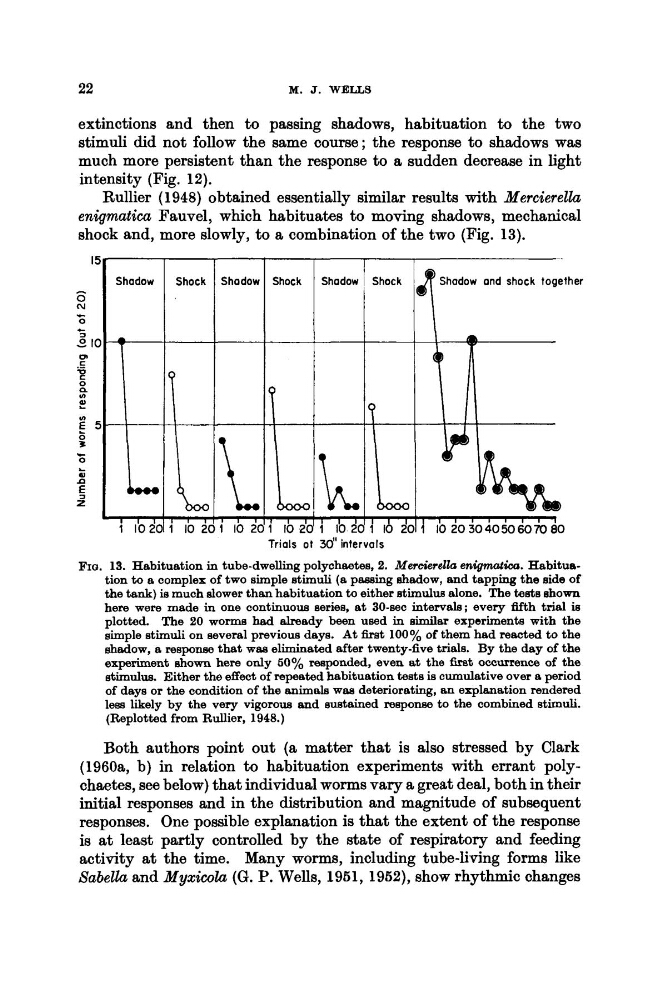
Rullier ( 1948) obtained essentially similar results with Mercierella
enigmutica Fauvel, which habituates to moving shadows, mechanical
shock and, more slowly, to a combination of the two (Fig. 13).
Shodou
1.
1 1 0 21
Shodow
i -
1 102c
Shock
Shodow ~ Shock
Shodow and shock together
i i q
t , , ,
I l 0 2 0 ' 1 I'O2dl lb $014 1020304050607080
I
1
I
I
I
I
I
I
I
i
Trials ot 30" intervals
FIG. 13. Habituation in tube-dwelling polychaetes, 2. Mercierella e n @ d h a . Habituation to a complex of two simple stimuli (a passing shadow, and tapping the side of
the tank) is much dower than habituation to either stimulm alone. The tests ehown
here were made in one continuous series, at 30-sec intervals; every 6fth trial is
plotted. The 20 worms had already been used in similsr experiments with the
simple stimuli on several previous days. At first lOOyo of them had reacted to the
shadow, a response that waa eliminated after twenty-five trials. By the day of the
experiment shown here only SOYo reeponded, even at the f h t occurrence of the
stimulus. Either the effect of repeated habituation tests is cumulative over a period
of days or the condition of the animals waa deteriorating, an explanation rendered
less likely by the very vigorous and sustained response to the combined stimuli.
(Replotted from Rullier, 1948.)
Both authors point out (a matter that is also stressed by Clark
(1960a, b) in relation to habituation experiments with errant polychmtes, see below) that individual worms vary a great deal, both in their
initial responses and in the distribution and magnitude of subsequent
responses. One possible explanation is that the extent of the response
is at least partly controlled by the state of respiratory and feeding
activity at the time. Many worms, including tube-living forms like
Subella and Myzicola (G. P. Wells, 1961, 1952), show rhythmic changes
M. J. WELLS
Shock
0
,$1 1 0 20
extinctions and then to passing shadows, habituation to the two
stimuli did not follow the same course ; the response to shadows was
much more persistent than the response to a sudden decrease in light
intensity (Fig. 12).
Rullier ( 1948) obtained essentially similar results with Mercierella
enigmutica Fauvel, which habituates to moving shadows, mechanical
shock and, more slowly, to a combination of the two (Fig. 13).
Shodou
1.
1 1 0 21
Shodow
i -
1 102c
Shock
Shodow ~ Shock
Shodow and shock together
i i q
t , , ,
I l 0 2 0 ' 1 I'O2dl lb $014 1020304050607080
I
1
I
I
I
I
I
I
I
i
Trials ot 30" intervals
FIG. 13. Habituation in tube-dwelling polychaetes, 2. Mercierella e n @ d h a . Habituation to a complex of two simple stimuli (a passing shadow, and tapping the side of
the tank) is much dower than habituation to either stimulm alone. The tests ehown
here were made in one continuous series, at 30-sec intervals; every 6fth trial is
plotted. The 20 worms had already been used in similsr experiments with the
simple stimuli on several previous days. At first lOOyo of them had reacted to the
shadow, a response that waa eliminated after twenty-five trials. By the day of the
experiment shown here only SOYo reeponded, even at the f h t occurrence of the
stimulus. Either the effect of repeated habituation tests is cumulative over a period
of days or the condition of the animals waa deteriorating, an explanation rendered
less likely by the very vigorous and sustained response to the combined stimuli.
(Replotted from Rullier, 1948.)
Both authors point out (a matter that is also stressed by Clark
(1960a, b) in relation to habituation experiments with errant polychmtes, see below) that individual worms vary a great deal, both in their
initial responses and in the distribution and magnitude of subsequent
responses. One possible explanation is that the extent of the response
is at least partly controlled by the state of respiratory and feeding
activity at the time. Many worms, including tube-living forms like
Subella and Myzicola (G. P. Wells, 1961, 1952), show rhythmic changes