

LEARNING BY MARINE INVERTEBRATES
21
A. Habitua,tion to repeated stimuli
1. Tubiculous polychetes
Nicol (1950) has summarized the literature and made experiments
on Branchiomma vesiculosum Montagu with the results that in general
confirm and extend previous work. Branchiomma withdraws suddenly
into its tube when it is stimulated by passing shadows or a sudden
decrease in light intensity. A sudden increase has no effect. Nicol found
that the animal is sensitive throughout the human visual spectrum,
minimally in red light and maximally at about 6500 8. Dark-adapted
0
I
1
5
to' 1
5
10
Trials at 1-10 rnin intervals
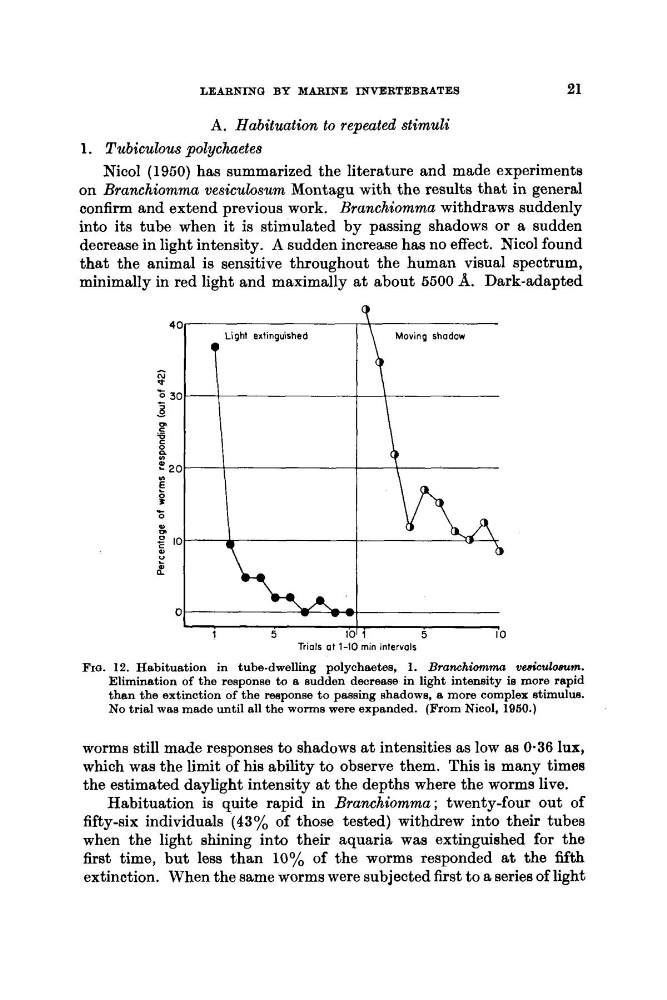
FIG. 12. Habituation in tube-dwelling polychaetes, 1. Branchiomma veaiculoeum.
Elimination of the response to a sudden decrease in light intensity is more rapid
than the extinction of the response to passing shadows, a more complex stimulus.
No trial was made until all the worms were expanded. (From Nicol, 1950.)
worms still made responses to shadows at intensities as low as 0-36 lux,
which was the limit of his ability to observe them. This is many times
the estimated daylight intensity at the depths where the worms live.
Habituation is quite rapid in Branchiomma; twenty-four out of
fifty-six individuals (43% of those tested) withdrew into their tubes
when the light shining into their aquaria was extinguished for the
first time, but less than 10% of the worms responded at the fifth
extinction. When the same worms were subjected first to a series of light
21
A. Habitua,tion to repeated stimuli
1. Tubiculous polychetes
Nicol (1950) has summarized the literature and made experiments
on Branchiomma vesiculosum Montagu with the results that in general
confirm and extend previous work. Branchiomma withdraws suddenly
into its tube when it is stimulated by passing shadows or a sudden
decrease in light intensity. A sudden increase has no effect. Nicol found
that the animal is sensitive throughout the human visual spectrum,
minimally in red light and maximally at about 6500 8. Dark-adapted
0
I
1
5
to' 1
5
10
Trials at 1-10 rnin intervals
FIG. 12. Habituation in tube-dwelling polychaetes, 1. Branchiomma veaiculoeum.
Elimination of the response to a sudden decrease in light intensity is more rapid
than the extinction of the response to passing shadows, a more complex stimulus.
No trial was made until all the worms were expanded. (From Nicol, 1950.)
worms still made responses to shadows at intensities as low as 0-36 lux,
which was the limit of his ability to observe them. This is many times
the estimated daylight intensity at the depths where the worms live.
Habituation is quite rapid in Branchiomma; twenty-four out of
fifty-six individuals (43% of those tested) withdrew into their tubes
when the light shining into their aquaria was extinguished for the
first time, but less than 10% of the worms responded at the fifth
extinction. When the same worms were subjected first to a series of light