

296
FINDLAY E. RUSSELL
bulb is generally considered unimportant in the production of the
toxin, it probably plays some role in the venom apparatus. I n a recent
letter ( 5 May, 1964), Endean states that he has good evidence that the
venom of Conus is produced in both the bulb and the duct.
The radula is a Y-shaped organ lying anterior to the esophagusstomach and opening into the pharynx just anterior to the entrance of
the venom duct. It produces the radula teeth. The organ is divided
into three sections. The largest section, which overlies the esophagusstomach, may contain as many as thirty teeth in various stages of
development. The short arm of the gland attaches to the pharynx
and contains most of the mature teeth. The third section is known as
the ligament sac. The radula teeth are needle-like, from 1-10 mm in
length and almost transparent. They vary in size and shape depending
on the species involved.
A ligament is attached to the base of each tooth and serves as a
means of fixation while the tooth is in the radula sheath. The teeth
are moved from the radula into the pharynx and thence into the
proboscis. They are then thrust by the proboscis into the prey during
the stinging act. It is not known whether this is done by a sling shotlike mechanism, or by hydrostatic pressure or by some other means.
I n some species the tooth is held forcibly by the proboscis during the
stinging act, while in others it is freed into the victim. When and how
the venom gets into the radula teeth is not known. Some investigators
have suggested that this occurs as the teeth are being transported
through the pharynx or proboscis, while others feel that filling of the
tooth and envenomation of the prey do not occur until the tooth is
fired, or even until after it is fired, into the tissues of the victim.
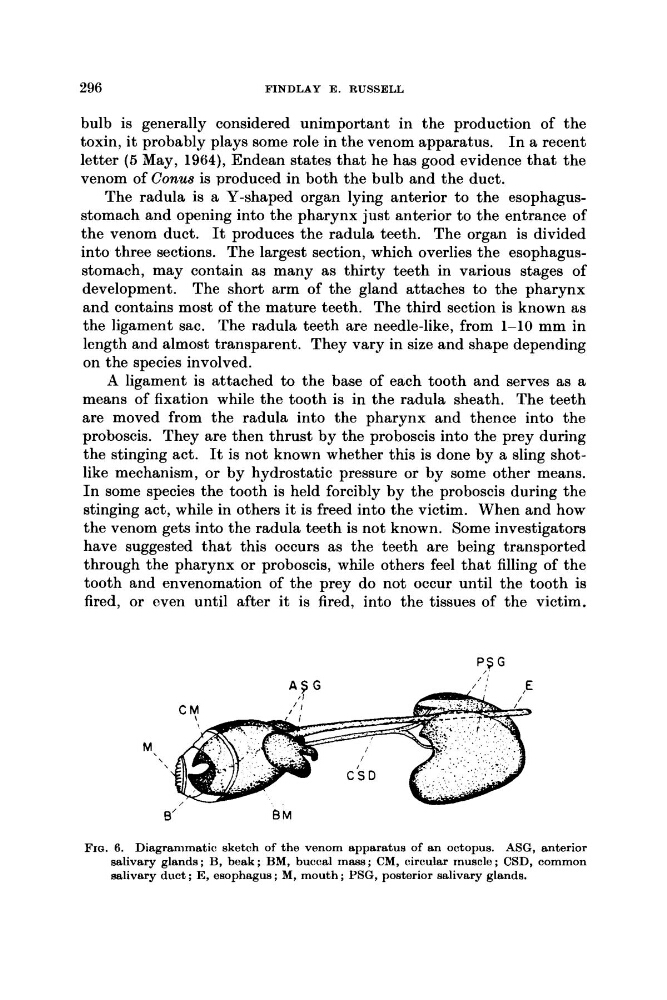
FIQ. 6. Diagrammatic sketch of the venom apparatus of an octopus. ASG, anterior
salivary glands ; B, beak ; BM, buccal mass ; CM, circular muscle ; CSD, common
salivary duct ; E, esophagus ; M, mouth ; PSG, posterior salivary glands.
FINDLAY E. RUSSELL
bulb is generally considered unimportant in the production of the
toxin, it probably plays some role in the venom apparatus. I n a recent
letter ( 5 May, 1964), Endean states that he has good evidence that the
venom of Conus is produced in both the bulb and the duct.
The radula is a Y-shaped organ lying anterior to the esophagusstomach and opening into the pharynx just anterior to the entrance of
the venom duct. It produces the radula teeth. The organ is divided
into three sections. The largest section, which overlies the esophagusstomach, may contain as many as thirty teeth in various stages of
development. The short arm of the gland attaches to the pharynx
and contains most of the mature teeth. The third section is known as
the ligament sac. The radula teeth are needle-like, from 1-10 mm in
length and almost transparent. They vary in size and shape depending
on the species involved.
A ligament is attached to the base of each tooth and serves as a
means of fixation while the tooth is in the radula sheath. The teeth
are moved from the radula into the pharynx and thence into the
proboscis. They are then thrust by the proboscis into the prey during
the stinging act. It is not known whether this is done by a sling shotlike mechanism, or by hydrostatic pressure or by some other means.
I n some species the tooth is held forcibly by the proboscis during the
stinging act, while in others it is freed into the victim. When and how
the venom gets into the radula teeth is not known. Some investigators
have suggested that this occurs as the teeth are being transported
through the pharynx or proboscis, while others feel that filling of the
tooth and envenomation of the prey do not occur until the tooth is
fired, or even until after it is fired, into the tissues of the victim.
FIQ. 6. Diagrammatic sketch of the venom apparatus of an octopus. ASG, anterior
salivary glands ; B, beak ; BM, buccal mass ; CM, circular muscle ; CSD, common
salivary duct ; E, esophagus ; M, mouth ; PSG, posterior salivary glands.