

MARINE TOXINS AND VENOMOUS AND POISONOUS MARINE ANIMALS
295
C. Venom apparatus
1. Conus
The venom apparatus of Conus is thought to be homologous with
the unpaired gland of Leiblein of certain of the higher gastropods.
It serves as an offensive weapon for the gaining of food and, to a much
lesser extent, as a defensive weapon against predators. It consists
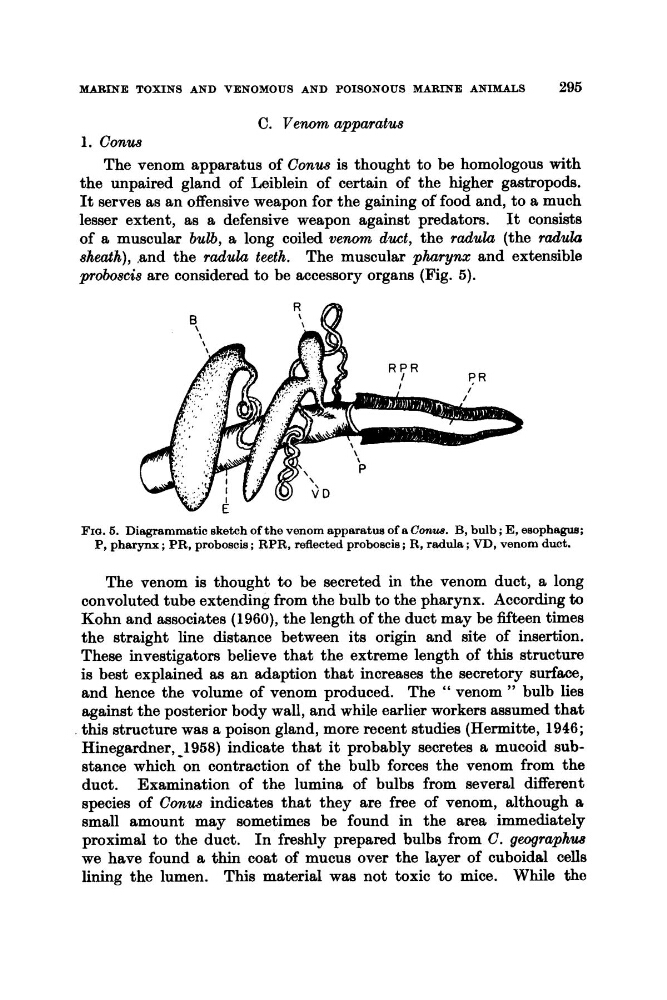
of a muscular bulb, a long coiled venom duct, the radula (the radulcr
sheath), .and the radula teeth. The muscular phurynx and extensible
proboscis are considered to be accessory organs (Fig. 5).
FIG. 6. Diagrammatic sketch of the venom apparatus of a Conwr. B, bulb ; E, esophague;
P, pharynx ; PR, proboscis ; RPR, reflected proboscis ; R, radula ; VD, venom duct.
The venom is thought to be secreted in the venom duct, a long
convoluted tube extending from the bulb to the pharynx. According to
Kohn and associates (1960), the length of the duct may be fifteen times
the straight line distance between its origin and site of insertion.
These investigators believe that the extreme length of this structure
is best explained as an adaption that increases the secretory surfme,
and hence the volume of venom produced. The " venom " bulb lies
against the posterior body wall, and while earlier workers assumed that
this structure was a poison gland, more recent studies (Hermitte, 1946;
Hinegardner, -1968) indicate that it probably secretes a mucoid substance which on contraction of the bulb forces the venom from the
duct. Examination of the lumina of bulbs from several different
species of Conus indicates that they are free of venom, although a
small amount may sometimes be found in the area immediately
proximal to the duct. I n freshly prepared bulbs from C. geographus
we have found a thin coat of mucus over the layer of cuboidal cells
lining the lumen.
While the
This material was not toxic to mice.
295
C. Venom apparatus
1. Conus
The venom apparatus of Conus is thought to be homologous with
the unpaired gland of Leiblein of certain of the higher gastropods.
It serves as an offensive weapon for the gaining of food and, to a much
lesser extent, as a defensive weapon against predators. It consists
of a muscular bulb, a long coiled venom duct, the radula (the radulcr
sheath), .and the radula teeth. The muscular phurynx and extensible
proboscis are considered to be accessory organs (Fig. 5).
FIG. 6. Diagrammatic sketch of the venom apparatus of a Conwr. B, bulb ; E, esophague;
P, pharynx ; PR, proboscis ; RPR, reflected proboscis ; R, radula ; VD, venom duct.
The venom is thought to be secreted in the venom duct, a long
convoluted tube extending from the bulb to the pharynx. According to
Kohn and associates (1960), the length of the duct may be fifteen times
the straight line distance between its origin and site of insertion.
These investigators believe that the extreme length of this structure
is best explained as an adaption that increases the secretory surfme,
and hence the volume of venom produced. The " venom " bulb lies
against the posterior body wall, and while earlier workers assumed that
this structure was a poison gland, more recent studies (Hermitte, 1946;
Hinegardner, -1968) indicate that it probably secretes a mucoid substance which on contraction of the bulb forces the venom from the
duct. Examination of the lumina of bulbs from several different
species of Conus indicates that they are free of venom, although a
small amount may sometimes be found in the area immediately
proximal to the duct. I n freshly prepared bulbs from C. geographus
we have found a thin coat of mucus over the layer of cuboidal cells
lining the lumen.
While the
This material was not toxic to mice.