

BIOLOGY O F SEAWEEDS O F ECONOMIC IMPORTANCE
143
- 405 36f
' 3228
24_I
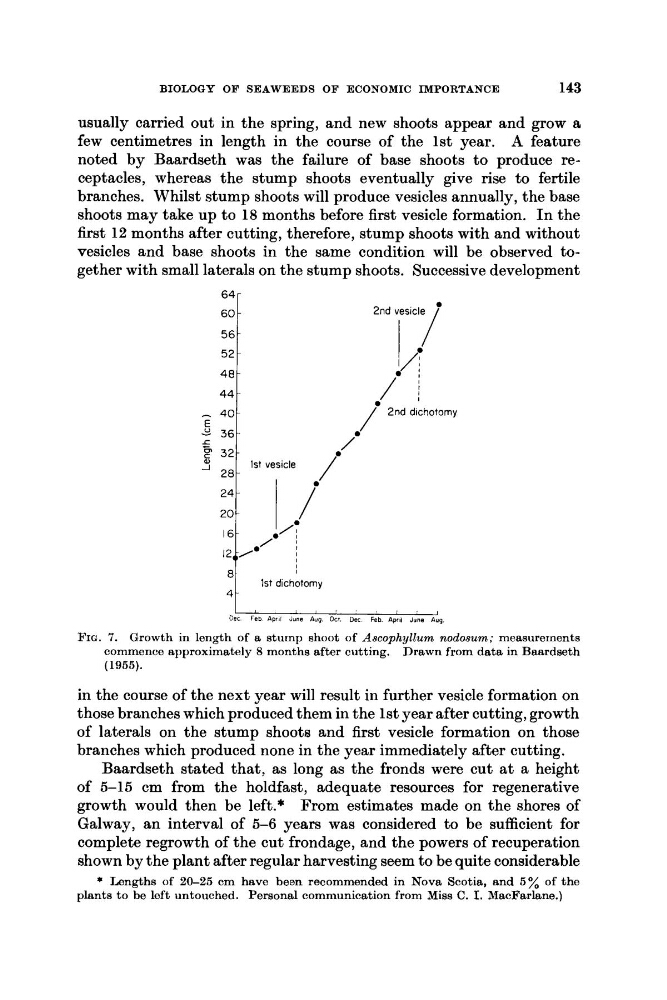
usually carried out in the spring, and new shoots appear and grow a
few centimetres in length in the course of the 1st year. A feature
noted by Baardseth was the failure of base shoots to produce receptacles, whereas the stump shoots eventually give rise to fertile
branches. Whilst stump shoots will produce vesicles annually, the base
shoots may take up to 18 months before first vesicle formation. I n the
first 12 months after cutting, therefore, stump shoots with and without
vesicles and base shoots in the same condition will be observed together with small laterals on the stump shoots. Successive development
64 r
/- 2nd dichotomy
i
1st vesicle
/
I 7
-
2nd vesicle 7
56
I /
: : I t
44
4
I
Dec Feb April June A q Ocf. Dec Feb Dprll June l u g .
FIG. 7. Growth in length of a stump shoot of Ascophyllum nodosum; measurements
Drawn from data in Baardseth
commence approximately 8 months after cutting.
(1955).
in the course of the next year will result in further vesicle formation on
those branches which produced them in the 1st year after cutting, growth
of laterals on the stump shoots and first vesicle formation on those
branches which produced none in the year immediately after cutting.
Baardseth stated that, as long as the fronds were cut at a height
of 5-15 cm from the holdfast, adequate resources for regenerative
growth would then be left.* From estimates made on the shores of
Galway, an interval of 5-6 years was considered to be sufficient for
complete regrowth of the cut frondage, and the powers of recuperation
shown by the plant after regular harvesting seem to be quite considerable
* Lengths of 20-25 cm have been recommended in NOVE Scotia, and 5% of the
plants to be left untouched. Personal communication from Miss C. I. MacFarlane.)
143
- 405 36f
' 3228
24_I
usually carried out in the spring, and new shoots appear and grow a
few centimetres in length in the course of the 1st year. A feature
noted by Baardseth was the failure of base shoots to produce receptacles, whereas the stump shoots eventually give rise to fertile
branches. Whilst stump shoots will produce vesicles annually, the base
shoots may take up to 18 months before first vesicle formation. I n the
first 12 months after cutting, therefore, stump shoots with and without
vesicles and base shoots in the same condition will be observed together with small laterals on the stump shoots. Successive development
64 r
/- 2nd dichotomy
i
1st vesicle
/
I 7
-
2nd vesicle 7
56
I /
: : I t
44
4
I
Dec Feb April June A q Ocf. Dec Feb Dprll June l u g .
FIG. 7. Growth in length of a stump shoot of Ascophyllum nodosum; measurements
Drawn from data in Baardseth
commence approximately 8 months after cutting.
(1955).
in the course of the next year will result in further vesicle formation on
those branches which produced them in the 1st year after cutting, growth
of laterals on the stump shoots and first vesicle formation on those
branches which produced none in the year immediately after cutting.
Baardseth stated that, as long as the fronds were cut at a height
of 5-15 cm from the holdfast, adequate resources for regenerative
growth would then be left.* From estimates made on the shores of
Galway, an interval of 5-6 years was considered to be sufficient for
complete regrowth of the cut frondage, and the powers of recuperation
shown by the plant after regular harvesting seem to be quite considerable
* Lengths of 20-25 cm have been recommended in NOVE Scotia, and 5% of the
plants to be left untouched. Personal communication from Miss C. I. MacFarlane.)