

142
A. D. BONEP
of the zone to be 8 years (ranging from 5 to 15 years), whereas plants
from the top of the zone showed a mean age of 4-5 years, and those from
the lower limit 6-7 years. The plants thus survive on the shore for much
longer periods than species of Fucus (p. 137) and Laminaria (p. 155).
Printz (1950) found plants 10-13 years old on the Norwegian coast, and
a specimen 19 years old was observed.
f n
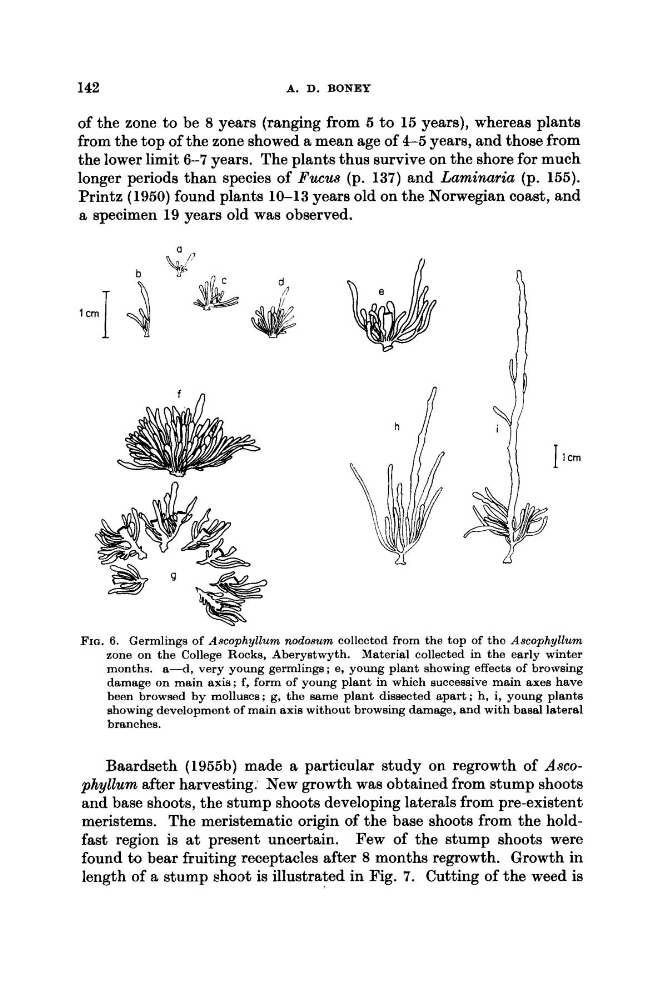
FIQ. 6. Germlings of Ascophyllum nodosum collected from the top of the Ascophyllum
zone on the College Rocks, Aberystwyth. Material collected in the early winter
months. a d , very young germlings ; e, young plant showing effects of browsing
damage on main axis; f, form of young plant in which successive main axes have
been browsed by molluscs; g, the eame plant dissected apart ; h, i, young plants
showing development of main axis without browsing damage, and with basal lateral
branches.
Baardseth (195513) made a particular study on regrowth of Ascopkyllum after harvesting: New growth was obtained from stump shoots
and base shoots, the stump shoots developing laterals from pre-existent
meristems. The meristematic origin of the base shoots from the holdfast region is at present uncertain. Few of the stump shoots were
found to bear fruiting receptacles after 8 months regrowth. Growth in
length of a stump shoot is illustrated in Fig. 7. Cutting of the weed is
A. D. BONEP
of the zone to be 8 years (ranging from 5 to 15 years), whereas plants
from the top of the zone showed a mean age of 4-5 years, and those from
the lower limit 6-7 years. The plants thus survive on the shore for much
longer periods than species of Fucus (p. 137) and Laminaria (p. 155).
Printz (1950) found plants 10-13 years old on the Norwegian coast, and
a specimen 19 years old was observed.
f n
FIQ. 6. Germlings of Ascophyllum nodosum collected from the top of the Ascophyllum
zone on the College Rocks, Aberystwyth. Material collected in the early winter
months. a d , very young germlings ; e, young plant showing effects of browsing
damage on main axis; f, form of young plant in which successive main axes have
been browsed by molluscs; g, the eame plant dissected apart ; h, i, young plants
showing development of main axis without browsing damage, and with basal lateral
branches.
Baardseth (195513) made a particular study on regrowth of Ascopkyllum after harvesting: New growth was obtained from stump shoots
and base shoots, the stump shoots developing laterals from pre-existent
meristems. The meristematic origin of the base shoots from the holdfast region is at present uncertain. Few of the stump shoots were
found to bear fruiting receptacles after 8 months regrowth. Growth in
length of a stump shoot is illustrated in Fig. 7. Cutting of the weed is