

BIOLOGY O F SEAWEEDS OF ECONOMIC IMPORTANCE
117
available for places and regions where there are long established
industries.
1. British Isles
The quantitative data from the British Isles are mainly a result of
surveys carried out within the last 25 years, and initiated by the need
for home-produced alginates and agar during the 1939-45 war. Information is available on the intertidal fucoid algae (Walker, 1947a, 1952b;
Chapman, 1948 ; Gibb, 1950), and on the sublittoral Laminaria forests
(Chapman, 1948; Walker, 1947b, 1950, 1952a, 1954a,b,c, 1956, 1957;
Walker and Richardson, 1955a,b, 1956, 1957). The Gigartina and Chondrus resources of the coast of England, Scotland and Wales were
reported by Marshal1 et al. (1949). Chapman (1948) and his co-workers
based their estimates on both the standing crops of intertidal rockweed
and Laminaria species and on the quantities of cast weed since this was
also considered to be of economic value.
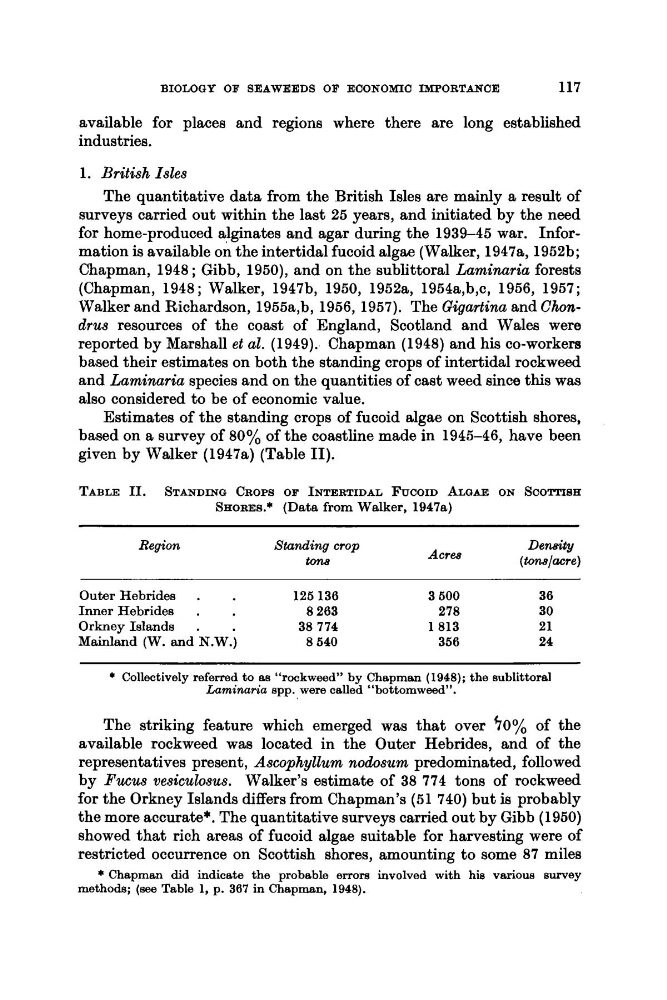
Estimates of the standing crops of fucoid algae on Scottish shores,
based on a survey of 80% of the coastline made in 1945-46, have been
given by Walker (1947a) (Table 11).
TABLE 11. STANDINQ CROPS OF INTERTIDAL FUCOID ALQAE ON SCOTTISH
SHORES.* (Data from Walker, 1947a)
Region
Stunding crop
Deneity
(tona/acre)
Acres
t m
Outer Hebrides .
126 136
3 600
36
Inner Hebrides
.
8 263
278
30
Mainland (W. and N.W.)
8 640
366
24
Orkney Islands .
38 774
1813
21
* Collectively referred to as “rockweed” by Chapman (1948); the sublittoral
Laminaria spp. were called “bottomweed”.
The striking feature which emerged was that over $Ox of the
available rockweed was located in the Outer Hebrides, and of the
representatives present, Ascophyllum nodosum predominated, followed
by Fucus vesiculosus. Walker’s estimate of 38 774 tons of rockweed
for the Orkney Islands differs from Chapman’s (51 740) but is probably
the more accurate*. The quantitative surveys carried out by Gibb (1950)
showed that rich areas of fucoid algae suitable for harvesting were of
restricted occurrence on Scottish shores, amounting to some 87 miles
* Chapman did indicate the probable errors involved with his various survey
methods; (see Table 1, p. 367 in Chapman, 1948).
117
available for places and regions where there are long established
industries.
1. British Isles
The quantitative data from the British Isles are mainly a result of
surveys carried out within the last 25 years, and initiated by the need
for home-produced alginates and agar during the 1939-45 war. Information is available on the intertidal fucoid algae (Walker, 1947a, 1952b;
Chapman, 1948 ; Gibb, 1950), and on the sublittoral Laminaria forests
(Chapman, 1948; Walker, 1947b, 1950, 1952a, 1954a,b,c, 1956, 1957;
Walker and Richardson, 1955a,b, 1956, 1957). The Gigartina and Chondrus resources of the coast of England, Scotland and Wales were
reported by Marshal1 et al. (1949). Chapman (1948) and his co-workers
based their estimates on both the standing crops of intertidal rockweed
and Laminaria species and on the quantities of cast weed since this was
also considered to be of economic value.
Estimates of the standing crops of fucoid algae on Scottish shores,
based on a survey of 80% of the coastline made in 1945-46, have been
given by Walker (1947a) (Table 11).
TABLE 11. STANDINQ CROPS OF INTERTIDAL FUCOID ALQAE ON SCOTTISH
SHORES.* (Data from Walker, 1947a)
Region
Stunding crop
Deneity
(tona/acre)
Acres
t m
Outer Hebrides .
126 136
3 600
36
Inner Hebrides
.
8 263
278
30
Mainland (W. and N.W.)
8 640
366
24
Orkney Islands .
38 774
1813
21
* Collectively referred to as “rockweed” by Chapman (1948); the sublittoral
Laminaria spp. were called “bottomweed”.
The striking feature which emerged was that over $Ox of the
available rockweed was located in the Outer Hebrides, and of the
representatives present, Ascophyllum nodosum predominated, followed
by Fucus vesiculosus. Walker’s estimate of 38 774 tons of rockweed
for the Orkney Islands differs from Chapman’s (51 740) but is probably
the more accurate*. The quantitative surveys carried out by Gibb (1950)
showed that rich areas of fucoid algae suitable for harvesting were of
restricted occurrence on Scottish shores, amounting to some 87 miles
* Chapman did indicate the probable errors involved with his various survey
methods; (see Table 1, p. 367 in Chapman, 1948).