

68
J. E. SHELBOURNE
oulum to complete absenoe, except for traces of melanin around the
eyes or at the base of the fins.
I n my experience, the degree of abnormality has varied from
sewon to seaaon, and from place to place. For instance, at Lowestoft
in 1960, 62% of all survivors were normaJly pigmented, compared
with 66% at Port Erin the aame year and 19% in 1961. Dannevig
loor
1960 reoring e x p p - -.
5
i ;
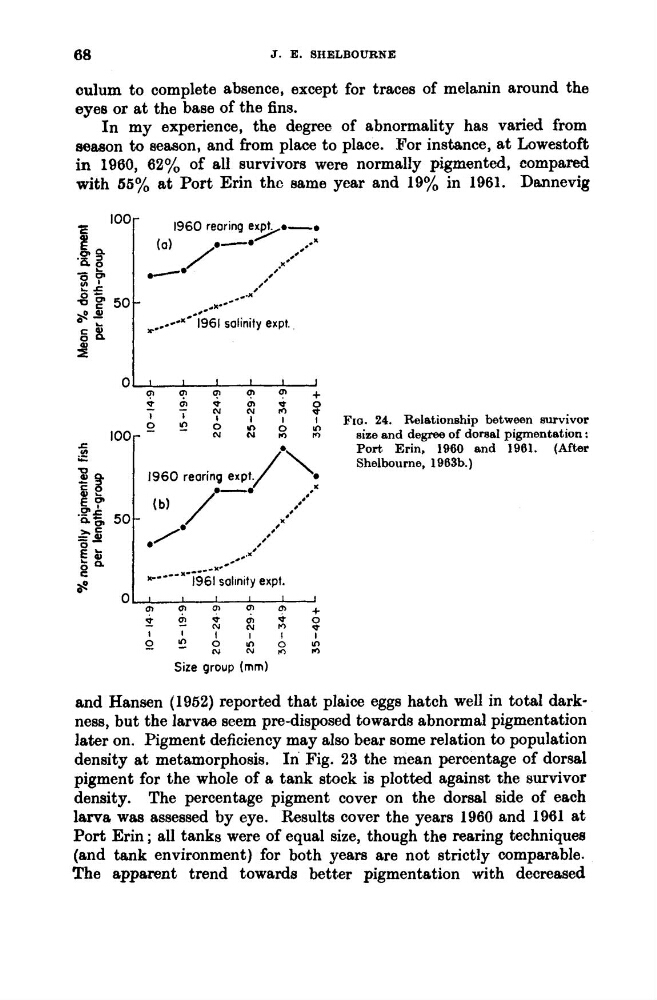
Fro. 24. Relationship between survivor
size and degree of dorsal pigmentation :
Port Erin, 1960 and 1901. (After
Shelbourne, 1963b.)
Size group (mm)
and Hansen (1962) reported that plaice eggs hatch well in total darkness, but the larvae seem pre-disposed towards abnormal pigmentation
later on. Pigment deficiency may also bear some relation to population
density at metamorphosis. In Fig. 23 the mean percentage of dorsal
pigment for the whole of a tank stock is plotted against the survivor
density. The percentage pigment cover on the dorsal side of each
larva was assessed by eye. Results cover the years 1960 and 1961 at
Port Erin ; all tanks were of equal size, though the rearing techniques
(end tank environment) for both years are not strictly comparable.
The apparent trend towards better pigmentation with decreased
J. E. SHELBOURNE
oulum to complete absenoe, except for traces of melanin around the
eyes or at the base of the fins.
I n my experience, the degree of abnormality has varied from
sewon to seaaon, and from place to place. For instance, at Lowestoft
in 1960, 62% of all survivors were normaJly pigmented, compared
with 66% at Port Erin the aame year and 19% in 1961. Dannevig
loor
1960 reoring e x p p - -.
5
i ;
Fro. 24. Relationship between survivor
size and degree of dorsal pigmentation :
Port Erin, 1960 and 1901. (After
Shelbourne, 1963b.)
Size group (mm)
and Hansen (1962) reported that plaice eggs hatch well in total darkness, but the larvae seem pre-disposed towards abnormal pigmentation
later on. Pigment deficiency may also bear some relation to population
density at metamorphosis. In Fig. 23 the mean percentage of dorsal
pigment for the whole of a tank stock is plotted against the survivor
density. The percentage pigment cover on the dorsal side of each
larva was assessed by eye. Results cover the years 1960 and 1961 at
Port Erin ; all tanks were of equal size, though the rearing techniques
(end tank environment) for both years are not strictly comparable.
The apparent trend towards better pigmentation with decreased