

THE ARTIFICIAL PROPAGATION OF MARINE FISH
67
Port Erin, and bore little relationship to population density (Fig. 21).
A more consistent correlation emerged between the incidence of biting
and the size of fish (Fig. 22). Thus, within a mixed size population, with
perhaps occasional food shortages, smaller fish are more likely to auf€er
damage from biting activity than their larger contemporaries. Cannibalism is perhaps too strong a term to use, though large adult plaice in
spawning ponds have been seen to eat their newly-metamorphosed
young. Biting is a manifestation of normal feeding behaviour ; plaice
larvae instinctively snap at smaller, moving organisms.
C. Abnormal pigmentation
A t metamorphosis, the ability of a larva to merge with the background coloration will play a vital part in survival, since defensive
loo r
1960
x 1961
2ol
Cl
f
I
I
I
I
0
100
200
300
400
01
Number of metomorphosed fish p e r tonk
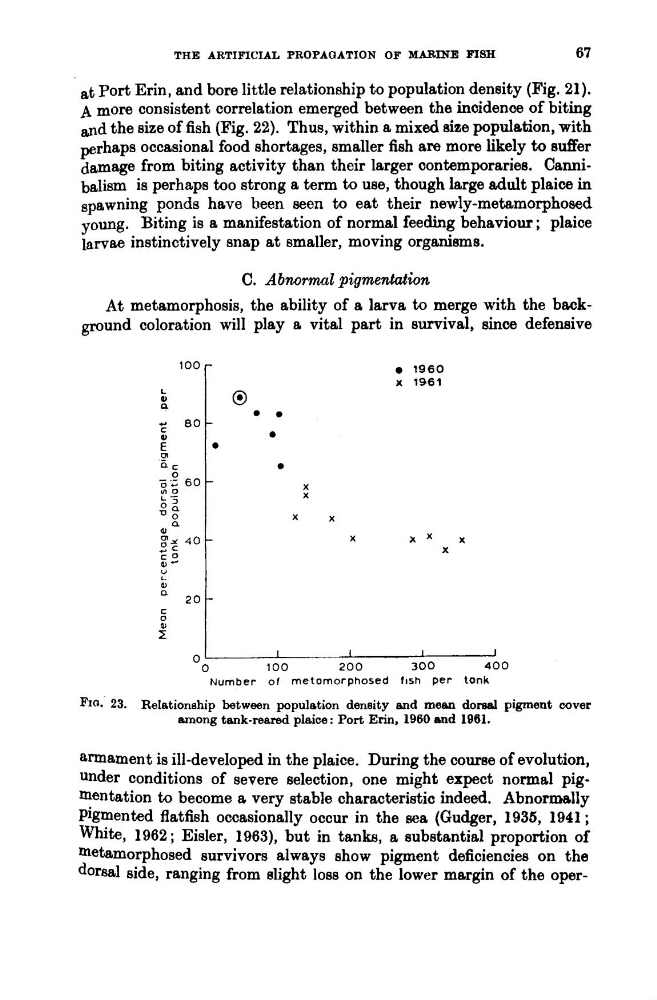
FIG. 23. Relationship between populstion density and mean doreel pigment cover
among tank-reared plaice : Port Erin, 1960 and 1961.
armament is ill-developed in the plaice. During the course of evolution,
under conditions of severe selection, one might expect normal pigmentation to become & very stable characteristic indeed. Abnormally
Pigmented flatfish occasionally occur in the sea (Gudger, 1935, 1941 ;
White, 1962; Eisler, 1963), but in tanks, a substantial proportion of
metamorphosed survivors always show pigment deficiencies on the
dorsal side, ranging from slight loss on the lower margin of the oper-
67
Port Erin, and bore little relationship to population density (Fig. 21).
A more consistent correlation emerged between the incidence of biting
and the size of fish (Fig. 22). Thus, within a mixed size population, with
perhaps occasional food shortages, smaller fish are more likely to auf€er
damage from biting activity than their larger contemporaries. Cannibalism is perhaps too strong a term to use, though large adult plaice in
spawning ponds have been seen to eat their newly-metamorphosed
young. Biting is a manifestation of normal feeding behaviour ; plaice
larvae instinctively snap at smaller, moving organisms.
C. Abnormal pigmentation
A t metamorphosis, the ability of a larva to merge with the background coloration will play a vital part in survival, since defensive
loo r
1960
x 1961
2ol
Cl
f
I
I
I
I
0
100
200
300
400
01
Number of metomorphosed fish p e r tonk
FIG. 23. Relationship between populstion density and mean doreel pigment cover
among tank-reared plaice : Port Erin, 1960 and 1961.
armament is ill-developed in the plaice. During the course of evolution,
under conditions of severe selection, one might expect normal pigmentation to become & very stable characteristic indeed. Abnormally
Pigmented flatfish occasionally occur in the sea (Gudger, 1935, 1941 ;
White, 1962; Eisler, 1963), but in tanks, a substantial proportion of
metamorphosed survivors always show pigment deficiencies on the
dorsal side, ranging from slight loss on the lower margin of the oper-