

METH0I)S OF SAMPLINQ THE BENTHOS
237
B. Sorting techniques
Examination of thc sievings is a tedious and time-consuming
occupation, and efforts have hrcn made to simplify sorting by the
use of flotation techniques. Animals, also organic debris, can be
induced to float on the surface of various heavy liquids, but the
presence of rather drnsc organisms such as shelled molluscs and
echinodcrrns may iiivolve somc hand-picking of the residue.
A rcvirw of flotation t,cchnicpc~s is given I)y Andorson (1959), who
himaclf ~ s e d a strong siicrw' soliltion (S.(;. I . 12) for norting froshwatcr organisms sucli as inacct Inrvac, amphipods, and tuhifex. The
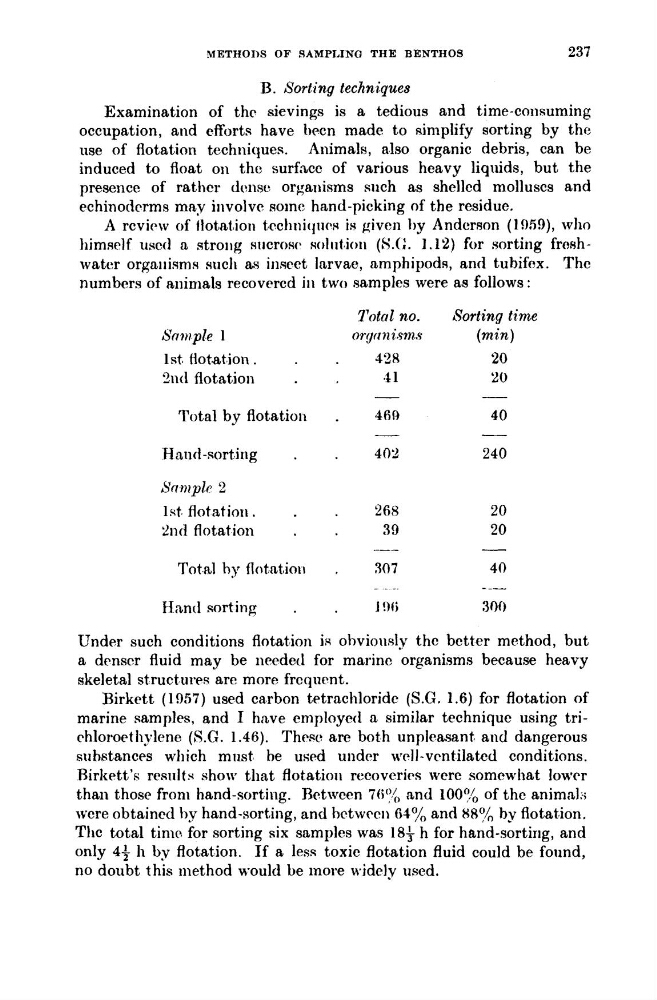
numbers of animals recovered in two samples were as follows :
Total no.
h'orting time
Smtiple 1
or!pz isms
(min)
1 st) flotat ion .
. 428
20
2nd flotation
.
4 1
'LO
Total by flotation
. 468
40
Hand-sorting
.
. 402
240
-
-
__
-
Snmplc 3
1st flotation.
.
268
20
2nd flotation
.
39
20
__
-
'rot81 hy flotathi
,
307
40
Hand sorting
.
.
1 !)fi
300
. .
-
Under such conditions flotation is ohvionsly the better method, but
a denser fluid may be needed for marinc organisms because heavy
skeletal structures are more frcqucnt.
Birkett (1957) used carbon tetrachloride (S.G. 1.6) for flotation of
marine samples, and I have employed a similar technique using trichlorocth~-lene (S.G. 1.46). Thew are both unpleasant and dangerous
substances wdiich must be used undrr well-ventilated conditions.
Rirltett's resnlts show that flotation recoveries w r e somewhat lower
than those from hand-sorting. Rctwcen 7(i(:{) and 100'?/, of the animal.;
were obtained hy hand-sorting, and bctwecii 64% and rCSo/, , by flotation.
The total tinic for sorting six samples was IS$ h for hand-sorting, and
only 4% 11 by flotation. If a less toxic flotation fluid could be found,
no doubt this method would be more widely used.
237
B. Sorting techniques
Examination of thc sievings is a tedious and time-consuming
occupation, and efforts have hrcn made to simplify sorting by the
use of flotation techniques. Animals, also organic debris, can be
induced to float on the surface of various heavy liquids, but the
presence of rather drnsc organisms such as shelled molluscs and
echinodcrrns may iiivolve somc hand-picking of the residue.
A rcvirw of flotation t,cchnicpc~s is given I)y Andorson (1959), who
himaclf ~ s e d a strong siicrw' soliltion (S.(;. I . 12) for norting froshwatcr organisms sucli as inacct Inrvac, amphipods, and tuhifex. The
numbers of animals recovered in two samples were as follows :
Total no.
h'orting time
Smtiple 1
or!pz isms
(min)
1 st) flotat ion .
. 428
20
2nd flotation
.
4 1
'LO
Total by flotation
. 468
40
Hand-sorting
.
. 402
240
-
-
__
-
Snmplc 3
1st flotation.
.
268
20
2nd flotation
.
39
20
__
-
'rot81 hy flotathi
,
307
40
Hand sorting
.
.
1 !)fi
300
. .
-
Under such conditions flotation is ohvionsly the better method, but
a denser fluid may be needed for marinc organisms because heavy
skeletal structures are more frcqucnt.
Birkett (1957) used carbon tetrachloride (S.G. 1.6) for flotation of
marine samples, and I have employed a similar technique using trichlorocth~-lene (S.G. 1.46). Thew are both unpleasant and dangerous
substances wdiich must be used undrr well-ventilated conditions.
Rirltett's resnlts show that flotation recoveries w r e somewhat lower
than those from hand-sorting. Rctwcen 7(i(:{) and 100'?/, of the animal.;
were obtained hy hand-sorting, and bctwecii 64% and rCSo/, , by flotation.
The total tinic for sorting six samples was IS$ h for hand-sorting, and
only 4% 11 by flotation. If a less toxic flotation fluid could be found,
no doubt this method would be more widely used.